It is renewal week. You open the MyCase invoice you have paid without thinking for three years, and the number is bigger. Not wildly bigger, but bigger, and you cannot remember agreeing to it. You check the plan page, and the price there does not match the one in your head either. Somewhere between last spring and this one, MyCase moved its rates up, and the only person who noticed was the one who signs the checks.
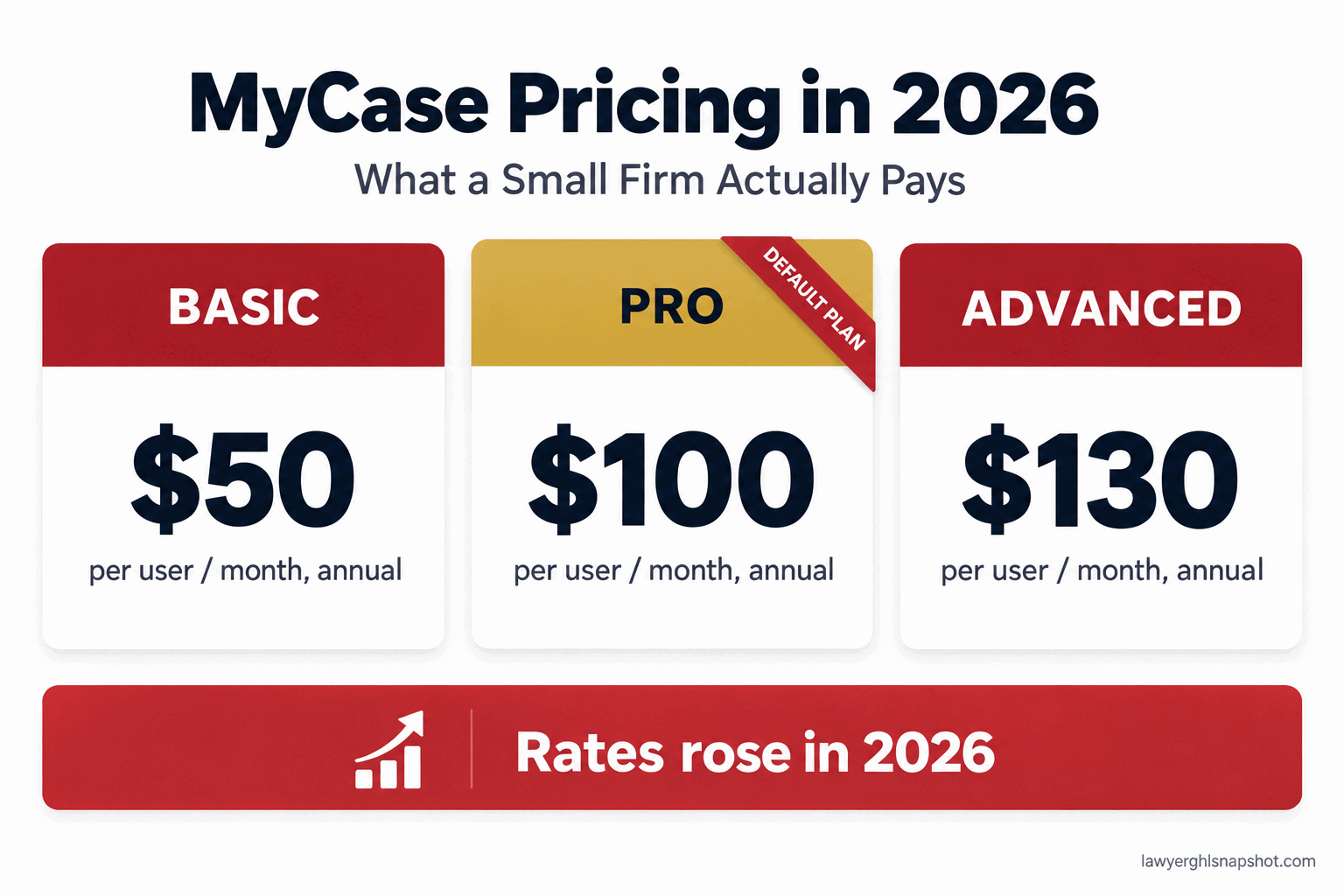
Here is the short answer. MyCase now publishes three plans: Basic at $50, Pro at $100 and Advanced at $130 per user per month on annual billing, higher if you pay monthly (MyCase). Those rates rose in 2026 from the figures review sites still quote. The seat price is only the start: MyCase Accounting is a separate $39 per user add-on, and payment processing takes its own cut of every dollar a client pays you. For a firm that bills by the hour and lives inside one tool, it can be fair. For a solo or lean team whose real leak is unanswered calls, the math gets harder every time you hire.
Key Takeaways
- MyCase publishes real prices, and they rose in 2026. Current annual rates are Basic $50, Pro $100 and Advanced $130 per user per month, with month-to-month at $60, $120 and $150 (MyCase).
- The default plan is Pro, not Basic. eSignature, document automation, client intake and two-way texting live in Pro and above, not the entry tier.
- The real bill is seats plus add-ons. MyCase Accounting is $39 per user per month extra, and card payments run roughly 2.99% plus $0.30 per transaction (MyCase).
- Per-seat pricing punishes growth. A 5-attorney firm on Pro is near $9,600 a year before add-ons; a 15-attorney firm on Advanced clears $39,000.
- Cheaper paths exist. Clio publishes seats from $49 to $149 (Clio), PracticePanther from $49 (PracticePanther), and a flat-fee automation layer covers intake and follow-up with no per-seat tax.
Table of contents
- What changed: MyCase raised its prices in 2026
- The three MyCase tiers, and what each really includes
- What does MyCase actually cost in 2026?
- The add-ons and fees the demo skips
- What MyCase costs at three firm sizes
- Is MyCase worth it, and who is it for?
- 3 cheaper alternatives to MyCase
- Steal this: the email that forces a real number before you renew
- The compliance angle marketing vendors skip
- Common objections
- Frequently asked questions
What changed: MyCase raised its prices in 2026
For years the easy pitch for MyCase was that it undercut Clio, listed around $39 for the entry plan, and that number stuck. In 2026 the rates moved up, and the figures a quick search surfaces are out of date.
The current published prices, straight off the MyCase plan pages, are Basic $50, Pro $100 and Advanced $130 per user per month when billed annually, with month-to-month running $60, $120 and $150 (MyCase). Against the annual rates review sites listed through early 2026, roughly $39 Basic, $89 Pro and $109 Advanced, that is a rise of about 12 to 28 percent by tier.
On a 10-person Pro firm, moving from $89 to $100 a seat is an extra $1,320 a year for software that did not change. A price that rose once can rise again.
The three MyCase tiers, and what each really includes
MyCase sells three plans, and how the features are split matters more than the sticker price (MyCase).
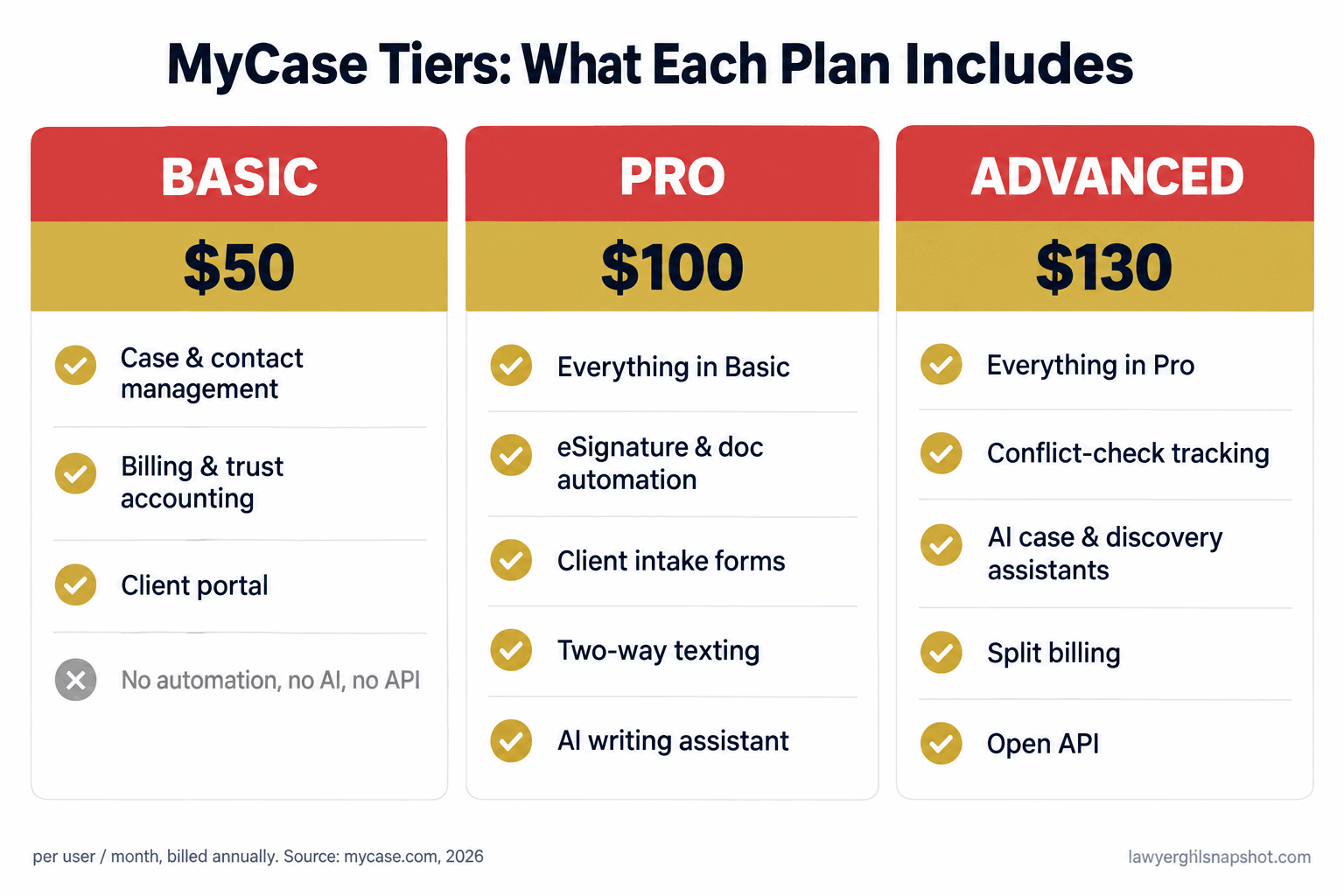
Basic is the floor: case and contact management, time entry, invoicing, trust accounting, online payments, reporting and a client portal. What you do not get is the automation most firms are shopping for. No eSignature at volume, no document automation, no AI assistant, no open API.
Pro is where MyCase expects you to land, priced as the default. It adds unlimited eSignature and document generation, automated workflows, client intake forms, two-way text messaging and the AI writing assistant. If you liked what you saw in the demo, you were looking at Pro, not Basic.
Advanced sits on top, adding the AI case and discovery assistants, advanced document automation, conflict-check tracking, split billing and the open API. Conflict checking alone pushes some firms here, because running conflicts by hand is the task a small firm forgets until it becomes an ethics problem.
The entry price you remember buys the plan most firms outgrow in a month, and the features that sold you sit a tier or two up. That is why “from $50” and the price you pay are rarely the same.
What does MyCase actually cost in 2026?
MyCase counts every active firm user as a seat: attorneys, paralegals, the front-desk person who lives in the calendar. Clients and contacts are free, but your staff are the meter (MyCase).
On Pro at the annual rate, one seat is $100 a month, or $1,200 a year. Hold that figure, because the plan page shows a monthly-looking price while the commitment is annual. Pay month-to-month and the same seat is $120, a 20 percent premium for the freedom to leave. To its credit, MyCase publishes these numbers, which puts it ahead of the quote-only crowd like Smokeball and Filevine (for the picture across every vendor, our legal case management software pricing breakdown is the pillar this sits under, and the Smokeball teardown shows what quote-only pricing hides).
The trap is not the seat price. It is everything stacked on top, so look there next.
The add-ons and fees the demo skips
These are the lines that turn a tidy quote into a bill your bookkeeper questions.
MyCase Accounting. Full legal accounting beyond the built-in trust and billing is a separate product at $39 per user per month, on Pro and Advanced (MyCase). Stack it on a Pro seat and your real per-user cost is $139 a month, not $100.
Payment processing. Built-in payments run through LawPay. No separate monthly fee, but every card payment carries roughly 2.99% plus $0.30, with eCheck around 1 percent. On a firm collecting $300,000 a year by card, that is close to $9,000 in processing, tied to your revenue, not your seat count.
The annual commitment. The headline price is the annual-billing price, which means a contract. Ask what happens if you reduce seats mid-term; the answer is usually “you cannot until renewal.”
Data migration in, and export out. Getting data into MyCase is work, and getting it back out if you leave is the question vendors never volunteer. Ask for the export format and whether there is a fee. That answer is your switching cost, the number that keeps firms paying a price they have outgrown.
Metered AI features. The newer AI assistants on Advanced meter some usage, such as discovery processing by the page, with overage priced in blocks. Confirm the included allowance before you assume the seat covers it.
What MyCase costs at three firm sizes
Per-seat pricing feels fair for a solo and turns punishing as you grow. Here is the annual math on MyCase Pro at the published annual rate ($100 per user per month), before add-ons.
The solo (2 seats). You and a paralegal is roughly $2,400 a year on Pro, a reasonable line against a solo’s revenue. The catch: a one-attorney shop rarely needs Pro’s workflow machinery, yet Basic strips out the intake and eSignature that made the demo look good, so you pay Pro to get the part you wanted.
The 5-attorney firm (8 seats). Counting attorneys plus support staff, eight Pro seats is about $9,600 a year. Many firms this size get steered to Advanced for conflict checks and the open API, pushing it to roughly $12,500. Add MyCase Accounting and you are near $16,000 before a single card fee. This is the firm that gets surprised at renewal, having grown from three seats to eight without re-running the math.
The 15-attorney firm (25 seats). At the Advanced annual rate, 25 users is about $39,000 a year. Layer on MyCase Accounting and you clear $50,000, before payment processing. A per-seat model means every hire comes with a software raise you never voted for.
Here is the structural point. A large share of that spend is not the case-management core. It is the intake and follow-up layer that fills your calendar, and that need not be priced per seat.
Disclosure: the GoHighLevel link above is an affiliate link. We may earn a commission if you sign up, at no extra cost to you.
Is MyCase worth it, and who is it for?
MyCase is a genuinely good product for a particular firm, and the per-seat model decides whether that firm is you.
It is worth it when you are an hourly-billing firm that lives inside one system and will actually use the Pro and Advanced automation: intake forms, eSignature, workflows, conflict checks. One tool for matters, billing, documents and intake beats stitching four together.
It is a weaker fit when you are a solo or a flat-fee, contingency or high-volume practice where billing software is not the bottleneck, you want seasonal help without permanent seats, or your real leak is leads you never answered. For transparent alternatives, see our best Clio alternatives for small law firms rundown and the head-to-head in Clio vs MyCase.
And here is the leak MyCase will not fix, whichever tier you buy. In Clio’s Legal Trends data, the average lawyer’s utilization rate is 38 percent, about 3.0 billable hours in an 8-hour day, with an 88 percent realization rate (Clio, 2025). Better billing software helps you invoice the hours you worked. It does nothing for the consultations you never booked because the phone rang while you were in court, the gap we cover in speed to lead.
3 cheaper alternatives to MyCase
1. A transparent per-seat tool at a lower rung. For matters, billing and trust accounting with a price you can read, PracticePanther publishes a ladder from $49 Solo through $69 Essential, $89 Business and $114 Business Pro per user per month on annual billing (PracticePanther). Clio publishes seats from $49 to $149 (Clio). Either gives you a case-management core without MyCase’s 2026 step-up.
2. Keep your current system and fix the real leak. Most small firms do not lose money inside their case-management tool. They lose it before a matter exists, in unanswered calls and no-show consultations. If MyCase already does your billing fine, bolt a flat-fee intake layer onto it and stop paying per seat for the part that grows revenue.
3. Replace the intake-and-follow-up layer with automation. Our GoHighLevel-based system handles 24/7 answering, instant follow-up, multi-stage reminders, review requests and database reactivation as a one-time install, refined across more than 80 U.S. law firm deployments. It is a flat fee, not a per-user subscription, so it does not get pricier the year you hire a second paralegal. See what is included on the pricing page. Whatever you choose, compare total annual cost across every seat and add-on, a number our software-cost audit walks you through.
Steal this: the email that forces a real number before you renew
MyCase publishes prices, but your renewal still has moving parts the invoice hides. Before you re-sign, make your rep put the whole number in writing. Copy this and send it two weeks before renewal.
Subject: Confirming our full MyCase cost before renewal
Hi [Rep], we are reviewing our renewal and I need the complete picture in writing first. Please confirm the items below by email so I can take an accurate annual figure to the partners.
The seven questions that unmask the real total:
- Our per-user rate for our current tier, annual and month-to-month, for the coming term.
- Our total seat count today, and the per-seat cost to add one mid-term.
- Whether MyCase Accounting is on our account, at what rate, and what we lose if we drop it.
- Our current card and eCheck processing rates, and the all-in processing we paid last year.
- Any price increase built into this renewal versus last term.
- What it costs to export all our data, and in what format, if we leave.
- The included allowance on any metered AI feature we use, and the overage rate.
Then run the one-page seat audit. List every active seat and the last time that person logged in. On almost every account we migrate, one or two seats have not been touched in months: a departed associate, a seasonal hire, a “just in case” login. At $1,200 a year each, two dead seats is $2,400 for nothing. Cutting them is the fastest money you will find all quarter.
The compliance angle marketing vendors skip
Your software is rarely where firms get into trouble. Their marketing is, and it is your license on the line.
- ABA Model Rule 7.1 bars false or misleading communication about you or your services (ABA). If an automated campaign overstates results, that is on you.
- Rule 7.2 permits paying for lead generation only when the generator does not recommend, vouch for or select the lawyer. A “we send you signed cases for a cut” pitch tends to cross that line.
- Rule 7.3 governs solicitation, and automated outbound to people who never asked to hear from you is a classic way to earn a grievance.
- Non-lawyer fee-sharing is broadly banned, which rules out the revenue-share-on-signed-cases model some marketing vendors propose.
One more, because it is where the AI features inside these platforms are heading. A client-facing chatbot has to make clear it is not an attorney and should route or schedule, not answer “what are my chances.” A bot that offers legal predictions risks unauthorized practice of law and privilege problems. Our AI chatbot compliance guide covers the consent language and the lines you cannot cross.
Common objections
“MyCase is still cheaper than Clio, so why compare?” Sometimes at matching tiers, and sometimes not once you add MyCase Accounting and the annual contract. The point is not that MyCase is expensive in a vacuum. It is that the price moved, the default plan is Pro not Basic, and the total scales with every hire. Run your own all-in number first.
“I already pay for MyCase and it works, isn’t switching a hassle?” Usually, and you may not need to. If your case-management core is fine, the expensive problem is almost always the intake and follow-up layer, which you can fix without touching your billing system.
“Do I really need Advanced, or can I live on Basic?” It depends on whether you use eSignature, client intake and conflict checks. If you run conflicts by hand and chase signatures over email, you are spending staff hours to save on a tier, and that trade usually loses. If you truly need only billing and matters, Basic is honest value, just know the demo was Pro.
Frequently asked questions
How much does MyCase cost per user in 2026?
On annual billing, MyCase lists Basic at $50, Pro at $100 and Advanced at $130 per user per month. Month-to-month is higher at $60, $120 and $150. Every active firm user counts as a seat; clients and contacts are free. Confirm current rates with MyCase before you sign.
Did MyCase raise its prices in 2026?
Yes. The published annual rates rose in 2026 to $50, $100 and $130 per user per month, up from roughly $39, $89 and $109 that review sites listed through early 2026, an increase of about 12 to 28 percent by tier. Older aggregator pages still show the previous figures.
What is the difference between MyCase Basic, Pro and Advanced?
Basic covers case management, billing, trust accounting and a client portal, with no automation or AI. Pro, the default plan, adds eSignature, document automation, client intake forms, two-way texting and an AI writing assistant. Advanced adds AI case and discovery assistants, conflict-check tracking, split billing and the open API.
What are the hidden costs of MyCase?
Beyond the per-seat subscription, expect MyCase Accounting as a separate $39 per user per month add-on, card-processing fees of roughly 2.99% plus $0.30 per transaction through the built-in LawPay processor, an annual contract, migration work to get data in, a possible export cost to get it out, and metered usage on some AI features.
Is MyCase worth it for a solo or small firm?
It can be, for an hourly-billing firm that lives inside one system and will use the Pro and Advanced automation. For solos, flat-fee or contingency practices, or firms whose real bottleneck is unanswered calls rather than billing, the per-seat and add-on cost is harder to justify, since billing software does nothing for the consultations you never booked.
What are the cheaper alternatives to MyCase?
For a transparent case-management core, PracticePanther publishes seats from $49 and Clio from $49 to $149 per user. For the part that grows revenue, intake and follow-up, a flat-fee automation layer handles answering, follow-up, reminders and reactivation for one price, with no per-seat cost as you add staff.
Back to renewal week. The honest move is not to pay the new number out of habit, and not to panic-switch tools either. Spend one hour: list your seats, kill the dead ones, get the all-in total in writing, and ask whether your money is leaking where you think. For most small firms it is not hiding inside a better billing tool. It is leaking out of the phone that rang while you were in court, and that is a far cheaper problem to fix.