It is renewal week. The Clio invoice landed, and the number is bigger than last year’s. You added a paralegal in the spring, the seat you signed at $89 renewed higher, and when you checked what a competitor charges, the tier you need just said “Get pricing.” So you are doing what every small-firm owner does eventually: shopping for a Clio alternative.
Good instinct. Clio is a strong product, but it is priced to grow with your headcount, and in 2026 it moved most of its numbers behind a sales call (Clio, 2026).
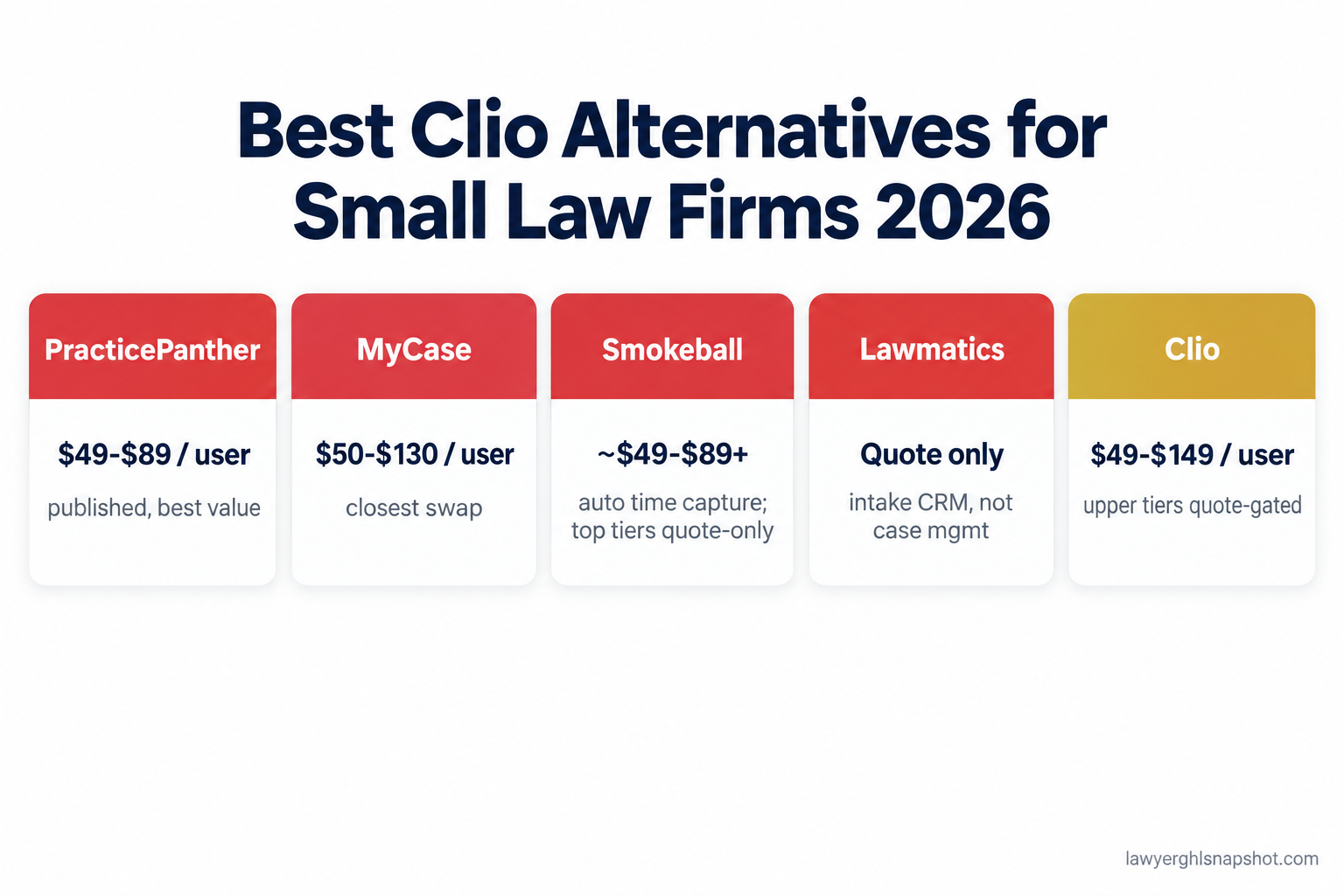
Here is the short version. The cleanest full-featured alternatives are MyCase and PracticePanther, real case-management systems with published prices in the $89 to $130 per-seat range. Smokeball is the pick if automatic time capture is your bottleneck, and Lawmatics is an intake-and-marketing CRM, not a Clio replacement. And the part most firms overpay Clio for, the intake and follow-up layer, does not have to be rented per seat at all. That last point is where the real savings live.
Key Takeaways
- The direct swaps are MyCase and PracticePanther, full case-management systems with published pricing: MyCase about $50 / $100 / $130 per user, PracticePanther about $49 / $69 / $89 (MyCase, PracticePanther, 2026).
- Smokeball is the specialist pick if manual time tracking is bleeding you, but its two best tiers are quote-only (Capterra, 2026).
- Lawmatics is not a case-management system. It is an intake-and-marketing CRM, quote-only, with a reported three-user minimum (Capterra, 2026), so it does not replace Clio.
- Switching has a real cost: migration commonly runs $2,000 to $10,000, and the tool you leave may charge to export your data.
- The biggest saving is not a cheaper seat. Much of your per-seat spend covers intake, follow-up, reminders, and texting, which a flat-fee layer handles without a per-user tax.
Table of contents
- Why small firms are leaving Clio in 2026
- MyCase: the closest direct swap
- PracticePanther: the transparent value pick
- Smokeball: the automatic time-tracking pick
- Lawmatics: not case management
- The full comparison table
- What switching off Clio actually costs
- Which alternative fits your firm size
- The compliance angle vendors skip
- Common objections
- FAQ
Why are small firms leaving Clio in 2026?
Clio is the category leader, and for many firms it is the right tool. Firms still leave it, and the reasons are consistent.
Price, and the direction of price. Clio runs four annual, per-user tiers in 2026: EasyStart $49, Essentials $89, Advanced $119, and Complete $149 per user per month (SoftwareAdvice, G2, 2026). The features a real firm runs on, trust accounting, document automation, proper reporting, live on Advanced or Complete. So the working price is $119 to $149 a seat, not the $49 on the ad.
The pricing page went dark. Clio’s public page now shows only the EasyStart figure and puts a “Get pricing” prompt on the higher tiers (Clio, 2026). When a company stops publishing a number, it rarely went down.
The product keeps moving up-market. Clio completed a roughly $1 billion acquisition of legal-research company vLex in late 2025 and is folding AI across the platform (PR Newswire, 2025). Big acquisitions mean bigger platforms and, eventually, bigger bills for features a three-attorney shop will never touch.
The per-seat model punishes growth. The same Advanced seat that costs a solo about $2,900 a year costs a 25-user firm roughly $35,700 a year (Clio, 2026). Nothing about the software changed. You hired, and your vendor got a raise.
None of that makes Clio a bad product. It makes it worth pressure-testing at renewal instead of re-signing on autopilot. For the head-to-head with its closest rival, see Clio vs MyCase for small law firms.
Do not shop these alternatives on the sticker price. Compare on what decides your bill: the working-tier price (not the $49 hook), how it scales across your real headcount over three years, whether trust accounting is included at that tier, the cost to migrate in and export out, and how much of the bill is really the intake layer that need not be per-seat at all. Every option below wins on some of those and loses on others.
Is MyCase a good Clio alternative?
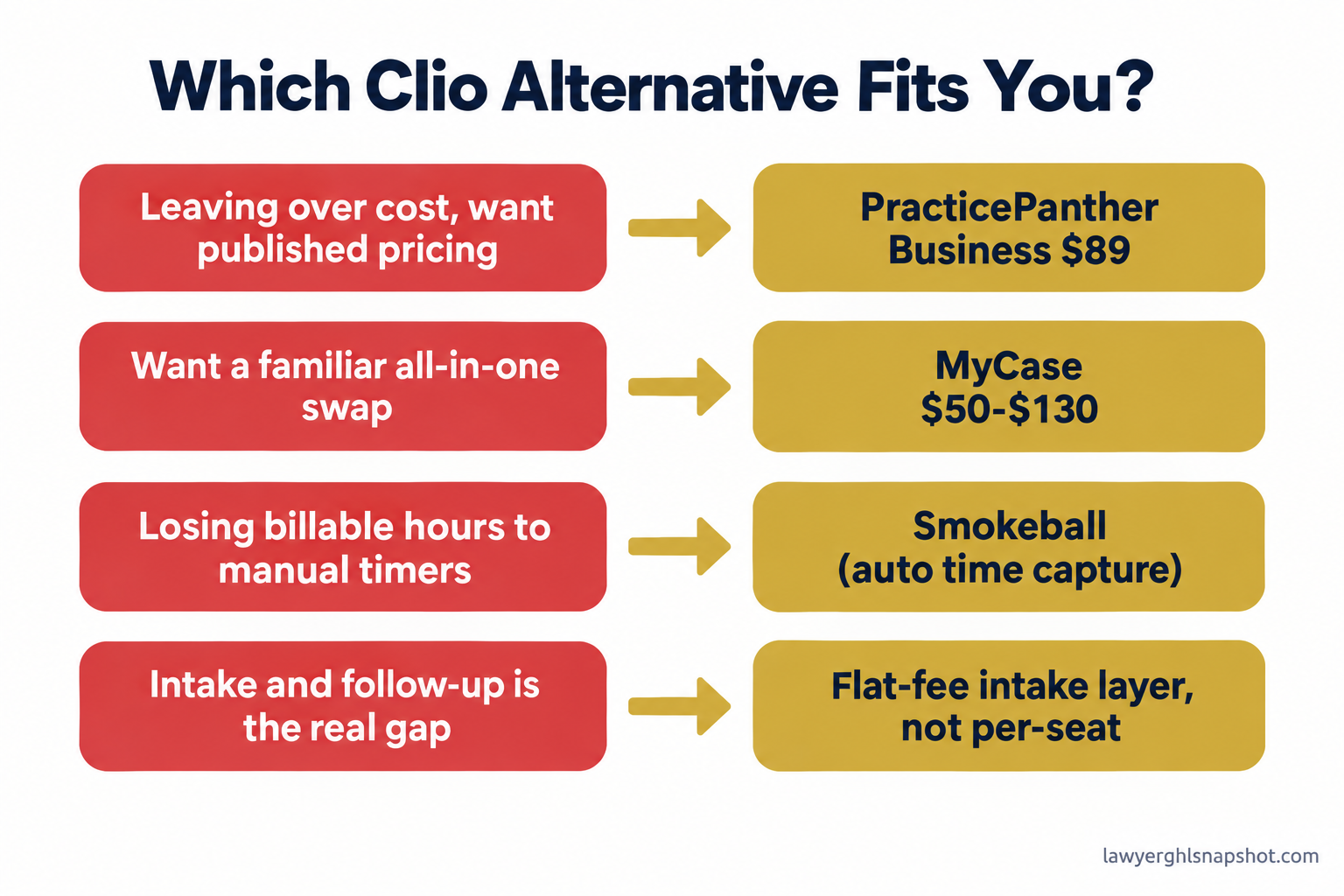
MyCase is the closest like-for-like swap. It is a full case-management platform with billing, trust accounting, document management, and client messaging, and it competes head-on with Clio for the small-firm market.
Price. Three annual tiers: Basic $50, Pro $100, and Advanced $130 per user per month, with month-to-month running roughly 20% higher (MyCase, 2026).
Where it breaks. Those tiers went up in 2026 from about $39 / $89 / $109, without a loud announcement (Lawyerist, 2026). If you are leaving Clio to escape price increases, know you are moving to a vendor that just did the same. At the top, MyCase Advanced at $130 is pricier per seat than Clio Advanced at $119, so the swap only saves money if you can live on Basic or Pro.
Who it fits. A firm that wants a familiar, all-in-one system with a gentler learning curve and is happy on the mid tier. If you were on Clio Essentials at $89, MyCase Pro at $100 is a lateral move, not a rescue.
Is PracticePanther a good Clio alternative?
PracticePanther is the value pick among the transparent vendors, and for a cost-driven small firm it is often the strongest answer here.
Price. Three published annual, per-user tiers, with no “Get pricing” button: Solo $49, Essential $69, and Business $89 per user per month (PracticePanther, Capterra, 2026).
Where it breaks. The catch is in the name: Solo is capped at one user, so the moment you add a paralegal you are on Essential or Business. And “value” is relative. Business at $89 is a real case-management tool, but firms wanting the deepest reporting or the largest integration marketplace sometimes find Clio and MyCase have more range. Test your must-have integrations during the trial, not after you migrate.
Who it fits. A firm leaving Clio mainly over cost and transparency that wants a published, predictable number. Business at $89 undercuts both Clio Advanced and MyCase Advanced while covering the case-management core. For a shop that read the true cost of manual time tracking and wants software without the up-market drift, this is the cleanest swap on price.
Is Smokeball a good Clio alternative?
Smokeball is a specialist. Its whole pitch is automatic time capture: it records the time you spend in documents and email without you starting a timer, for firms that leak billable hours to forgotten entries.
Price. This is where the fog rolls in. Smokeball markets four plans, Bill, Boost, Grow, and Prosper+, but only the lower two carry public per-seat numbers. Third-party feeds list Bill around $49 and Boost around $89 per user per month, while Grow and Prosper+ are quote-only, and Smokeball’s own site shows a generic “from $149/month” figure rather than a per-tier card (Capterra, Smokeball, 2026).
Where it breaks. The two tiers that carry automatic time tracking and document automation are the two you cannot price without a call. So you are leaving Clio partly because it hid its prices, and Smokeball hides its best tiers too. Get the exact figure, the renewal rate, and any minimums in writing before you commit.
Who it fits. A firm where unbilled time is the number-one leak and passive capture would pay for itself. If your problem is per-seat cost rather than lost hours, Smokeball does not solve it.
Is Lawmatics a Clio alternative?
Short answer: no, and this is the mistake that costs firms the most. Lawmatics gets recommended as a “Clio alternative” constantly, and it is not a case-management system. It is a legal CRM for intake and marketing: lead capture, intake forms, follow-up automation, and client onboarding. It does not run your matters, billing, or trust accounting the way Clio does.
Price. Quote-only, with no public pricing. It is commonly reported to start around $99 to $299 per user per month with a three-user minimum, plus a reported onboarding fee near $399 and an annual contract (Capterra, 2026). Every figure there is a community estimate. A three-user floor at $149 a seat is already $5,400 a year.
Where it breaks. Replace Clio with Lawmatics and you have swapped your case-management system for a marketing tool while still needing something to run your matters. That is two subscriptions, not one. It only makes sense as an addition, and even then its core job, intake and follow-up, is the exact layer you can get on a flat fee instead of a per-seat CRM contract with a three-seat minimum and an annual lock-in.
The full Clio alternatives comparison table
Every option in one view, per user per month on annual billing, in 2026. Read “quote-only” as “get it in writing first.”
Clio alternatives for small law firms, 2026 (per user / month, annual)
| Plan | PracticePanther recommended | MyCase | Smokeball | Lawmatics | Clio (for reference) |
|---|---|---|---|---|---|
| Price | $49–$89 | $50–$130 | ~$49–$89+ | Quote only | $49–$149 |
| Feature 1 | Solo $49 (1-user cap), Essential $69, Business $89 | Basic $50, Pro $100, Advanced $130 (annual) | Bill ~$49, Boost ~$89 (third-party feeds) | No public pricing; ~$99–$299/user reported | EasyStart $49 → Complete $149 |
| Feature 2 | Fully published pricing, no quote games | Raised in 2026 from ~$39 / $89 / $109 | Grow and Prosper+ are quote-only | Reported 3-user minimum + ~$399 onboarding | Only EasyStart fully public; upper tiers quote-gated |
| Feature 3 | Best-value transparent full case management | Closest like-for-like swap for Clio | Best if automatic time capture is the goal | Intake/marketing CRM, NOT case management | Category leader; working tier is $119–$149 |
For raw pricing on all six major tools, including Filevine, plus the hidden implementation and export fees, see the full law firm software pricing teardown.
What does switching off Clio actually cost?
The per-seat difference is what everyone looks at. The switching cost decides whether the move is worth it.
Migration in. Moving your matters, contacts, documents, and billing history off Clio is rarely free. Professional migration commonly runs $2,000 to $10,000 depending on data volume (industry estimate, not a fixed rate). Ask whether the vendor performs the migration or only “supports” it; the second means you do the work.
Export out of Clio. Ask what it costs to get your data out, and in what format, before you start. Exports that come back as a pile of PDFs instead of structured records turn a clean cutover into weeks of re-entry. This is your real switching cost, and the line vendors never volunteer.
Downtime and retraining. Plan to run both systems in parallel for a week or two, which means paying for both briefly, losing some billable hours, and having everyone relearn where things live.
The mechanics of a clean cutover, including the parallel-run window, are in how to migrate your law firm to GoHighLevel.
Which alternative fits your firm size?
The right Clio alternative is not the same for a solo and a fifteen-attorney firm. The per-seat model means the tool that is cheap at two seats can be brutal at twenty-five. Here is the honest read at three sizes.
The solo (1 to 2 seats). Cost is barely the issue, so optimize for fit. PracticePanther Solo at $49 is one user, so a true solo runs cheapest there; add one assistant and you are on Essential, or on MyCase Basic at $50 if you want more room. The leak that actually costs a solo money is missed intake, not the software bill, which we cover in speed to lead for law firms.
The 5-attorney firm (about 8 seats). This is where the per-seat model bites and PracticePanther Business at $89 pulls ahead: roughly $8,500 a year versus about $11,400 for Clio Advanced and $12,500 for MyCase Advanced, before add-ons. It is also the firm most likely to be overpaying, because it grew from three seats to eight without re-running the comparison. Re-run it, then re-run your marketing budget math on the savings.
The 15-attorney firm (about 25 seats). Here the per-seat number dominates. Clio Advanced at $119 a seat is about $35,700 a year, and a top tier or heavy add-on load pushes it past $45,000 (Clio, 2026). The move that saves the most is not switching vendors for a $30-a-seat difference. It is pulling the intake layer out of the per-seat model entirely, because it does not scale with attorney headcount.
Annual cost for an 8-seat firm on the upper tier, before add-ons. Per-seat prices per PracticePanther, Clio and MyCase, 2026.
And a cheaper seat does not, by itself, make your firm more money. In Clio’s Legal Trends data the average lawyer’s utilization rate is 38%, about 3.0 billable hours in an 8-hour day, of which the realization rate is 88% and the collection rate is 93% (Clio, 2025). No case-management tier fixes that leak, which is unbooked consultations and slow follow-up, not billing software.
The compliance angle vendors skip
When you switch tools, a rep will often pitch a “lead generation” bundle or a revenue-share on signed cases. The bar rules constrain what you can actually buy, and a slick rep will not raise it.
- ABA Model Rule 7.1 bars any false or misleading communication about your services (ABA). If a tool’s automated marketing overstates results, that is your license on the line, not the vendor’s.
- Model Rule 7.2 lets you pay the reasonable costs of advertising and the usual charges of a legitimate lead-generation service, but you generally may not give something of value for a recommendation, and the generator cannot vouch for or hand-pick you (ABA). A pay-per-signed-case pitch is where firms get into trouble.
- Model Rule 5.4 bars sharing legal fees with a non-lawyer (ABA), which is why a vendor’s “we take a percentage of every case” offer is a non-starter.
A flat software cost is a “reasonable cost of advertising” you can defend on a bar audit. A cut of your fees is a conversation with disciplinary counsel waiting to happen. If you run intake by text or an AI chatbot, the disclosure rules apply too, which we cover in can law firms text clients and use AI chatbots. None of this is legal advice; confirm your state’s version of each rule before you sign.
Common objections
“Isn’t switching more hassle than it is worth?” Sometimes, yes, and that is a fair reason to stay. But price the hassle against three years of per-seat drift, not one month of downtime. A firm paying $12,500 a year that drops to $8,500 saves $12,000 over three years, which pays for a painful migration several times over. If the gap is small, stay put. Run the number first.
“Cheaper software must be worse, right?” Not automatically. Price here tracks positioning as much as capability. PracticePanther publishes $89 and hides nothing; Lawmatics hides everything and starts higher. The lower-priced, transparent tool is not the weaker product. It is the one that decided not to price you by how much it thinks you can pay.
“I do not want to lose my data or my history.” Then make export the first question, not the last. The email template above gets you that answer in writing before you commit a dollar.
Frequently asked questions
What is the best Clio alternative for a small law firm in 2026?
For most small firms it is MyCase or PracticePanther, both full case-management systems with published pricing (MyCase about $50/$100/$130 per user, PracticePanther about $49/$69/$89) (MyCase, PracticePanther, 2026). PracticePanther Business at $89 is the value pick; MyCase is the closest like-for-like swap. Smokeball fits if automatic time capture is the priority.
Is there a cheaper alternative to Clio?
Yes. PracticePanther Business at $89 per user per month undercuts Clio Advanced at $119 and MyCase Advanced at $130 while still covering the case-management core (PracticePanther, Clio, 2026). But the larger saving for most firms is moving the intake and follow-up layer off per-seat pricing entirely, since it does not scale with attorney headcount.
Is Lawmatics a replacement for Clio?
No. Lawmatics is a legal CRM for intake and marketing, not a case-management system, so it does not replace Clio's matters, billing, or trust accounting (Capterra, 2026). Using it means running two subscriptions. It is quote-only with a reported three-user minimum, so for most small firms the intake job is better handled by a flat-fee layer.
What does it cost to switch off Clio?
Budget $2,000 to $10,000 for professional migration depending on data volume, plus any fee to export your data and a short window of paying for both systems during cutover (industry estimate). Ask the new vendor whether they perform the migration or only support it, and get your current vendor's export terms in writing before you sign.
Should I switch case management or just lower my bill another way?
Often you can lower the bill without switching case-management systems. A large share of per-seat spend covers intake, follow-up, reminders, and client texting, which does not have to be priced per user. Keep your core and move that intake layer to a flat-fee system. See our flat-fee pricing.
So back to renewal week. You do not have to re-sign on autopilot, or rip everything out either. Price the tier you actually use against MyCase and PracticePanther, get the export terms in writing, and separate the case-management core you should keep from the intake layer you are overpaying for. The firm that wins renewal is not the one that found the cheapest seat. It is the one that stopped renting its own growth.