It is 6:15 on a Thursday and you are finally writing down your day. A docket call this morning, three client calls between other things, a demand letter before lunch, two quick emails that each turned into twenty minutes of research. You stare at the blank timesheet and rebuild it from memory. The demand letter is easy. The calls are a guess. The two emails you forget entirely. You write down six hours because that feels about right and go home.
Here is the short version: you did not bill six hours today, you did closer to seven, and the hour you dropped is gone for good. Manual time tracking, the habit of reconstructing your day at night or at the end of the week, is the single most expensive thing most small firms do, and nobody puts it on an invoice. Timekeeping is the only step between that effort and getting paid, and doing it from memory quietly writes off a slice of every day.
Key Takeaways
- You capture less than you work. The average lawyer logs about 3.0 billable hours in an 8-hour day (38% utilization), and manual, delayed timekeeping is a big reason the rest vanishes (Clio Legal Trends).
- Memory is the leak. Time entered the moment the work happens is complete. Time rebuilt at 6pm or on Friday drops the short tasks first, and short tasks are most of your day.
- The cost is a real number. Recovering even half a billable hour a day is tens of thousands a year for a solo and six figures for a small team.
- It is also a compliance surface. Reconstructed time that rounds up or double-counts can turn a billing dispute into a bar problem under the reasonable-fee rule. Contemporaneous records are your defense.
- The fix is a habit, not a product. Capture at the moment, write the narrative once, and take the non-billable admin off your plate so more of the day is billable to begin with.
Table of contents
- What does manual time tracking actually cost you?
- The 6 places a billable hour leaks out
- The real math: solo, 5-attorney, 15-attorney
- Steal this: the contemporaneous capture routine
- The compliance angle vendors skip
- Common objections
- The bottom line
- Frequently asked questions
What does manual time tracking actually cost you?
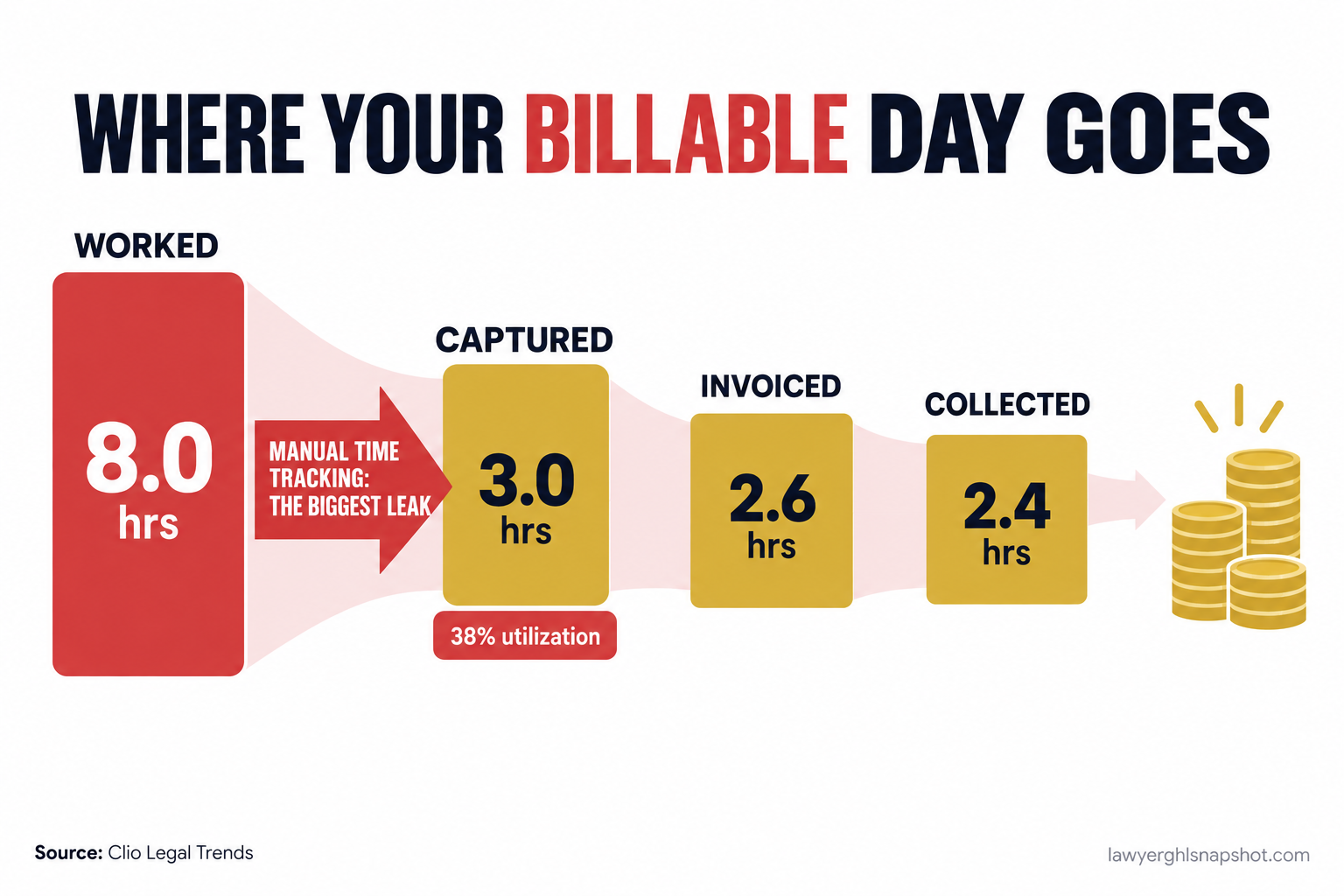
Start with the day you already work. In Clio’s benchmarks the average lawyer’s utilization rate is 38%, about 3.0 billable hours in an 8-hour day (Clio Legal Trends; see Clio’s how to calculate utilization rate and its 2024 report highlights). After a realization rate around 86% to 88% (the share of worked time that makes it onto a bill) and a collection rate near 90% to 93% (the share of billed work you get paid for), a whole day of effort becomes roughly 2.4 hours of collected, billable time, with 86% realization and 90% collection reported for solo and small firms in Clio’s 2024 solo and small firm report.
The biggest drop is not collection or realization. It is the gap between the hours you work and the hours you capture at all: part genuine non-billable time, and part bill-worthy work you never wrote down, because you tracked it from memory hours later.
An average 8-hour workday turned into collected billable time at small-firm utilization (38%), realization, and collection. Source: Clio Legal Trends.
A manual timekeeper loses that slice like this. Most firms bill in tenths of an hour, so the smallest unit is six minutes. A quick call to confirm a hearing is a legitimate 0.1. An email answering a client question is a 0.1 or 0.2. These tiny entries are the ones memory erases first. Forget three a day, a call, an email, a document you pulled, and you drop roughly 0.5 billable hours. Do that daily and you lose more than a hundred billable hours a year, without ever feeling like you slacked off.
That is the real cost of manual time tracking. Not the five minutes a night on the timesheet, but the hour a day you give away because you tried to remember instead of capture.
The 6 places a billable hour leaks out
Follow one hour of real work from the moment it happens to the day the money lands. It passes through six stages, and manual timekeeping springs a leak at each one. None is fatal by itself. Together they are why the firm feels busy and the bank account does not agree.
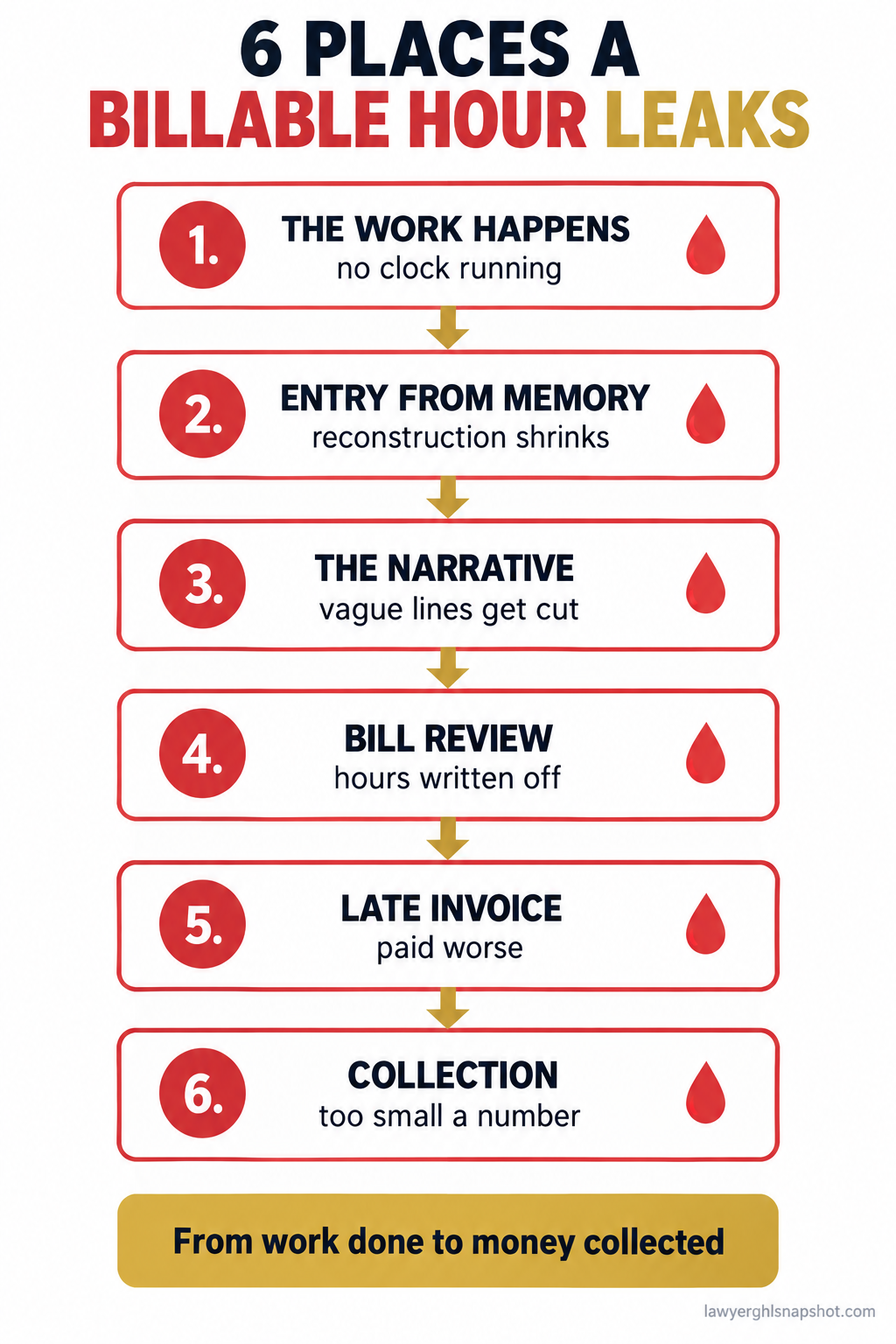
Stage 1. The work happens, and no clock is running
The hour starts when you pick up the phone or open the document. Right now the entry is worth the most, because you know exactly what you did and how long it took. A timekeeper with no system in front of them lets the moment pass, meaning to log it later.
How it breaks: later never has the detail that now has. By 6pm the 18-minute call is a fuzzy “client call, 0.2,” if you remember it at all. The short tasks, most of your count, disappear.
What to do: capture at the moment, even roughly. A running timer, a sticky note, a one-line note on your phone, anything timestamped. You cannot recover a task you never noted.
Stage 2. The entry gets made from memory, not from the work
End of day, you sit down to “do your time.” This is reconstruction, and reconstruction shrinks. Your memory is just lossy and conservative. Unsure whether a task was 0.2 or 0.3, you round down, because padding feels wrong. Multiply that honest rounding across every fuzzy entry and the daily total lands well below what you actually did.
How it breaks: the longer the delay, the worse the shrinkage. A day-end rebuild loses the small stuff. A month-end scramble is barely a guess.
What to do: shorten the gap to zero. Contemporaneous entry (recording as you go) is the only method that does not leak. If you cannot do it mid-task, do it between tasks, not at night.
Stage 3. The narrative gets written, badly or not at all
Every entry needs a line describing the work. Under time pressure this becomes “attention to file” or a block entry lumping four hours of tasks into one vague line. Vague narratives do not just look lazy. They get cut.
How it breaks: block billing is the first thing a client, an auditor, or a court trims, because nobody can tell what they are paying for.
What to do: one task, one entry, one plain-English verb. “Drafted motion to compel” beats “litigation.” Specific entries survive review. Vague ones get written down.
Stage 4. The bill gets reviewed, and hours get written off
Before the invoice goes out, someone reviews it. At a solo shop that is you, second-guessing yourself; at a bigger firm it is a partner. This is where realization happens: the gap between hours worked and hours actually billed. Some write-downs are fair. Many happen because the reviewer cannot defend a vague or oversized entry, so they cut it to be safe.
How it breaks: the firm already did and recorded the work, then erases it to avoid an awkward client conversation. Realization around 86% means roughly one in seven recorded hours never makes it onto a bill, and Clio reports mid-sized firms running lower, near 83% (Clio 2024 mid-sized report).
What to do: make entries you would be comfortable defending out loud. Review should remove genuinely non-billable time, not clean up sloppy capture.
Stage 5. The invoice goes out late, so it goes out weaker
An invoice built from reconstructed time is slow to produce, so it ships late, and late invoices get paid worse.
How it breaks: billing 45 days out means negotiating against a client who has forgotten the value. Billing promptly, with clear line items, reminds the client what they got.
What to do: bill on a short, regular cycle. Clean contemporaneous entries make a monthly, on-time invoice trivial to generate, which is half of getting it paid.
Stage 6. The payment comes in, or does not
The last stage is collection: the share of billed work you get paid for, around 90% to 93% for small firms. The entries you dropped in Stage 1 never reach this stage, so a healthy-looking collection rate is measured only against the reduced number you managed to bill. The upstream leak is invisible here, which is exactly why it goes unfixed.
How it breaks: you celebrate a 93% collection rate on a bill that already lost 15% of your real hours before it went out. You are collecting almost all of a number that is too small.
What to do: fix the top of the funnel first. Capturing an extra half hour a day beats squeezing another point of collection, and it is easier.
The real math: solo, 5-attorney, 15-attorney
The honest cost is the billable time you earn and never record, valued at your rate. These are illustrative figures at a round $300 rate and about 230 working days a year, not a quote. Plug in your own numbers.
| Firm size | How time gets tracked | Billable time lost per attorney | At $300/hr, 230 days | Annual revenue left on the table |
|---|---|---|---|---|
| Solo | Rebuilt at day’s end from memory | ~0.5 hr/day | ~115 hrs/yr | ~$34,000 |
| 5-attorney | Mixed, some rebuild Friday | ~0.5 to 0.75 hr/day | ~115 to 170 hrs/yr each | ~$170,000 to $255,000 |
| 15-attorney | Varies by attorney, weakest set the loss | ~0.5 to 0.75 hr/day | ~115 to 170 hrs/yr each | ~$510,000 to $765,000 |
The pattern compounds with head count. Half a billable hour a day sounds trivial until you price it. For a solo it is a used car every year. For a 15-attorney firm it is a salaried associate, or two, paid for by hours the firm already worked and simply failed to write down. None of it is a demand to work longer. Every dollar is for work already done, the cheapest revenue in your building.
Illustrative annual billable revenue lost to manual, delayed time tracking at a $300 rate, using the midpoint of each range above. Your number depends on your rate and how much you reconstruct from memory.
Steal this: the contemporaneous capture routine
The fix is a habit you can start tomorrow, no new software required: zero gap between doing the work and noting it, and a narrative clean enough to survive review. Copy the routine and the entry language below.
The second half is the narrative. The same work, written two ways, gets paid two different amounts.
Pair the timer habit with a system that takes non-billable admin off your plate, through legal intake automation, so there is more billable room in the day. We cover that broader stack in the true cost of software that costs more than it saves and in how a solo firm can automate client intake.
The compliance angle vendors skip
Manual time tracking is not only a revenue problem. In a law firm, how you record time is an ethics surface, and it cuts both ways.
The governing rule is the reasonable-fee requirement under ABA Model Rule 1.5: a fee must be reasonable and a bill must reflect work actually done. Reconstructed time is dangerous precisely because it is a guess. Guess low and you lose money, which is the rest of this article. Guess high, round up to feel whole, or let a vague block entry imply more work than happened, and you have drifted toward an unreasonable fee. ABA Formal Opinion 93-379 is blunt on the related sins: a lawyer may not bill one client for work done for another, and may not charge for more time than was actually spent. Padding a reconstructed timesheet, even by accident, turns a routine fee dispute into a disciplinary one.
Contemporaneous records are the defense. Time captured as the work happened, with a clear narrative, holds up when a client challenges a bill or a court reviews a fee petition. A timesheet rebuilt a month later does not. The same habit that recovers your lost hours protects your license. We are an automation product, not a law firm, and none of this is legal advice, so confirm specifics with your own state bar. But the direction is not in doubt: accurate, timely records are the cheaper and the safer way to bill.
Common objections
“I do not have time to track time all day. That is the whole problem.” The routine above adds no time, it moves it. You already spend five or ten minutes at night reconstructing your day. Logging a line per task as you finish it takes the same few minutes and captures what the night-time rebuild drops. You are doing the chore when it is accurate instead of when it is a guess.
“We already pay for Clio (or MyCase, or PracticePanther). Does it not track time?” Every practice-management tool has a timer. The tool is not the problem, the habit is. A timer you never start captures nothing, and most attorneys reconstruct at day’s end even with one a click away. Turn it on at the start of the task, not after. If you are weighing those tools on cost, we break the numbers down in law firm case management software pricing and the best transparent Clio alternatives.
“Is this not just a billing issue for hourly firms? We do contingency and flat fees.” Even on contingency, time records decide your fee in a lodestar or fee-shifting fight, and reconstructed time is the first thing a court discounts. On flat fees, knowing your true hours is how you price the next matter profitably. Guessed time hides that too.
The bottom line
You are not under-earning because you are lazy or because your rate is too low. For most small firms the money is already earned and never recorded, lost in the gap between doing the work and writing it down hours later. Manual time tracking is the quietest, most expensive habit in the building.
The fix costs nothing and starts tomorrow: capture each task the moment it ends, write a plain-English line a stranger would understand, round honestly, and bill on time. Then take the non-billable admin off your plate so more of the day is billable. Do that and you recover the cheapest hours you will ever bill, the ones you already worked.
Frequently asked questions
How much billable time do lawyers lose to manual time tracking?
It varies by habit, but the mechanism is consistent: time rebuilt from memory drops the short tasks first, and short tasks are most of a lawyer's day. Recovering even half a billable hour a day is over 100 billable hours a year. At a $300 rate that is roughly $34,000 per attorney, for work that was already done and simply never recorded.
What is contemporaneous time tracking and why does it matter?
It means recording each task the moment it happens, rather than reconstructing your day later. It captures the small entries memory erases, so you bill what you actually worked, and it produces records that hold up if a client disputes a bill or a court reviews a fee, because they were made at the time of the work instead of guessed afterward.
Is manual or reconstructed time tracking an ethics problem?
It can be. Under ABA Model Rule 1.5 a fee must be reasonable and reflect work actually done, and ABA Formal Opinion 93-379 holds that a lawyer may not charge for more time than was spent or bill two clients for the same hours. Reconstructed timesheets risk this in both directions: rounding down loses money, and rounding up or using vague block entries can drift toward an unreasonable fee. Contemporaneous records are the safer practice. Confirm specifics with your state bar.
Will practice management software like Clio or MyCase fix my time tracking?
Only partly. Every major tool includes a timer, but a timer you never start captures nothing, and most attorneys still reconstruct from memory even with one available. Software removes the friction; it does not supply the discipline. Pair a timer habit with a system that takes non-billable admin off your plate so more of the day is billable in the first place.
How do I write time entries that do not get written off?
Use one task, one entry, one plain-English verb. 'Drafted motion to compel discovery responses' survives a bill review; 'attention to matter' gets cut. Avoid block billing, which lumps many tasks into one vague line and is the first thing clients, auditors, and courts trim. A stranger reading the entry should understand what you did and why it was worth the time.