It is 4:50 on a Tuesday and the consult went great. The potential client sat with you for forty minutes, said “this is exactly what I was afraid of,” and asked good questions. At the end they said, “Let me talk to my spouse and I’ll get back to you.” That was nine days ago. They never called back.
That person almost certainly hired someone else, and probably not because the other lawyer was better. It was because the other lawyer made signing easy and you left the client to come back on their own. The leak most firms obsess over is at the top, the missed call and the slow callback. The quieter, more expensive leak is at the bottom: the consultation that goes well and still never becomes a signed, paid client. This is the system that closes it.
Key Takeaways
- The consult is not the finish line, it is halftime. A good meeting earns you the right to make signing easy. Most firms stop there and wait for the client to come back on their own, which is where the matter dies.
- Clients tell you what they need to say yes: a prompt response, a clear next step, and a sense of the cost (Clio 2019 Legal Trends Report). Give all three in the room and same day, and your sign rate climbs.
- “Let me think about it” is a process, not a rejection. The firms that win follow up fast and more than once. Friction kills warm deals, so e-sign and a one-tap retainer close the gap a mailed agreement leaves open.
- You cannot fix what you do not count. Almost no small firm tracks its consult-to-signed rate. The cheapest clients you will ever get are already in your conference room.
Table of contents
- Why do good consultations never sign?
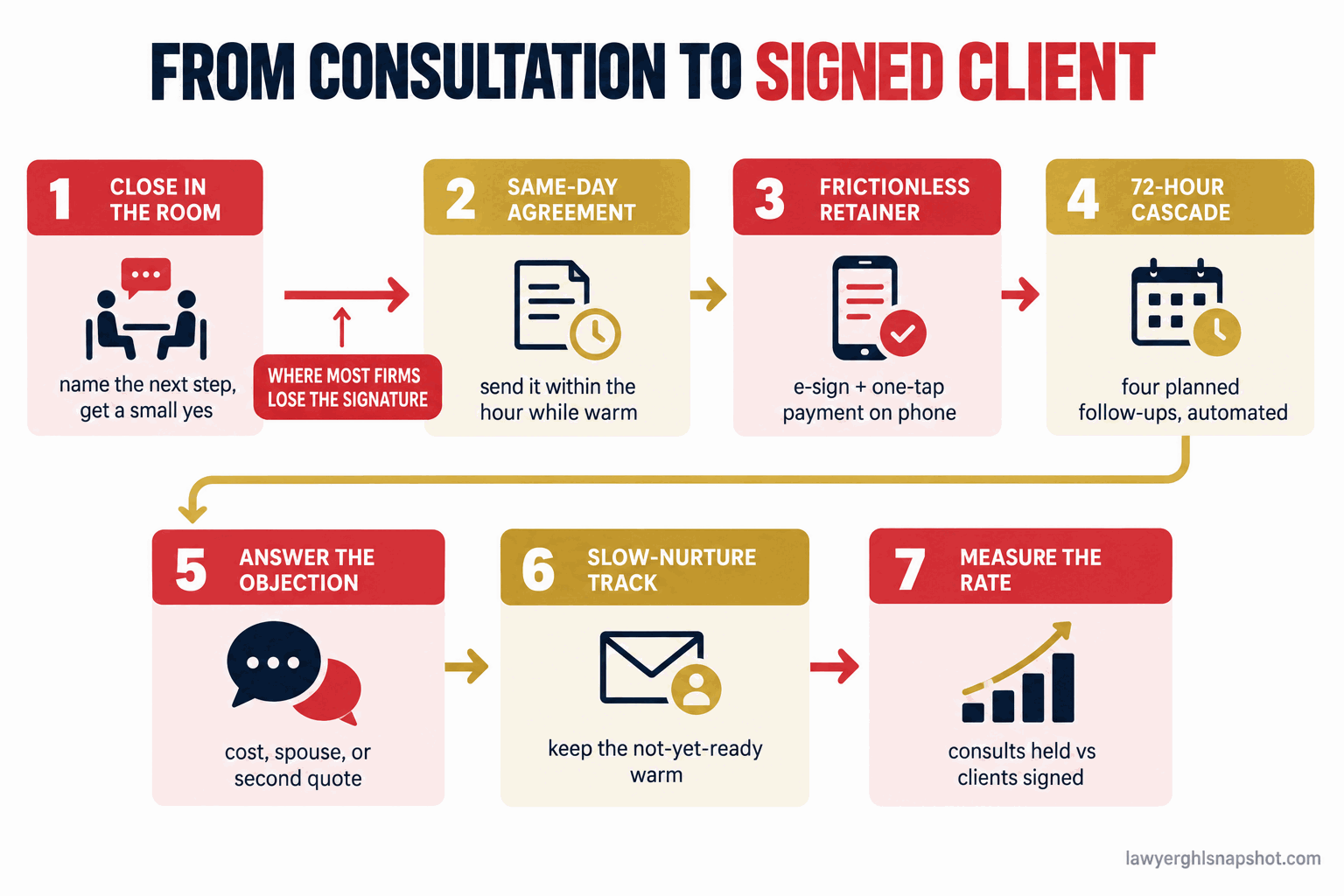
- The 7 stages from consultation to signed client
- The real math: solo, 5-attorney, 15-attorney
- Steal this: the 72-hour follow-up cascade
- The compliance lines that keep it clean
- Common objections
- The bottom line
- Frequently asked questions
Why do good consultations never sign?
Start with what the client told you they wanted. In Clio’s survey of legal consumers, 82% ranked a prompt response among the top factors in choosing a lawyer, 80% wanted a clear understanding of how to proceed, and 76% wanted a sense of what the case would cost (Clio 2019 Legal Trends Report, via the Illinois lawyer-regulation commission). All three are things you control right after the consultation: the next step, the cost, and how fast you follow through.
What legal consumers say matters most when choosing a lawyer. Source: Clio 2019 Legal Trends Report.
Now look at how firms perform. Clio’s 2024 secret-shopper study of 500 firms found only 40% answered the phone and 33% replied to an email (2Civility on the 2024 report), and Hennessey Digital’s 2025 study of 1,333 firms found 26% never reply to an online lead at all (Hennessey Digital 2025). That top-of-funnel leak is real, and we wrote the fix in the speed-to-lead playbook and missed-call text-back.
Here is the part nobody measures. The same instinct that lets a firm ignore a new lead, the belief that a serious client comes back on their own, kills the warm consultation too. The person in your conference room is the most qualified lead you will ever have. Let them leave with no next step and no easy way to say yes, and they stall, comparison shop, and sign with whoever made it simplest. The seven stages below are how you move the one number you are least likely to know: your consult-to-signed rate.
The 7 stages from consultation to signed client
This is the path from the last handshake to a cleared retainer, and the signature can die at any of these seven stages. None of it is about being pushy, only about removing reasons to drift away.
Stage 1. The close in the room, not “think about it”
How it breaks: most lawyers end with “let me know if you’d like to move forward,” which dumps the whole decision on the client. “Let me talk to my spouse” is not a no, it is an unmanaged maybe, and the client leaves with homework they will never do.
What to do: close with a concrete next action and a reason to do it now. “Here is what I’d recommend. I’ll send the agreement within the hour while this is fresh. Look it over tonight, and I’ve held time Thursday to start once it’s signed.” For practice-area language, see intake call scripts by practice area.
Stage 2. The same-day agreement, while it is still warm
How it breaks: the firm waits to “draft it up properly,” Tuesday’s urgency cools into Friday’s doubt, and a competitor who sent their agreement that night signs the client first. The warm window is hours, not days.
What to do: build the agreement from a template the moment the consult ends, pre-filled with the client’s name, matter type, and the fee you quoted. Make the fee section clear, since 76% of clients said they wanted a sense of the cost. A client who understands what they are paying for signs; one staring at “fees to be determined” does not.
Stage 3. The frictionless retainer: e-sign and one-tap payment
How it breaks: if signing means print, sign, scan, and email back, the agreement sits in an inbox because it is a chore. A week later the urgency is gone and so is the client. The deal lost on logistics, not merits.
What to do: send it as an e-signature link they can complete on their phone in under two minutes, with the retainer payment right next to it: a card or bank link, not “mail a check.” Trust-account rules still govern the money once it arrives, but collecting it should be one tap. For the full build, see the solo attorney’s client intake system and the legal intake process guide.
Stage 4. The 72-hour follow-up cascade for the undecided
How it breaks: some clients will not sign the same day, and that is fine. The mistake is following up once. The agreement gets buried under forty other emails, your one “just checking in” lands on a bad day, you read the silence as a no, and you lose a client who was 80% of the way to yes.
What to do: run a fixed cascade over the first 72 hours and beyond: a same-evening recap, a next-day nudge, a value touch, and a final “should I close your file?” that often gets the fastest reply of all. The exact copy is below. Automating it is where a system earns its keep, like a reminder cascade that cuts no-shows.
Stage 5. Answering the real objection, not the stated one
How it breaks: “let me think about it” is almost never the real reason. Underneath it is the fee, a spouse to consult, or a second quote. The firm treats every hesitation as a price problem and starts discounting, or ignores the objection and sends cheerful check-ins that never touch what is holding the client back.
What to do: name the likely objection and resolve it. If it is cost, restate the fee and what it buys, and offer a payment plan, never a random discount. If it is a spouse, offer to answer their questions directly. If it is a second quote, make it easy to compare you on clarity and responsiveness, the two things competitors usually lose on.
Stage 6. The slow-nurture track for the not-yet-ready
How it breaks: not every consultation should sign this week. Estate planning clients procrastinate for months. The firm has two settings, hot-pursuit and forgotten, so a client six weeks from ready gets the same cascade, goes cold, and is never contacted again. When they finally act, they find a different firm.
What to do: move unsigned-but-interested consults onto a low-frequency track: a useful email or text every few weeks, tied to their matter type, that keeps you top of mind without nagging. This is the same muscle as database reactivation and follow-up email templates, pointed at warm consults.
Stage 7. Measure the consult-to-signed rate
How it breaks: you track how many leads and consults you get, but not what share of consultations become signed clients, so you cannot tell a marketing problem from a closing problem. A firm pours money into more leads when its real issue is that it signs only a third of the people who already show up.
What to do: count it monthly. Consultations held, clients signed, divide. Watch it move as you tighten the stages above. If you are signing well under half of qualified consults, the fix is almost never more ads. Tie it to cost per lead to see what a signed client actually costs.
The real math: solo, 5-attorney, 15-attorney
The honest cost of a weak close is the matters you earned the meeting for and never signed. These are illustrative figures, not a quote; plug in your own numbers.
| Firm size | Consults/year | If sign rate goes 35% → 50% | Extra signed clients/year | At a $3,500 average matter |
|---|---|---|---|---|
| Solo | ~200 | +15 points | ~30 more clients | ~$105,000 |
| 5-attorney | ~800 | +15 points | ~120 more clients | ~$420,000 |
| 15-attorney | ~2,400 | +15 points | ~360 more clients | ~$1,260,000 |
You are not buying more leads or working more hours, just keeping a larger share of the people who already sat down with you.
Illustrative: signed clients from 200 held consultations per year at a 35% versus a 50% consult-to-signed rate. A fifteen-point lift is the cheapest growth a firm can buy, because acquisition was paid for the day they booked.
Steal this: the 72-hour follow-up cascade
Send the recap the evening of the consult, then run the cascade on anyone who has not signed. Automate it so it fires whether or not your day fell apart.
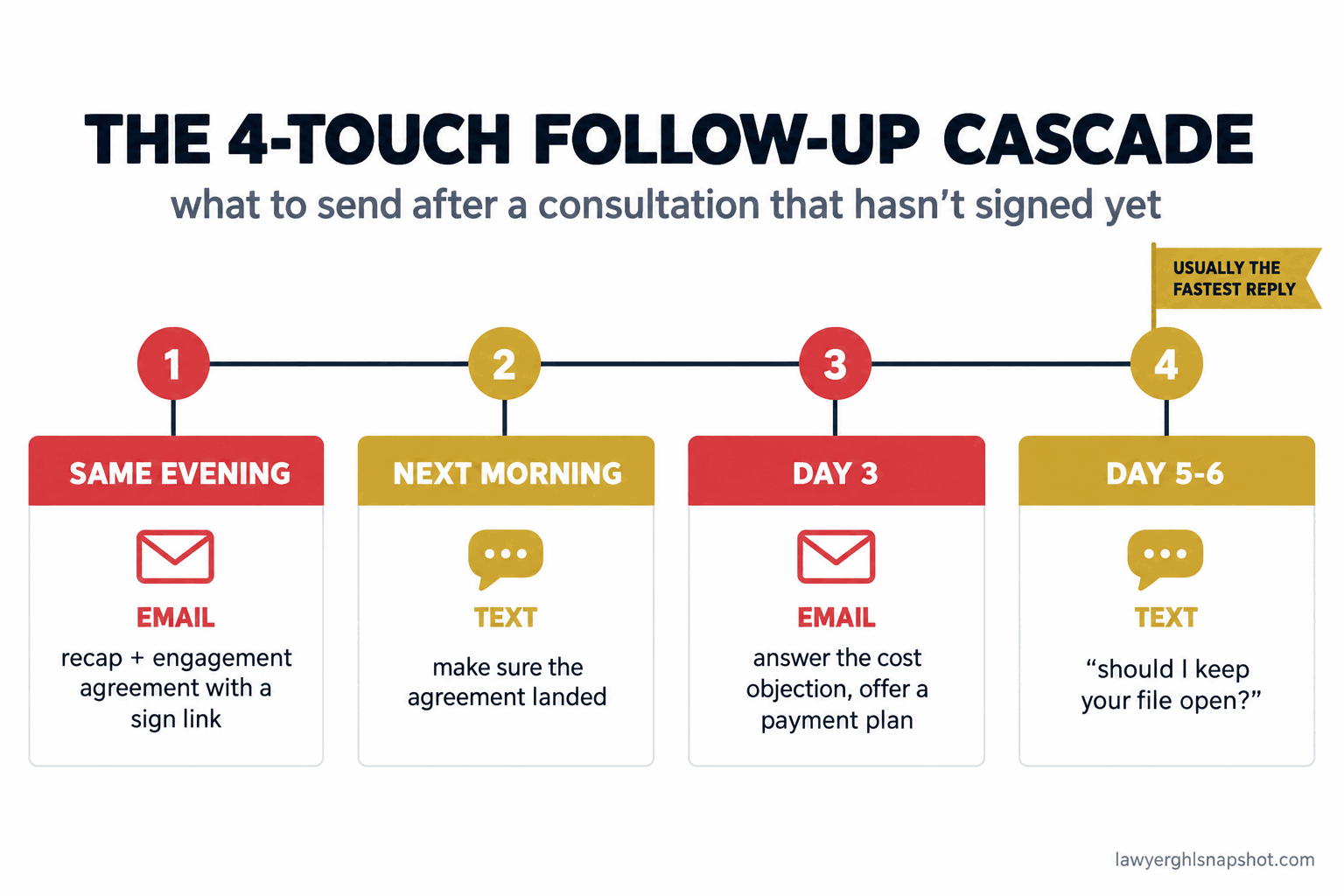
The last message does the most work. Giving the client permission to say no is what finally gets a reply, and a surprising share are “no, let’s do it, I just got busy.” For the longer horizon, use these follow-up email templates.
A firm that follows up four times, calmly and on schedule, will out-sign a better lawyer who follows up once.
The compliance lines that keep it clean
Closing harder does not mean cutting ethical corners. A few rules shape how this works; none of this is legal advice, so confirm against your own state’s rules.
- No misleading fee or outcome promises (Model Rule 7.1). Your agreement and follow-ups cannot create unjustified expectations or imply a result. “A flat $2,500 covering the scope below” is fine. “We’ll win” is not (ABA Model Rule 7.1).
- A fee the client can understand (Model Rule 1.5). Fees must be reasonable and, for contingency matters, in a written agreement. The clarity clients ask for and the clarity the rule demands are the same, so a clean fee section does double duty (ABA Rule 1.5).
- Following up a person who contacted you is not forbidden solicitation (Model Rule 7.3). The rule targets unprompted outreach to strangers. A prospect who booked and attended a consultation initiated contact, so your cascade is permitted within the rule’s limits (ABA Model Rule 7.3).
- Get texting consent and honor opt-outs (TCPA). Follow-up texts need consent and a working opt-out. Capture consent at booking, and make STOP work. The build is in law firm texting and AI chatbot compliance; the FCC’s TCPA overview is the backstop.
- Run the conflict check before the signature. Build it into the flow so the agreement goes out only once the matter clears, and never let a one-tap retainer get ahead of your trust-accounting obligations.
- No fee-sharing with a marketing vendor. A vendor taking a cut of signed matters is fee-sharing with a non-lawyer, broadly prohibited. Pay for the software and the service, never a slice of the fee (lawyer advertising rules).
Common objections
“Won’t all this follow-up make me look desperate?” Only if you do it badly. Four short, useful, well-spaced messages that each give the client something, a next step, an answer to a worry, permission to decline, read as professional. What looks desperate is one vague “just checking in” a week late.
“I already use Clio or MyCase. Doesn’t that handle this?” Case management software runs matters after someone becomes a client. Most of it is thin on the intake-to-signed window: the same-day agreement, the multi-touch cascade, the nurture track for the not-yet-ready. The system here sits in front of your practice-management tool and hands it a signed client.
“I’m a solo. I don’t have time to build or run this.” That is the point of automating it. The cascade works precisely because it runs without you remembering, firing for every consult while you are in court or at dinner. A solo benefits most, because you are the bottleneck this removes. If even the setup is too much, that is what a done-for-you install is for.
The bottom line
Go back to the client who said they’d talk to their spouse. In the firm that runs this system, they left with the agreement already on the way, signed it on their phone that night with a card payment attached, and if they had hesitated, a calm four-touch cascade would have answered the exact worry holding them back. Same consultation, same lawyer, same client. The only thing that changed is that you stopped handing the close to chance.
The people already sitting across from you are the cheapest clients you will ever sign, and most firms let a big share walk. Name the next step, send the agreement same day, make signing a two-minute phone task, follow up four times on a schedule, keep the slow ones warm, and count the result. That is the whole system.
Frequently asked questions
What is a good consultation-to-signed-client rate for a small law firm?
There is no single authoritative benchmark, and most firms do not measure it, so published ranges vary widely by practice area and by whether consults are free or paid. Measure your own rate monthly (consultations held divided into clients signed) and improve it against itself. If you are signing well under half of qualified, attended consultations, this system moves it more cheaply than buying more leads.
How fast should I send the engagement agreement after a consultation?
The same day, ideally within an hour, while the urgency that brought the client in is still stronger than the friction of signing. Clients rank a prompt response among the top factors in choosing a lawyer (Clio 2019 Legal Trends Report). Pre-fill the agreement from a template so sending it same-day is realistic.
Is following up with a potential client after a consultation an ethics problem?
Following up with someone who contacted you and attended a consultation is generally permitted; the anti-solicitation rule (ABA Model Rule 7.3) targets unprompted outreach to strangers, not a prospect who initiated contact. Keep fee and outcome statements accurate under Rule 7.1, get consent before texting under the TCPA, and confirm your state's rules.
How many times should I follow up after a consultation?
Run a fixed cascade of about four touches over the first week, then move anyone still interested to a low-frequency nurture track rather than dropping them. The final 'should I close your file?' message often gets the fastest reply.
Do I need special software to run this, or can I do it manually?
You can run it manually, but it only works if it happens every time, which is exactly where busy firms fail. Automating the same-day agreement, the e-sign and payment link, and the cascade means the sequence fires whether or not anyone remembers. A GoHighLevel-based system can run all of it; the Lawyer Snapshot ships it pre-built.