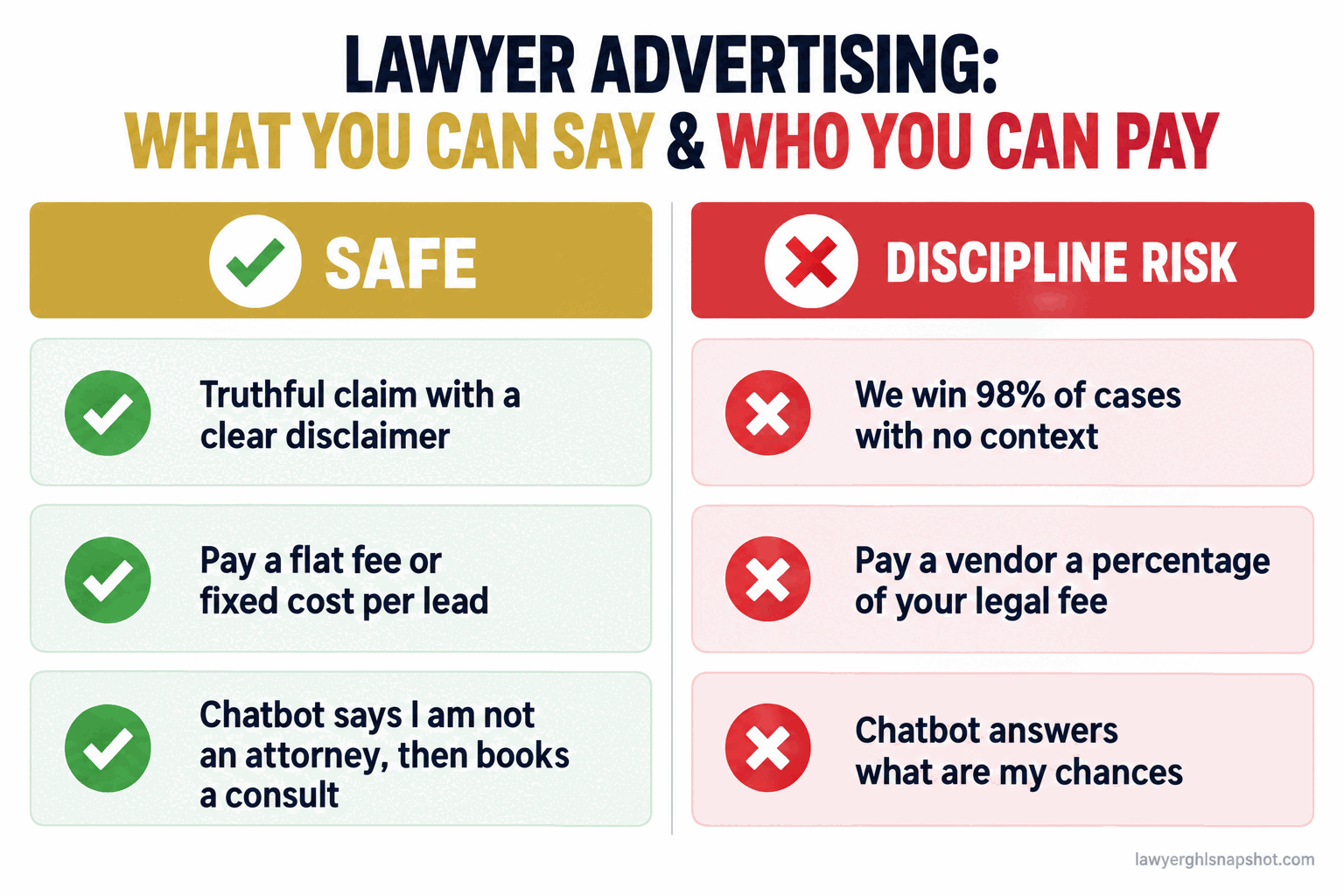
The ad looked great: a clean Google search ad, a landing page with a five-star review carousel, and a headline that read “We win 98% of our cases.” It ran three weeks and brought in nine leads. Then a competitor screenshotted it, attached it to a complaint, and sent it to your state bar’s advertising review committee.
Now you are thinking about whether that headline was a misleading communication, whether you ever had a disclaimer, and why your marketing company never mentioned it.
Here is the short version. For a law firm, advertising is not just marketing, it is regulated conduct. The same ABA Model Rules that govern you in a courtroom govern what you say in a Google ad, who you pay for a lead, and whether your chatbot can tell someone their case is strong. Most firms that get burned did not lie. They ran a truthful ad with no disclaimer, signed a vendor deal that paid a percentage of fees, or let a bot answer a legal question at 9pm. This guide walks the rules, the copy you can steal, and the system that keeps you clean when you are too busy to think about it.
Key Takeaways
- Advertising is regulated conduct. ABA Model Rule 7.1 bars false or misleading communications, and an omission can be as misleading as a lie.
- You can pay for leads, not for a recommendation. Rule 7.2 lets you pay a lead’s cost, but the source cannot vouch for you or imply a merit-based referral.
- Revenue-share is the trap. Rule 5.4 bars sharing legal fees with a non-lawyer. A fee pegged to your recovery is what sank Avvo Legal Services.
- Filing rules are state-specific. Florida wants most paid ads filed 20 days before first use; Texas wants a copy within 10 days after. Your website is treated differently from a banner ad.
- Your chatbot is an advertisement and cannot practice law. It must disclose it is not an attorney and route to a human, not answer “what are my chances.”
Table of contents
- Rule 7.1: what you are allowed to say
- Rule 7.2: who you are allowed to pay
- Rule 5.4 and the revenue-share trap
- Rule 7.3: the line on solicitation
- Does your AI chatbot practice law without a license?
- Florida vs Texas: the filing deadlines that trip firms up
- Run the same rules at three firm sizes
- Common objections
- FAQ
Almost everything you do to get a client counts as advertising: your website, Google ads, Local Service Ads, the review stars on a landing page, the chatbot on your site, even the text your front desk sends a missed caller. Four rules do most of the work. Rule 7.1 covers what you say, Rule 7.2 what you pay, Rule 7.3 how you reach out, and Rule 5.4 whether a vendor deal is a marketing expense or a fee split.
Rule 7.1: what you are allowed to say
The core of Rule 7.1 is one sentence: a lawyer shall not make a false or misleading communication about the lawyer’s services. The part that catches small firms is the definition of misleading. It misleads not only when false, but when it omits a fact needed to keep it from misleading the reader. An omission counts.
So the problem with “We win 98% of our cases” is not that the number is false. A bare results claim creates an expectation the next client’s case cannot honestly carry, and without context it is treated as misleading (Colorado’s adopted comment puts it plainly). The fix is cheap: add a disclaimer, and in most states a prominent, honest one keeps the ad on the right side of the line.
Testimonials and reviews sit in the same place. The rules do not ban client testimonials, only misleading ones. A real review from a real client is fine. One you wrote, paid for, or cherry-picked with no context is a 7.1 problem, and some states require a paid endorsement to be labeled as paid.
How this breaks
The classic failure is the results headline with no disclaimer, on a landing page your marketing company built and never showed a lawyer. Next is the five-star carousel of incentivized reviews. Both are cheap to prevent and expensive to defend.
Rule 7.2: who you are allowed to pay
Here is the rule that trips up every firm shopping for leads. Rule 7.2 says a lawyer shall not give anything of value for recommending the lawyer’s services, with a few exceptions: the reasonable cost of advertising, the usual charges of a legitimate lead-generation service, and a nominal thank-you gift. What you cannot do is pay someone to recommend you.
The whole question is advertising cost versus recommendation. A lead service can send you leads and charge you. It cannot tell those leads you are the best lawyer for their case, that it screened and selected you on the merits, or that it endorses you. The moment the middleman vouches, the payment becomes a prohibited payment for a referral.
How this breaks
The pitch sounds harmless: a pay-per-lead platform “matches” clients to you and takes a cut. A neutral matcher that picked you on the merits is the recommendation problem; a fee that floats with the value of the matter is the fee-sharing problem.
This is not theoretical. Avvo Legal Services ran a model where the lawyer got paid, then paid Avvo a “marketing fee” that varied with the size of the legal fee. Around eight state ethics committees warned lawyers not to participate, several reasoning it was either an improper payment for a referral or a fee split with a non-lawyer. Avvo shut the product down on July 31, 2018 (ABA Journal, LawSites). The lawyers who signed up were not villains. They bought a product a lot of smart people thought was fine, and it was not.
Rule 5.4 and the revenue-share trap
Rule 5.4(a) says a lawyer or firm shall not share legal fees with a non-lawyer. The point is to protect your independent judgment, so the lawyer steers the case, not a marketing company with a stake in the outcome.
This is where a modern marketing vendor most often puts you at risk, because the deal they love to pitch is “we only get paid when you get paid.” It sounds fair. It is also, when structured as a cut of your legal fee, the exact thing Rule 5.4 bans. A flat monthly fee is a business expense; a cut of the recovery is a fee split (LawSites). The safe path: pay for marketing the way you pay for rent.
Per-violation exposure for an outreach misstep, in U.S. dollars. Federal TCPA damages run $500 per call or text, up to $1,500 if willful (47 U.S.C. §227); Texas SB 140 lets the state attorney general seek $5,000 per violation, and each message is its own violation (Morgan Lewis).
Rule 7.3: the line on solicitation
Rule 7.3 defines solicitation narrowly: a communication targeting a specific person you know needs legal services, when a significant motive is your financial gain. It bars doing that by live, person-to-person contact (in-person, live telephone, real-time electronic), unless the person is a lawyer, a close or prior professional contact, or someone who routinely uses that kind of service. General advertising to the public is not solicitation. A billboard, a Google ad, a web page, and a mass email are communications to the world, so they live under 7.1 and 7.2 (ABA, 2018).
Firms get into trouble with the hybrid move: pulling a list of people just in an accident or just hit with a lien and having a human cold-call them. That is the targeted, live, financially motivated contact the rule stops, and several states add waiting periods for certain practice areas. Automated messages a person opted into are different, and their consent and registration mechanics (TCPA and A2P 10DLC) are covered in the 2026 guide to texting clients and using AI chatbots. Outreach the client asked for, through a channel you registered, is marketing, not prohibited solicitation.
Does your AI chatbot practice law without a license?
A chatbot on your site is two things at once: an advertisement, so everything it says is a communication under Rule 7.1, and software talking to the public about a legal problem, which is where the unauthorized practice of law gets dangerous.
The line is clean. A bot can say what you do, where you practice, and when you are available, and it can take a name and number and book a consultation. It cannot tell someone whether they have a case, what it is worth, or what to do next, because that is legal advice, and advice from a bot is advice no licensed lawyer gave. Answer “what are my chances” and you have two problems: a possible UPL issue, and a statement that may be misleading under 7.1 if the bot is wrong. So the rule is simple: disclose that it is not a lawyer, and route anything resembling advice to a person.
Florida vs Texas: the filing deadlines that trip firms up
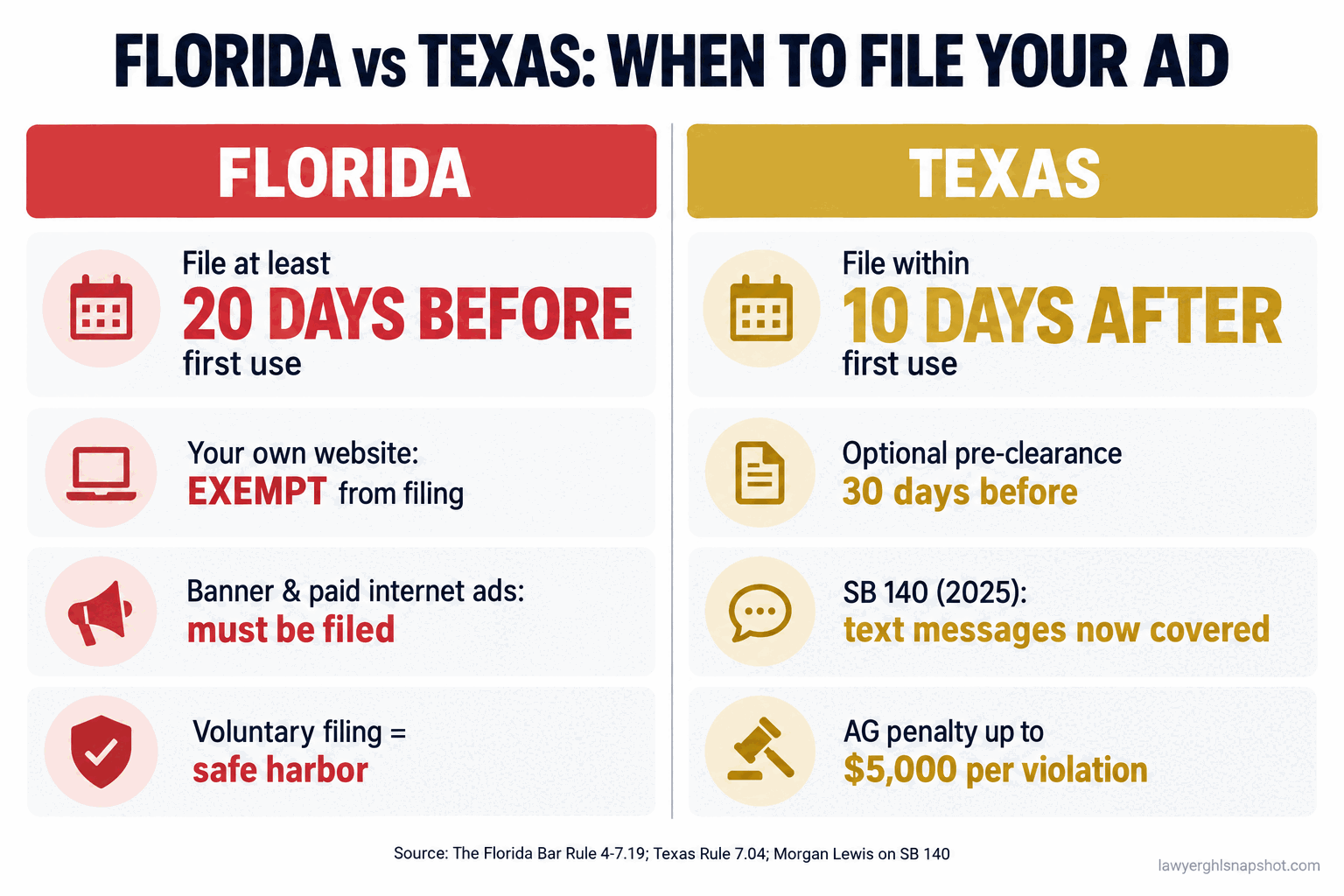
Most out-of-state marketers get this wrong, because filing rules are state-specific and two of the biggest legal markets sit at opposite ends. Florida wants to see most ads before they run; Texas wants a copy shortly after. Get the direction backward and you miss a deadline you did not know existed.
| Florida | Texas | |
|---|---|---|
| When you file | At least 20 days before first use (Rule 4-7.19(a)) | Within 10 days after first dissemination (Rule 7.04) |
| Your own website | Exempt from filing (including pop-ups on your site) | Confirm current treatment of your site |
| Banner / paid internet ads | Not exempt, must be filed like other media | Covered as advertisements of legal services |
| Voluntary pre-clearance | File even an exempt ad for a notice of compliance and a safe harbor | Submit at least 30 days before first use for a binding pre-approval |
The traps hide in the details. In Florida, your own website is exempt from filing, but a banner ad or paid placement is not, and the content still has to be truthful (The Florida Bar). Texas also tightened the screws on outreach: SB 140, effective September 1, 2025, extended the state’s telephone solicitation law to text and image messages, and lets the attorney general seek $5,000 per violation (Morgan Lewis). If you text in Texas, that should change the campaign.
Run the same rules at three firm sizes
The rules are the same for everyone. How you keep them changes as the firm grows.
The solo practitioner. You are the marketing department and the compliance officer, with small, concentrated exposure: your website, Google profile, maybe Local Service Ads, and a chatbot. One afternoon covers it. Add the disclaimer block to every claim, set the chatbot to disclose and route, and read any per-lead contract for percentage-of-fee language.
The 5-attorney firm. Now several people touch marketing, a vendor runs the ads, and associates ask the front desk to “just text them back.” The risk is drift: nobody owns compliance, so disclaimers vary and nobody read the vendor contract’s revenue-share clause. Name one owner, standardize the disclaimer block, fix the vendor contract to flat-fee terms, and calendar any Florida or Texas filing deadline when a campaign is approved.
The 15-attorney, multi-state firm. A paid agency, multiple practice areas, and clients in several states means several rule sets at once. The failure here is scale: one bad template across 40 landing pages, or a referral network quietly sharing fees across state lines. Build a compliance calendar by state, run every template through legal sign-off before it scales, keep vendor and co-counsel pay on flat-fee terms, and centralize intake so the disclosure lives in one system.
Common objections
“Nobody actually files ads with the bar, right?” Plenty of firms don’t, and plenty get a letter. Florida and Texas both run active review programs with real deadlines, and Florida’s voluntary filing buys a documented safe harbor. The risk is skipping it, then running a claim a competitor reports.
“My vendor says their revenue-share is totally legal.” Maybe, in their state. But Rule 5.4 is about your license, not theirs, and the Avvo lawyers heard the model was fine right up until eight states said otherwise. Ask for the deal in writing as a flat fee. A vendor confident in the model will not blink.
“Can I use testimonials and case results at all?” Yes, truthful ones. What the rules police is the omission: a results number with no context, or an incentivized review that is not disclosed. Add the disclaimer and keep the written consent.
“Does a website chatbot really count?” It counts as both an advertisement and a potential unauthorized-practice problem. It can describe the firm and book a consult, not tell someone whether they have a case. Disclose and route.
“I already pay for Clio or MyCase. Isn’t compliance handled?” Those tools manage your matters, calendar, and trust accounting. They do not write your ad copy, read your vendor contracts, or file your ads. We broke down where that money goes in our case management software pricing teardown.
Frequently asked questions
Can lawyers pay for leads?
Yes, within limits. Rule 7.2 lets you pay the reasonable cost of advertising and the usual charges of a legitimate lead-generation service. The line is that the lead source cannot recommend you, vouch for you, or imply it selected you on the merits. A neutral service that sends contacts is fine; one that calls you the best lawyer for the job is not.
Is a revenue-share deal with a marketing company allowed?
Usually not, if it is a percentage of your legal fee. Rule 5.4 bars sharing legal fees with a non-lawyer. Pay a flat management fee or a fixed cost-per-lead instead. A cut of the recovery is a fee split, and it is the structure that ended Avvo Legal Services.
Do I have to file my ads with the state bar?
It depends on your state. Florida requires most paid ads to be filed at least 20 days before first use, with your own website exempt. Texas requires a copy within 10 days after first dissemination, plus an optional 30-day pre-approval. Many states require no filing at all, so confirm your jurisdiction's rule before a campaign.
Can my AI chatbot answer a prospect's legal questions?
No. A chatbot can describe the firm, answer logistics, and book a consultation, but it cannot say whether someone has a case or what it is worth. That risks the unauthorized practice of law and can be misleading under Rule 7.1 if it is wrong. Set the bot to disclose that it is not an attorney and route legal questions to a human.
What actually happens if I get advertising wrong?
The front door is a bar grievance, which can run from a private reprimand to suspension. On outreach, you can also face statutory damages: the federal TCPA allows $500 per call or text and up to $1,500 for willful violations, and Texas SB 140 lets the attorney general seek $5,000 per violation.
The screenshot that never became a grievance
Go back to that Google ad. The headline was true, the firm really did win most of its cases. What turned a good month into a bad quarter was the missing context: a results claim with no disclaimer, run by a vendor who never looped in a lawyer, on a page showing reviews nobody had vetted. The fix was an afternoon of work that never happened. A reusable disclaimer under every claim. A vendor contract on a flat fee. A chatbot that said “I’m not an attorney” and booked the call instead of guessing at the odds. None of it would have cost a single lead.
That is the whole game. Advertising compliance is not about saying less. It is about building the guardrails into the system that runs your marketing and intake, so the compliant version is the automatic one. Do that once, and the next time someone screenshots your ad, the worst they find is a firm doing it right.