It is 4:50 on a Friday and a new client just signed the retainer in your lobby. You shake hands and move on to the fire that was already burning. The client drives home, tells their spouse they hired a lawyer, and then hears nothing. No welcome, no name to call. By Tuesday the good feeling has curdled into worry, and your newest client already doubts they picked the right firm.
That gap is where most small firms quietly lose goodwill they already paid for. The fix: treat onboarding as a system, not a feeling. Build a repeatable sequence that fires the moment the retainer is signed, sets expectations in plain language, handles the money cleanly, and keeps the client informed on a schedule even when there is no news. Do that and you turn a nervous new client into a calm one, protect yourself from the most common bar complaint, and set up the referral you will want in six months.
Key Takeaways
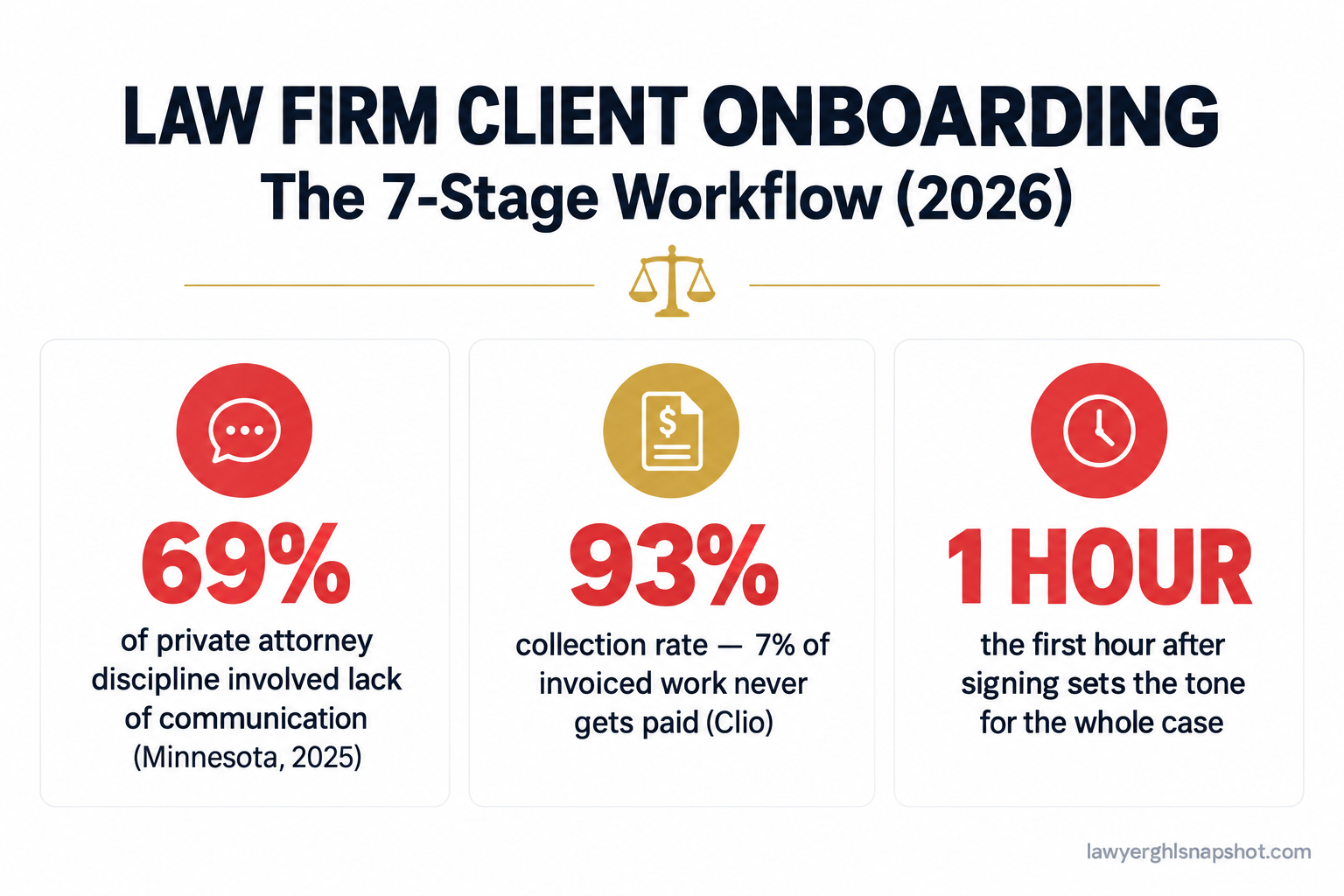
- Onboarding is a legal duty, not a nicety. ABA Model Rule 1.4 requires reasonable communication, and lack of communication drove 69% of private attorney discipline in Minnesota in 2025, in a year that logged a 25-year record of 1,572 complaints (Minnesota Lawyer).
- Weak onboarding leaks money. The average firm collects only 93% of what it invoices and realizes 88% of its billable work, and an ignored client disputes the bill (Clio).
- Clients value responsiveness above almost everything. Response time strongly shapes which firm a client trusts (Clio).
- The system beats the memory. Seven stages, each with real copy, fired automatically on the day of signing.
Table of contents
- Why onboarding is the most ignored growth lever
- The 7-stage client onboarding workflow
- Stage 1: The welcome
- Stage 2: The engagement packet and trust confirmation
- Stage 3: Setting expectations
- Stage 4: Collecting documents
- Stage 5: The proactive update cadence
- Stage 6: Milestones and the mid-case check-in
- Stage 7: The close, review, and referral ask
- Steal this copy: the onboarding messages
- What onboarding looks like at three firm sizes
- Common objections
- Frequently asked questions
Why client onboarding is the most ignored growth lever in a small firm
Most firms pour real money into getting the lead and winning the signature, and legal intake gets a real process. Then the client signs, and the system goes quiet. That handoff, from prospect to served client, is where the operational discipline falls off a cliff, and it is expensive in two ways most owners never connect.
First, it is a discipline risk. Communication is a duty, not a courtesy. The ABA Model Rules are explicit: Rule 1.4 requires a lawyer to keep the client reasonably informed and respond to reasonable requests (ABA Model Rule 1.4). In Minnesota, lack of communication appeared in 69% of private disciplines in 2025, the top area by a wide margin, in a year that logged 1,572 complaints, up 23% and the highest total in a quarter century (Minnesota Lawyer). Those are not lawyers stealing money. They are mostly decent lawyers who went quiet for a few weeks.
Second, it leaks cash. The average firm collects only 93% of what it bills and realizes just 88% of its billable work (Clio Legal Trends benchmarks). Part of that leak is clients who felt ignored and decided the bill was negotiable. A client who knows what you are doing rarely fights an invoice; one who has not heard from you in a month reads it very differently.
The upside is just as real. A well-onboarded client is the easiest referral source you will ever have, the bridge to the referral engine you want running next year.
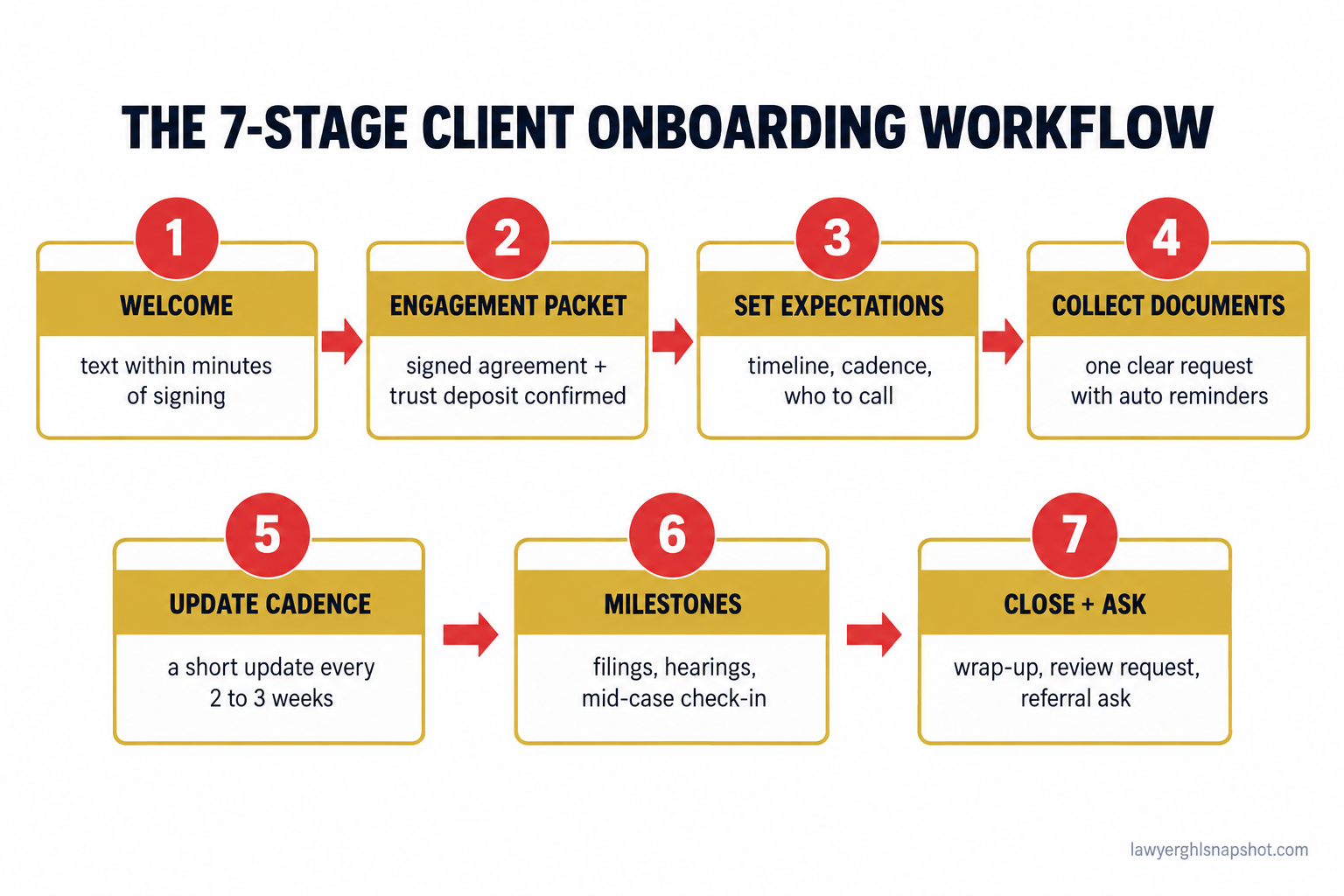
The 7-stage law firm client onboarding workflow
The fix is a defined sequence that runs the same way every time, triggered the moment the retainer is signed. Here are the seven stages.
Stage 1: The welcome, within the first hour
The first hour after signing is the most emotionally loaded moment of the engagement. The client just made a decision that costs money and matters to their life, so fill that silence fast. The moment the retainer is signed, a welcome message fires automatically: a text within minutes, an email within the hour. It names a real human they can reach, confirms you have their matter, and states one concrete next step. You are not asking for anything yet, just closing the gap between the decision and reassurance.
How it breaks. The welcome reads like a receipt, or it never fires because it waits on a paralegal to start a sequence after they have left for the weekend. Trigger it off the signature event so Friday at 4:50 works exactly like Monday at 9:00. The same speed-to-lead discipline that wins the client should win its first hour.
Stage 2: The engagement packet and trust deposit confirmation
Now you handle the paperwork and the money, cleanly and visibly. Send the fully executed engagement agreement so the client has a copy in hand. If you took a retainer into trust, confirm you received it and that it sits in the client trust account, as ABA Model Rule 1.15 requires client funds to be held separately and accounted for (ABA Model Rule 1.15). A simple “we received your $2,500 retainer and it is held in our client trust account” reassures the client and creates a record at once. For the mechanics, see our guide to IOLTA trust-accounting compliance.
How it breaks. The signed copy never goes back, so weeks later the client is unsure what they agreed to, or the trust deposit sits unconfirmed and they wonder where their money went. Both are avoidable with a templated confirmation on deposit.
Stage 3: Setting expectations in plain language
This is the stage that prevents the most grievances, and almost nobody does it well. Tell the client three things in plain English: how the case moves and roughly how long each phase takes, how and how often you will communicate, and who to contact for what. That answers the three questions that drive clients to file complaints: what is happening, when will I hear from you, and who do I call.
How it breaks. The firm sets no expectation, so the client invents their own: they assume weekly, you planned monthly, and the mismatch becomes resentment. An unmanaged expectation is a complaint waiting to be written. And responsiveness is what clients value most, with response time strongly shaping which firm they trust (Clio). You do not have to be instant, just predictable.
Stage 4: Collecting documents without the back-and-forth
Most matters need documents from the client: the police report, the medical release, the financials, the prior contracts. The old way is phone tag and half-answered emails that drag on for weeks. The onboarding system turns it into a short, guided task. Send one clear request listing exactly what you need and how to send it, ideally a secure upload link, then let the system handle follow-up: a reminder at day three, another at day seven, and a flag to a human if it is still outstanding at day ten.
How it breaks. The request is a wall of text with no clear list, so the client freezes and sends nothing. Or the follow-up depends on memory, and the case stalls before it starts.
Stage 5: The proactive update cadence
This is the heart of the whole system, and it separates firms clients rave about from firms clients grieve. You commit to a regular update and you send it even when there is nothing new. The “no news” update feels pointless to a lawyer and is priceless to a client. A short message every two to three weeks, “your case is active, here is where it sits, nothing is required from you right now, next step is X around Y,” does more for satisfaction than any single piece of legal work.
Automate the schedule, personalize the substance. The system reminds the assigned team member that a client is due and holds a template. A human adds the one real sentence about where the matter stands, and it goes out: the consistency of automation with the authenticity of a human touch, the balance a good client follow-up system should strike.
How it breaks. The cadence is “we will call when something happens,” and in a slow case nothing happens for two months. To an anxious client, no news reads as bad news.
Stage 6: Milestone moments and the mid-case check-in
Alongside the steady cadence, certain moments deserve their own message: a filing goes out, a hearing gets scheduled, an offer comes in. Marking these beats makes the client feel the matter is moving even when the calendar is slow. Keep a template for each milestone type so the update is one click, not a blank page. For longer matters, add a scheduled mid-case check-in, a brief call to take the client’s temperature and catch frustration before it becomes a review or a grievance. That check-in is cheap insurance against the client who quietly loses faith and fires you, taking the fee with them.
How it breaks. Milestones pass unmarked while everyone is heads-down, so the client learns about their own hearing from the court notice, not from you.
Stage 7: The close, the review, and the referral ask
When the matter resolves, most firms send a final invoice and move on, leaving their best marketing on the table. A deliberate close turns a finished case into two more: start with a clear wrap-up of what happened, what it means, what to keep, and what they need to do now. Then, while goodwill peaks, ask for the review. A client who got a good result and felt informed the whole way is primed to leave the five-star review that feeds your Google reviews. Make it one tap, and route unhappy clients to a private conversation first.
Shortly after, make the referral ask explicit. Clients fail to refer because they forgot you exist, not because they were unhappy. A warm message reminding them you take cases like theirs turns them into a pipeline. Then drop them into a long-term reactivation and nurture track so the relationship does not go cold the day the case ends.
How it breaks. No close, no review ask, no referral ask, so a genuinely happy client drifts away silent and you buy your next client all over again through ads. The most expensive referral is the one you never asked for.
Steal this copy: the onboarding messages that do the work
Stages are abstract. Messages are not. Here is language you can adapt today. Swap in your firm name and timelines, and have your own counsel review it for your state first.
These messages, wired to the right triggers, are most of the onboarding system. Notice what they share: plain language, a named human, a clear next step, and never a hint of guarantee or pressure. That tone keeps the automation on the right side of your bar’s texting and advertising rules.
What onboarding looks like at three firm sizes
The seven stages are the same for everyone. The way you run them scales with the firm.
Solo or two-attorney firm. You are the whole system, so the risk is that onboarding lives in your head and collapses the first busy week. Make it automatic. Trigger the welcome off the signed retainer, template the trust confirmation and document request, and set a recurring reminder listing which clients are due for their two-week update. You still write the one real sentence in each update, but the schedule, the chasing, and the review ask run without you, the same muscle as a tight solo intake system.
Mid-size firm, three to eight attorneys. Now the risk is inconsistency. One attorney onboards beautifully, another forgets, and the experience depends on the luck of the assignment. Standardize it: one shared sequence, one set of templates, one place the updates are logged, so every client gets the same experience no matter who has the file. This is where the mid-case check-in pays for itself.
Larger firm, nine to fifteen-plus attorneys. At real volume onboarding becomes a measurable operation. You want to see, across the whole book, which clients are overdue for an update, which documents are outstanding, and which closed matters never got a review ask. The system should surface those gaps, not hope a busy associate notices them. A tracked process across dozens of matters protects you from the one neglected client who becomes a grievance, and turns closed-case volume into a steady stream of reviews and referrals.
Common objections
“My clients are stressed people in a hard moment. Won’t automated messages feel cold?” They feel cold only when they are generic and obviously robotic. The messages above are warm, specific, and signed by a real person, and the automation handles the timing, not the empathy. A client does not know the reminder was scheduled; they know they were not left guessing. The genuinely cold experience is hearing nothing for three weeks.
“I already use Clio or MyCase. Isn’t onboarding handled?” Those tools store your matters, calendar, and billing. They do not fire a welcome text at signing, chase documents with reminders, keep a two-week update cadence, or ask for the review at the right moment. Many firms run matters in Clio and onboarding on a done-for-you GoHighLevel build, and connect the two. If you are weighing a bigger change, map who owns each step first.
“Do I need to be technical to build this?” No, but someone has to own it once. The triggers, templates, and schedule are a one-time setup. After that the work is small: write the one real sentence in each update.
“Will this actually move revenue?” In two directions. It protects collections, because informed clients dispute bills far less than ignored ones, and the average firm already loses 7% of invoiced work at the collection stage (Clio). And it feeds growth through reviews and referrals that cost nothing to acquire.
Frequently asked questions
What is client onboarding for a law firm?
It is the defined sequence a firm runs from the moment a client signs the retainer through the early stages of the matter: the welcome, the engagement packet and trust confirmation, setting expectations, collecting documents, and a regular update cadence. It is the handoff from prospect to served client, and done well it prevents the communication failures that drive most bar complaints.
How soon after signing should a client hear from the firm?
Within the first hour, ideally within minutes by text. The hour after signing is the most emotionally loaded point of the engagement, when the client is deciding whether they made the right choice. A fast, warm welcome that names a real contact and states one concrete next step closes that anxious gap.
Why is client communication such a big compliance risk?
Because it is an ethical duty, not a courtesy. ABA Model Rule 1.4 requires lawyers to keep clients reasonably informed. In Minnesota, lack of communication was involved in 69% of private disciplines in 2025, the top area, in a year that set a 25-year record for complaints. Most of those are competent lawyers who simply went quiet on a client.
Does practice-management software like Clio already do onboarding?
Not the client-experience part. Clio and MyCase manage matters, calendars, and billing, but they are not built to send a welcome text in minutes, run a document request with automated reminders, keep a two-week update cadence, or ask for a review at the right moment. Many firms keep case data in their practice-management system and run onboarding on a platform built for those workflows.
When should a firm ask a client for a review or referral?
Ask for the review at a positive close, right after a good result while goodwill peaks, with a one-tap link and a quiet path for unhappy clients to reach you privately first. Make the referral ask shortly after, as a warm invitation to send friends or family who need similar help. Clients rarely refer because they forgot you existed, so the well-timed ask is what turns a satisfied client into new business.
Winning the client is the hard part most firms obsess over. Keeping that client calm, informed, and loyal is the cheap part most firms ignore. A signed retainer is not the finish line. It is the moment the relationship starts, and the firm that treats it that way, with a system that fires on the day of signing and runs to the referral, keeps the clients it wins, protects the money it earns, and turns every closed matter into the next two.