It is Thursday afternoon and you just spent six hours on a custody motion. You go to post the time and the paralegal mentions the client’s trust balance hit zero two weeks ago. So those six hours are not in trust waiting to be earned. They are a bill you now have to chase, from a client who already got what they wanted. That is the quiet way small firms work for free: by letting the retainer run dry and billing after the fact.
The fix is not a bigger retainer. It is a replenishment system that refills the trust account before it empties, without you remembering to send anything. Here is how to build it, the copy to lift verbatim, and the trust rules that keep it clean.
Key Takeaways
- Billing after the work is where money leaks. The average firm realizes about 88% of what it bills and captures only 38% of the day as billable time (Clio). A dry retainer turns earned work into a receivable you collect twice.
- An evergreen retainer needs a replenishment trigger: a minimum balance in the engagement letter that, when trust drops below it, the client must restore to the original amount (LawPay).
- Monitoring by memory is the failure point. Manual checks miss low balances in your busiest weeks; automated alerts catch them the day they cross the line (LeanLaw).
- Advance fees live in trust until earned, under ABA Model Rule 1.15(c); Formal Opinion 505 confirms a “nonrefundable” label does not change it (ABA).
- A client who won’t replenish is a Rule 1.16 problem. You can withdraw for nonpayment, but only after warning and without leaving the client exposed (ABA).
Table of contents
- What a dry retainer actually costs you
- The replenishment system at a glance
- Stage 1: Write the trigger into the engagement letter
- Stage 2: Monitor the trust balance automatically
- Stage 3: Send the early low-balance heads-up
- Stage 4: Send the formal replenishment request
- Stage 5: Run the follow-up cascade
- Stage 6: Handle the client who will not pay
- Stage 7: Reconcile and apply the funds the clean way
- The same system at three firm sizes
- The compliance lines vendors skip
- Common objections
- Frequently asked questions
What a dry retainer actually costs you
The problem is not low rates. It is timing: when you bill after the work, every hour you post becomes a dollar you still have to collect, and collection is where small firms bleed. In Clio’s Legal Trends data, the average lawyer captures a 38% utilization rate, roughly 3.0 billable hours in an eight-hour day, and realizes about 88% of what they bill (Clio). That gap is the part people skip: if you bill a dollar and only 88 cents turns into money, the other 12 cents is work you did and will never be paid for.
A funded retainer closes most of it before it opens, because you draw against funds already in trust instead of collecting after the fact. That is the point of an evergreen retainer: the client deposits an amount, you bill against it, and they top it back up when the balance hits an agreed floor (LawPay).
The leak hides because it is slow. One client runs to zero, you keep working, and three months later you carry a four-figure receivable you are embarrassed to push. Multiply by a dozen matters and you have a cash-flow problem that looks like a marketing problem. It is not: you are getting the clients, then financing their cases.
The replenishment system at a glance
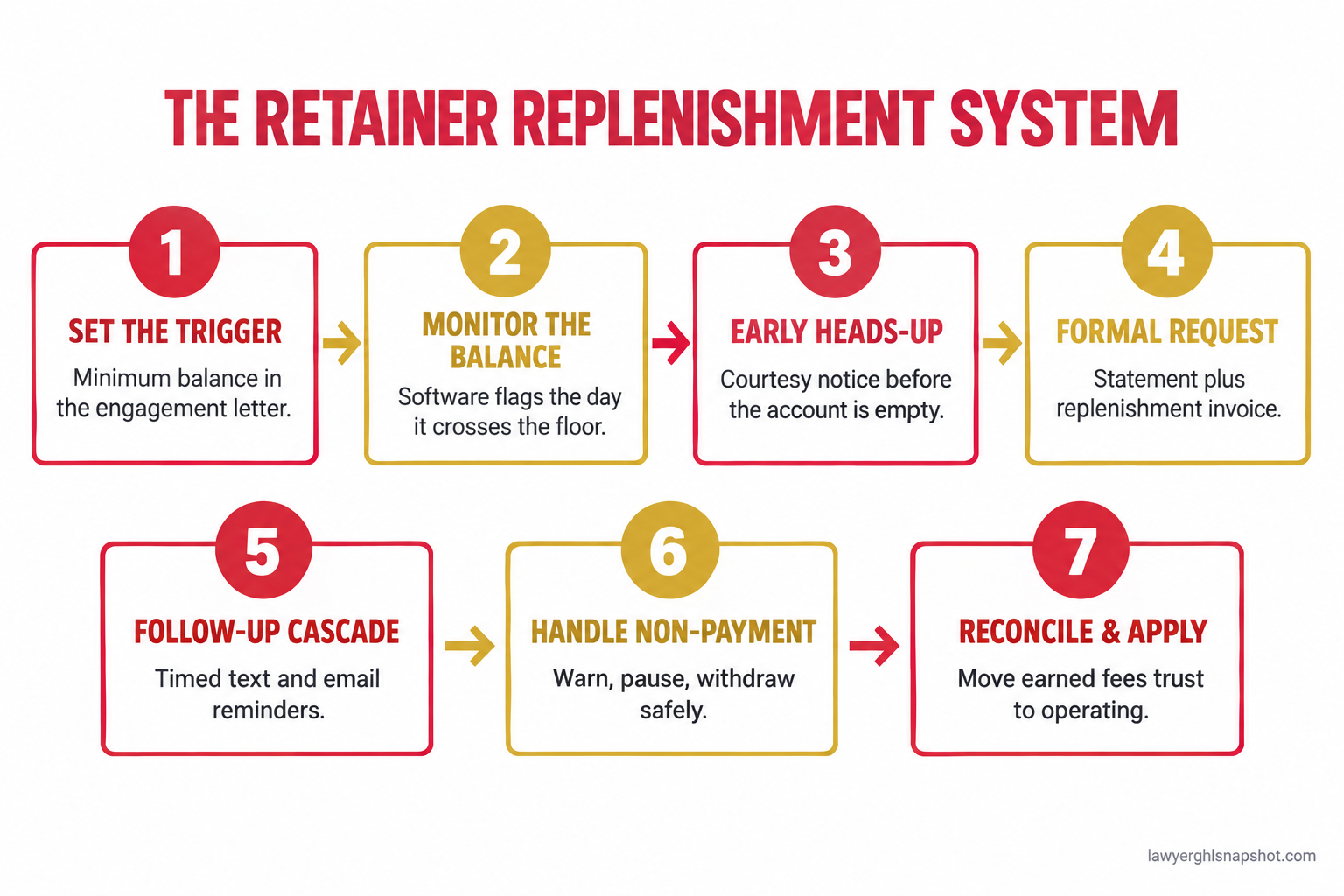
Replenishment is a loop, not a one-time setup. Seven stages run every cycle, and six should happen without you touching anything.
- •Stage 1
Set the trigger
Engagement letter names a minimum balance and top-up amount.
- •Stage 2
Monitor the balance
Software flags the day a matter crosses the floor.
- •Stage 3
Early heads-up
A friendly notice before the balance is spent, not after.
- •Stage 4
Formal request
A replenishment invoice with the current statement and a due date.
- •Stage 5
Follow-up cascade
Timed text and email reminders until the deposit lands.
- •Stage 6
Handle non-payment
A pause-and-withdraw path that protects the client and your license.
- •Stage 7
Reconcile and apply
Record the deposit, move earned fees to operating, keep the trail.
The clause and the one-time compliance review are human work. Everything after is a workflow that never forgets the Stage 3 notice.
Stage 1: Write the trigger into the engagement letter
Nothing downstream works if the client never agreed to top up, so the obligation lives in the signed fee agreement, in plain numbers. Three things go in: the minimum balance that triggers a top-up, the amount the client restores it to, and the days they have to pay after notice (Clio).
Steal this clause (take it to your own ethics counsel first):
Replenishing Retainer. Client’s initial deposit of $[amount] will be held in the Firm’s trust account and applied to fees and costs as earned. When the balance falls below $[floor], Client agrees to deposit additional funds within [10] days of the Firm’s notice to restore it to $[amount]. These funds remain Client’s property until earned. If Client does not replenish, the Firm may, consistent with the applicable Rules of Professional Conduct, cease further work and seek to withdraw, taking reasonable steps to protect Client’s interests.
How it breaks: The floor is too low. If you bill $4,000 a month and the floor is $500, you blow past zero between the notice and the deposit landing. Set it at roughly one billing cycle of work.
Stage 2: Monitor the trust balance automatically
This stage decides whether the system works, and it is the one firms get wrong, because they run it on memory and a spreadsheet. The manual check gets skipped the week you are in trial, exactly when balances drain fastest. Manual reviews fail to keep up; software can flag a low balance the moment it happens (LeanLaw). So the rule: trust balance is watched by software, not a person, and crossing the floor fires a trigger the same day. If your billing tool does not, bolt on a layer so the event starts the client sequence itself.
How it breaks: The alert fires to an internal inbox and dies there because the person it pings is busy. The low-balance event has to kick off the actual client messages, not just notify your team.
Stage 3: Send the early low-balance heads-up
The best notice goes out before the account is empty, framed as a courtesy, not a demand, the way a good vendor flags a low balance before it bites.
Steal this (text or email, sent the day the balance crosses the floor):
Hi [First name], quick heads-up on your account. The retainer for your matter is running low, with about $[balance] left. Under our agreement we top it back up to $[amount] so there is no pause in your case. We will send a short statement and a replenishment invoice tomorrow. I just never want funding to be the reason your matter slows down. Reply anytime. Thanks, [Firm].
A client who feels dunned goes quiet. A client who feels looked after pays.
How it breaks: The heads-up and the invoice arrive together, so it reads as a bill with a smile painted on. Keep Stage 3 and Stage 4 a day apart.
Stage 4: Send the formal replenishment request
Now the ask, with numbers: a short note, a current statement of what their funds were applied to, and a replenishment invoice with a due date.
Steal this:
Hi [First name], as mentioned, here is the statement for your matter through [date] and the invoice to restore your trust balance to $[amount]. Per our agreement, the deposit is due within [10] days. Pay securely here: [payment link]. The statement shows exactly how your retainer has been applied, happy to walk through any line. Thank you, [Firm].
Attach the statement every time. Clients hesitate most when they cannot see where the first deposit went; the itemized draw-down removes it.
How it breaks: The payment link is a hurdle. If paying means a business-hours phone call or a mailed check, your ten-day window becomes thirty. Make it one tap, mobile-friendly, and routed to trust, because advance funds cannot land in operating.
Stage 5: Run the follow-up cascade
Most replenishments do not land on the first ask, because your invoice is one of forty things in the client’s inbox. The cascade keeps it visible until the money arrives, then stops the instant it does.
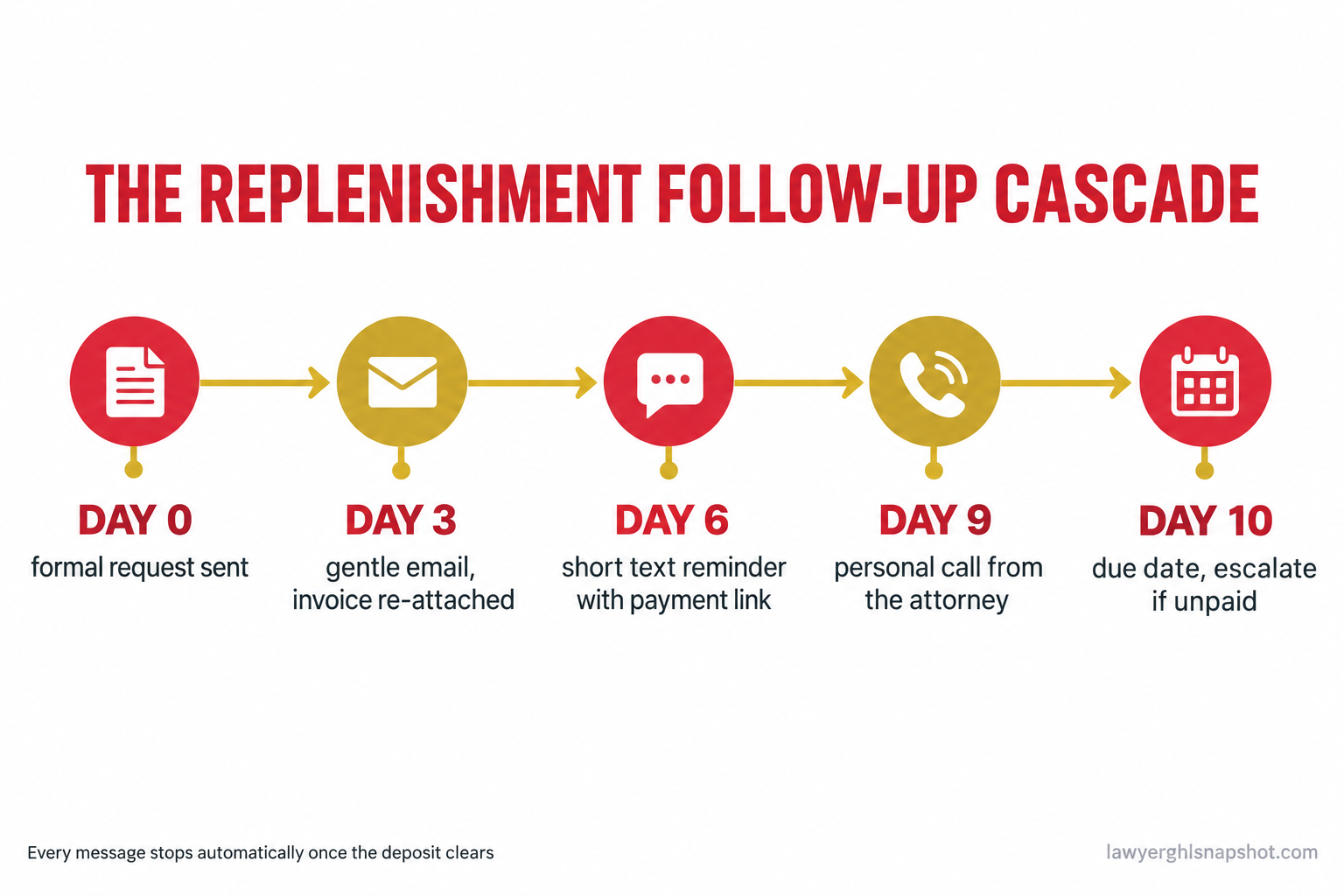
- Day 0: Formal request (Stage 4).
- Day 3: Gentle email, invoice re-attached: “just making sure this did not get buried.”
- Day 6: Short text: “Hi [First name], the replenishment is still open, here is the link again: [link]. Reply if anything is in the way.”
- Day 9: A human touch, a call or personal note from the responsible attorney, before the due date.
- Day 10: Due date. If unpaid, the matter moves into Stage 6.
Every message stops automatically the moment the deposit clears, because nothing is more corrosive than a reminder for a bill already paid.
How it breaks: The cascade keeps running after payment, or runs on a client who called to say they are paying Friday. Build an off-switch on the payment event and a pause a staffer can hit.
Disclosure: the GoHighLevel link above is an affiliate link. If you sign up through it we may earn a commission, at no extra cost to you.
Stage 6: Handle the client who will not pay
Sometimes the cascade ends and the deposit never comes. This is where billing becomes an ethics question. You generally may withdraw for nonpayment, but it is permissive, not automatic. Under ABA Model Rule 1.16, nonpayment is a ground only after the client has substantially failed to meet an obligation and you have given reasonable warning (ABA). And you cannot just walk: Rule 1.16(d) requires reasonably practicable steps to protect the client.
Stage 6 is a sequence, not a slammed door:
- Pause new work where you ethically can, and document the date and balance.
- Send a written warning that work stops and you will seek to withdraw if the retainer is not replenished by a date.
- If a tribunal is involved, a court can require you to continue and some withdrawals need its permission.
- On withdrawal, protect the client: reasonable notice, the file returned, any unearned balance refunded.
How it breaks: A firm quietly stops working without telling the client: not paid, and exposed on a Rule 1.16 and a diligence problem. The written warning is what makes the withdrawal defensible.
Stage 7: Reconcile and apply the funds the clean way
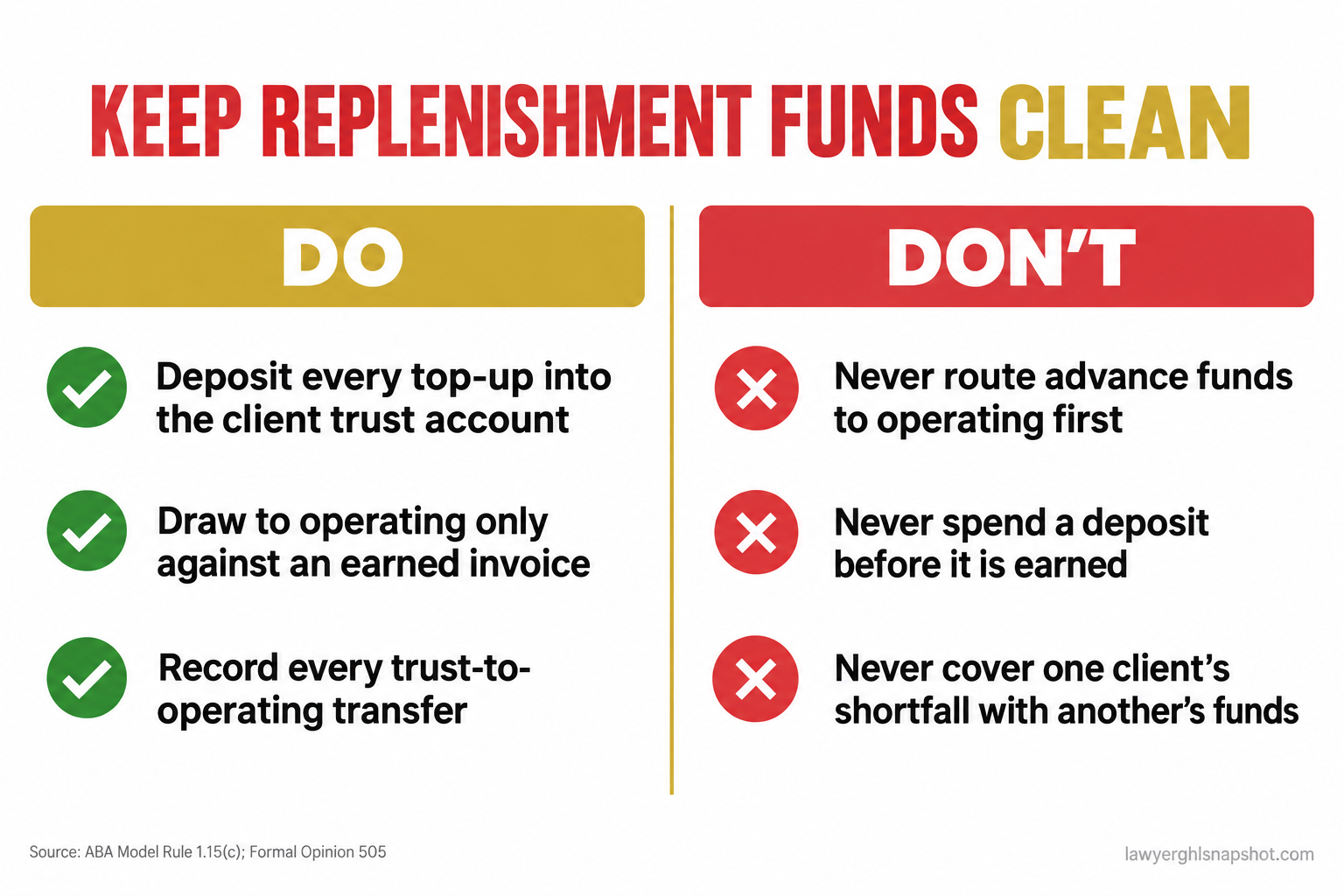
The deposit lands, but you are not done. This is where a well-run replenishment can still become a trust violation. Advance funds are the client’s property and must sit in trust, coming out only as earned, the core of ABA Model Rule 1.15(c) (ABA). Formal Opinion 505 drove it home in 2023: a fee paid in advance belongs in trust until earned, and calling it “nonrefundable” does not change that (ABA Journal).
In practice:
- The deposit goes into trust, never operating, even for a moment.
- You move money to operating only against a specific earned invoice, and record the transfer, so your ledger survives a bar audit.
- You never let one client’s trust funds cover another’s shortfall. That is commingling, and it is how careful firms get disciplined.
If reconciliation across matters is the part that keeps you up, our law firm trust accounting guide covers three-way reconciliation and the audit trail.
How it breaks: The firm treats a landed deposit as revenue and spends it before earning it. The money being in your account does not make it yours.
The same system at three firm sizes
The seven stages are the same everywhere, but the weight shifts with your practice.
Solo, mixed contingency and hourly. On contingency, replenishment matters less; your risk is costs advanced, not fees. But the hourly slice, the family matter, the business dispute, the estate work, is where you quietly finance clients. You are the lawyer, the biller, and the collector, so you cannot also check twelve trust balances every Friday. Set the floors and let the monitoring run; our solo attorney client intake system guide pairs with this.
Five-attorney family or criminal firm. Here replenishment is the cash engine, because hourly matters move fast and retainers drain in weeks. Raise the floors, a custody fight can burn a month of fees in days. The failure mode is the handoff: the attorney assumes the paralegal is watching the balance, the paralegal assumes the attorney is. Centralize monitoring so no matter depends on anyone remembering.
Fifteen-attorney firm. Now it is about consistency across people who each do it differently. The risk is the rainmaker who never enforces replenishment on a favorite client while everyone else does. Standardize the clause, the floors by matter type, and the cascade. This is also where the realization leak compounds; our piece on the true cost of manual time tracking shows where the rest hides.
The compliance lines vendors skip
A replenishment system touches client money, automated messaging, and sometimes AI, so it meets three sets of rules at once. Vendors routinely propose things your bar does not allow, and it is your license on the line.
- Trust first, always. Replenishment funds are client property under Rule 1.15 and sit in trust until earned (ABA). Any payment link must deposit to trust, not operating.
- Keep the fee reasonable. Rule 1.5 governs fees, so the amount and floor should track real expected work, not a number pulled to pad cash flow (ABA).
- No fee-sharing with the vendor. Non-lawyer fee-sharing is broadly banned, so a collections vendor that wants a cut of what it helps you collect is proposing something the rules do not permit. Pay a flat fee.
- If a bot talks to clients, it discloses. An automated reminder or chatbot must make clear it is not an attorney and should route or schedule, never answer a legal question or promise a result, or it risks unauthorized practice and privilege problems. Our texting and AI chatbot compliance guide covers the consent and disclosure language.
Automate the reminders and bookkeeping, keep the legal judgment human.
Common objections
“Won’t constant top-up requests annoy my clients?” Only if they feel like collections. A client who agreed to the floor, gets an early courtesy heads-up, and can see where their money went does not feel squeezed. The annoyance comes from surprise bills after the fact, which replenishment removes.
“My bookkeeper already handles the trust account.” Your bookkeeper reconciles, which is backward-looking. Replenishment is forward-looking: catching a balance as it crosses the floor before the account empties. The bookkeeper keeps the ledger clean; the system keeps it funded.
“I do contingency work, so this doesn’t apply.” The fee side may not, but the cost side does: you advance real money on contingency matters, and recovering costs has the same leak. And most contingency firms carry a few hourly matters they under-collect on.
Frequently asked questions
What is retainer replenishment?
It is refilling a client's trust-account retainer when the balance drops to an agreed minimum. With an evergreen retainer the client deposits an amount, the firm bills against it, and the client tops it back up whenever it falls below a floor set in the engagement letter, so you draw against money already in trust instead of billing after the fact.
How do I get clients to actually replenish their retainer?
Put the obligation in the signed fee agreement with a specific floor, amount, and payment window; send an early heads-up before the balance is spent; attach a current statement; and give them a one-tap payment link that routes to trust. Most resistance comes from clients not seeing where their money went, so the itemized statement removes it.
Where does a replenishment deposit have to go, trust or operating?
Into your client trust account. Under ABA Model Rule 1.15(c), advance fees are the client's property and must be held in trust, withdrawable only as earned. Formal Opinion 505 confirmed this applies even to fees labeled 'nonrefundable.' Move money to operating only against a specific earned invoice, and record every transfer. State rules vary.
Can I stop working if a client won't replenish?
Generally yes, but carefully. ABA Model Rule 1.16 treats nonpayment as a permissive ground to withdraw, only after the client has substantially failed to meet an obligation and you have given reasonable warning. You must also protect the client on the way out: notice, time to find new counsel, return of the file, and refund of unearned funds. Where a court is involved you may need its permission.
What minimum balance should trigger a top-up?
Roughly one billing cycle of expected work on that matter, so the heads-up goes out while there is still a cushion. A slow estate matter might sit fine at a low floor; a fast-moving custody fight might need several thousand dollars, because those matters can burn a month of fees in days.
The firms that never have a cash-flow problem are rarely the ones with the highest rates. They are the ones whose trust accounts stay funded, because a system refills them before they empty. Set the clause once, let the monitoring and cascade run, keep the trust accounting clean, and stop financing your clients’ cases out of your own pocket.
Related reading: Law firm trust accounting and IOLTA compliance · The true cost of manual time tracking · The solo attorney’s client intake system · Law firm client onboarding