It is 11:14pm and your phone buzzes with a Google alert. One star. A former client you worked hard for, who settled fine, has written three paragraphs that are not quite true, in public, under your firm name. Your first instinct is to type back the facts: the real timeline, what they actually asked for, why the number was the number. You have the file open, and you could set the record straight in ninety seconds.
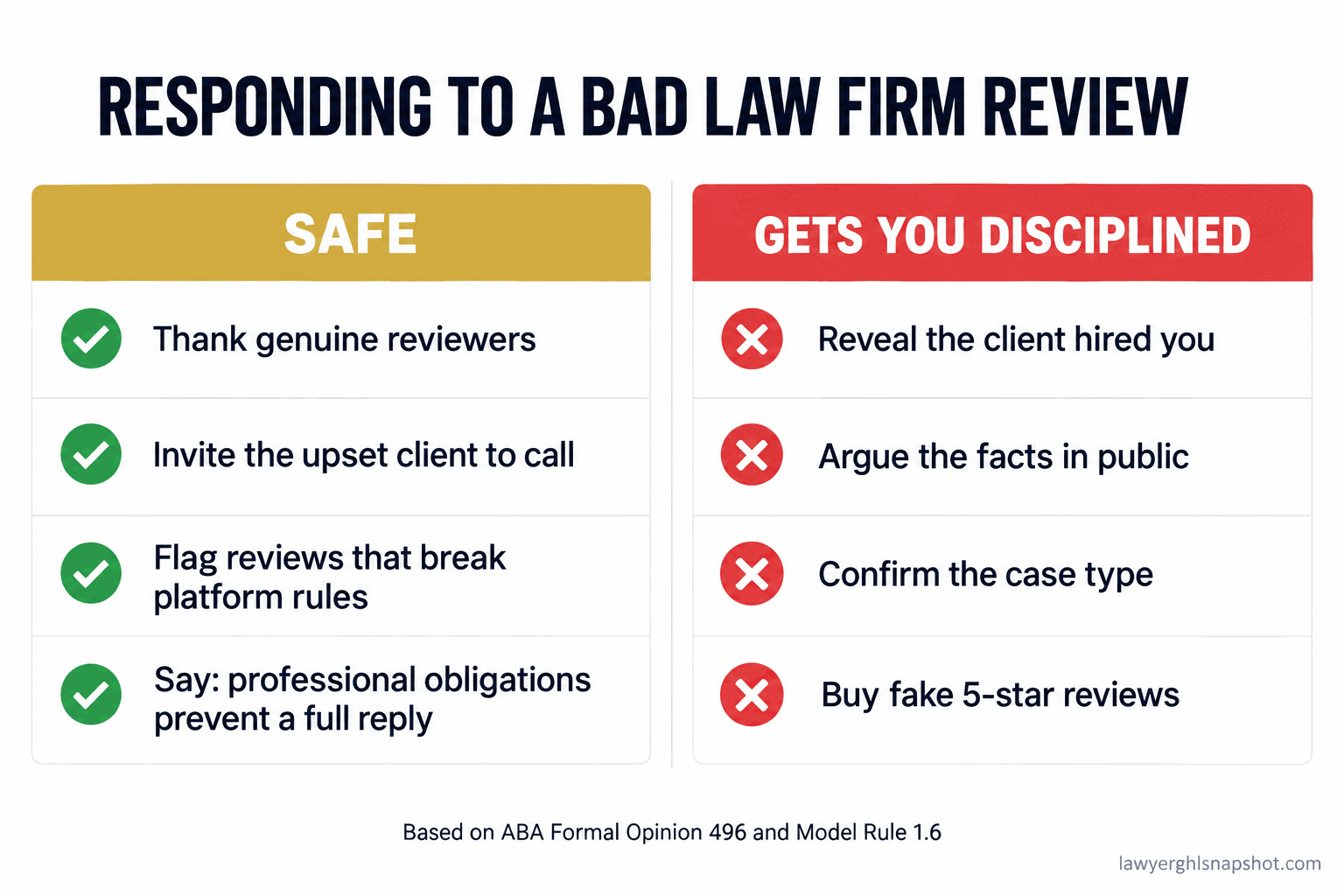
Do not touch the keyboard. For most lawyers, typing those facts in public is the fastest way to turn a bad review into a bar grievance.
Here is the short version. A negative review feels like a lie you are allowed to correct. Ethically, you usually are not. ABA Formal Opinion 496 says the duty of confidentiality in Model Rule 1.6 still applies even when the client went public first, and the self-defense exception does not cover an online review. So the whole game is protecting your reputation without saying anything about the representation. This guide gives you the exact copy for good reviews and bad, how to get a fake one pulled, and the system that handles it before you lose a night.
Key Takeaways
- You cannot explain your side in public. Rule 1.6 protects information about the representation, and ABA Opinion 496 says a review is not a “proceeding” or “controversy,” so the self-defense exception does not apply.
- Even confirming someone was a client can breach the rule, so a reply like “when I represented you” can be the disclosure.
- The safe public reply says nothing about the case. Opinion 496 blesses a version of “Professional obligations do not allow me to respond as I would wish,” plus an offline invitation.
- Reviews move clients: 57% of legal clients name them the top factor and 74% research a firm after a referral (Scorpion, 2025), so silence everywhere is not a strategy.
- Do not buy your way out. Fake reviews carry FTC civil penalties and are a Rule 7.1 problem on top.
Table of contents
- What a bad review actually costs your firm
- Why you cannot just explain your side
- The four-step review response system
- Steal this: the review response templates
- How to get a fake or abusive review removed
- Run the same system at three firm sizes
- How this breaks
- Common objections
- Frequently asked questions
What a bad review actually costs your firm
Reviews are not vanity. For a solo or small firm, your profile is often the deciding moment between a lead who calls you and one who calls the firm next door. The 2025 Scorpion Law Firm Search Trends Report found that 57% of legal clients named online reviews their top factor when choosing a firm, ahead of word of mouth, that 74% research a firm online even after a personal referral, and that more than half would not choose a firm below four stars.
So one angry one-star does damage in two directions: it drags your average toward the under-four line where leads stop calling, and it sits there as the most recent thing a nervous prospect reads before deciding whether to trust you. A firm that collects 93% of what it bills (Clio, 2025) can still starve if the top of the funnel dries up because the profile reads badly. That is the wrong lesson to take from Opinion 496: ignore the urge to argue, but not the profile.
Share of legal clients, 2025 (Scorpion Law Firm Search Trends Report, via Localogy).
Why you cannot just explain your side
The instinct that makes you a good advocate is the one that gets you in trouble here. The duty of confidentiality under Rule 1.6 covers all “information relating to the representation,” not just secrets or privileged material, and it does not switch off because the client spoke first. ABA Formal Opinion 496, from January 2021, closes the door on the one exception a lawyer might reach for: Rule 1.6(b)(5), self-defense, which lets you reveal information to establish a claim or defense in a controversy with a client or to respond to allegations in a proceeding. The opinion concluded that an online review is not a “proceeding,” that an informal post is not a “controversy between the lawyer and the client,” and that even if it were, a public reply is not reasonably necessary to defend yourself. So you are back to the plain rule: say nothing about the representation.
It goes further than most lawyers expect: the fact that a person was your client is often itself protected, so the reflexive opener “When I represented you in your divorce” can be the breach. The committee’s bottom line was blunt: the best response is often no substantive response at all.
When the poster is a current or former client, Opinion 496 offers a single safe public reply: a version of “Professional obligations do not allow me to respond as I would wish.” It says nothing about the matter, confirms nothing a stranger could use, and signals that you keep confidences even when provoked. That restraint is itself good marketing.
A few states are more generous: the committee flagged D.C. and Colorado guidance giving lawyers more room to correct the record. Check your own state before you assume the national default binds you.
The four-step review response system
You do not want to make these decisions at 11pm with your blood up. Build the system once, and most reviews get handled in under two minutes.
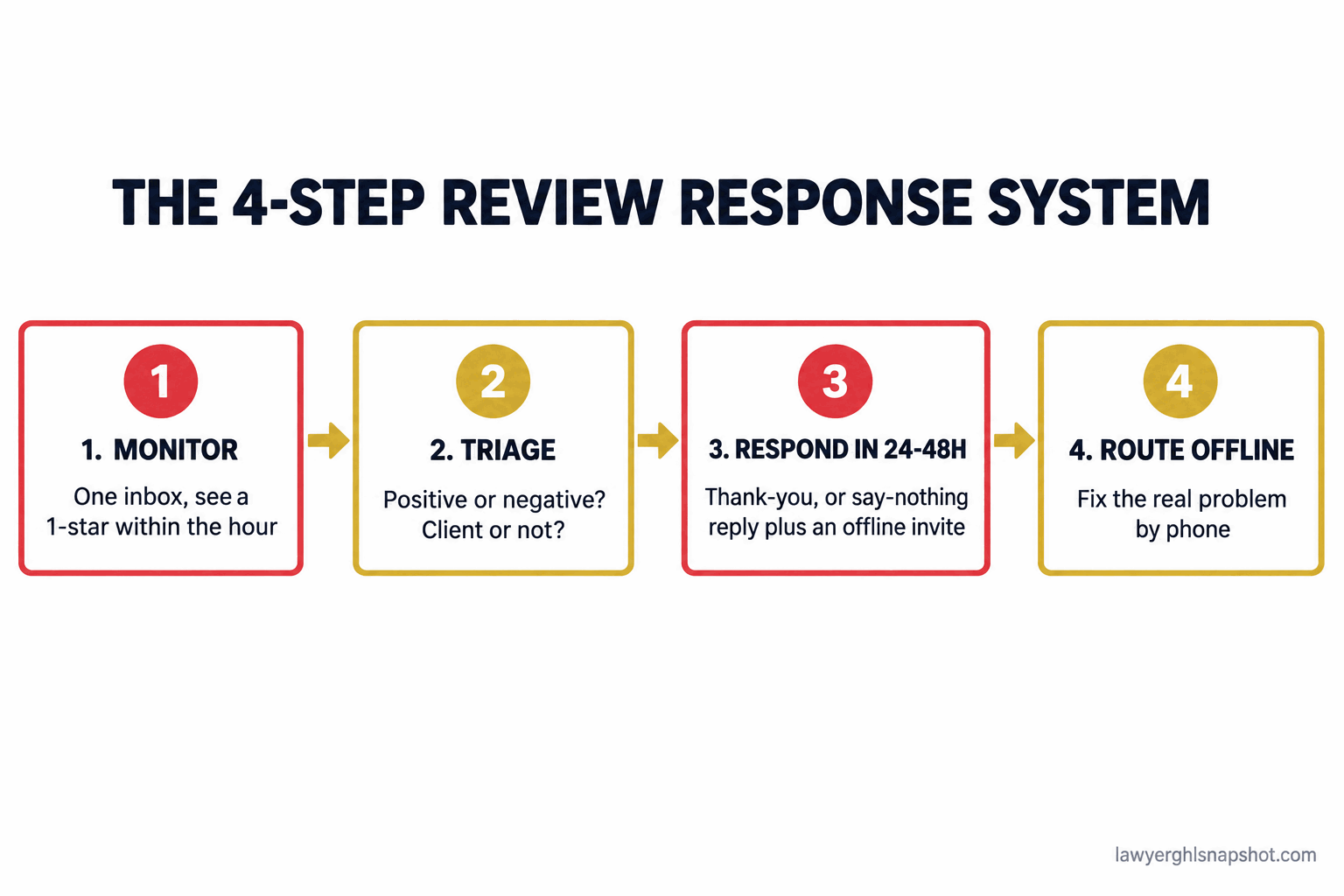
Step 1: Monitor. Turn on Google Business Profile notifications and route every new review into one place, star rating in the subject, so you see a one-star within the hour, not three weeks later when a prospect mentions it.
Step 2: Triage by two questions. Is it positive or negative, and can you confirm the poster was a client, or not (an unknown name, a competitor, an opposing party)? Those two answers pick your template. When you are unsure whether a negative poster was ever a client, treat them as if they were.
Step 3: Respond within 24 to 48 hours. Positive reviews get a warm, specific, no-detail thank-you. Negative reviews get the short, say-nothing reply plus an offline invitation. Both should sound like a person, not a form.
Step 4: Route the real conversation offline, and fix the cause. The public reply is for the next reader, not the reviewer; the actual problem gets solved by phone, where confidentiality is intact. If the same complaint keeps recurring, the review is flagging a leak worth closing: poor client communication is behind a huge share of one-stars and bar grievances alike.
Steal this: the review response templates
Here is the copy. Keep it where your front desk can reach it, edit the bracketed parts, and never add a sentence that touches the facts of a matter.
That block is the asset. Most firms have none of it written down, so a bad review becomes an hour of agonized drafting. Saved, it is a ninety-second, zero-disclosure routine.
How to get a fake or abusive review removed
Not every bad review is a disappointed client. Some are competitors, opposing parties, or a stranger who never walked through your door. When a review breaks the platform’s rules, the move is not to reply, it is to get it taken down.
Google’s rule matters most for law firms and it is simple: Google removes content that violates its policies, not content you merely dislike. Reviews get pulled for being a fake or non-genuine experience, a conflict of interest (a competitor or disgruntled former employee), off-topic, harassment, or revealing personal information.
One thing you must never do is manufacture good reviews to bury the bad one. Since October 2024 the FTC’s rule on fake reviews bans buying, selling, or writing fake or AI-generated reviews, with civil penalties that started at $51,744 per violation, and fabricated reviews are also a misleading communication under Rule 7.1. The compliant way to raise your average is to ask every satisfied client for an honest review consistently, which drowns the occasional one-star in real ones.
Run the same system at three firm sizes
The rules do not change with headcount, but who does the work and where it breaks does.
Who owns review response at each firm size
| Plan | Solo | 5-Attorney Firm recommended | 15-Attorney Firm |
|---|---|---|---|
| Price | You, in 10 min/week | Front desk + lawyer sign-off | Marketing/ops owns it |
| Feature 1 | Notifications to your phone; you respond personally | Office manager drafts from templates; attorney approves negatives | Central inbox, SLA on response time, monthly review report |
| Feature 2 | Risk: emotional late-night replies with no system | Risk: staff 'helpfully' confirms the client or the case type | Risk: generic replies that read like a bot, slow routing |
| Feature 3 | Fix: save the templates, sleep on anything one-star | Fix: written rule that only the safe line goes public | Fix: named owner, 24-48h SLA, quarterly template refresh |
The solo risk is emotional (you hold the posting access at midnight, so anything under three stars waits until morning). The five-attorney risk is delegation without guardrails, where a well-meaning paralegal writes “We represented you in your bankruptcy and did everything right,” and that one sentence is the breach. The fix scales: a written rule that only the approved say-nothing line ever goes public, a named owner, and a response target everyone keeps.
How this breaks
The failures here are predictable, and every one is avoidable.
The public rebuttal. You answer the facts, and now you have confirmed the person was a client, named the matter, and handed a bar investigator a written confidentiality breach with your signature on it. This is the one that turns a marketing problem into a discipline problem. Never correct the record in public.
The confirm-by-accident. “We are sorry your case did not resolve the way you hoped” feels harmless and is a disclosure: you just told the world this person had a case with you and lost. A thin-skinned “we stand by our work” is almost as bad, reading as combative to a prospect who is not on anyone’s side yet. Scrub every reply for anything a stranger could infer, and for defensiveness.
The silent profile. The opposite failure: a firm so scared of the wrong word that it never thanks a happy client or flags a fake one. The one-stars sit unanswered, and prospects read that as a dead firm. Responding to positives is safe and expected, so do it.
The bought reviews. A firm panics and buys a pack of five-stars or posts under fake names. That is now an FTC violation and a Rule 7.1 problem, platforms detect the pattern, and the cure is worse than the disease.
The slow response. A one-star that sits for three weeks is three weeks of prospects reading it as the latest word on your firm. Post the safe line fast.
Common objections
“If I say nothing, people will think the review is true.” Not if your reply is the Opinion 496 line. “My ethical obligations prevent me from discussing any representation publicly” tells the reader exactly why you are not rebutting, and most people respect a lawyer who keeps confidences. The dignified non-answer beats the thin, defensive rebuttal.
“My state lets me respond under self-defense.” Maybe. A few jurisdictions, including D.C. and Colorado guidance the ABA cited, give lawyers more room. That is a reason to read your own state’s rule, not to assume you are covered.
“I do not have time to watch reviews all day.” You do not need to. With a review automation system, a new review pings one inbox, the thank-you replies are near-automatic, and only the rare negative one needs your eyes. Ten minutes a week.
“Can I just ask the client to take it down?” Politely and offline, yes, but you cannot condition anything of value on it. A refund or discount in exchange for removing a review is its own ethics and FTC problem. Fix the underlying issue first; a satisfied client often updates it on their own.
Frequently asked questions
Can a lawyer respond to a negative online review at all?
Yes, but only in a way that reveals nothing about the representation. ABA Formal Opinion 496 says the duty of confidentiality in Rule 1.6 still applies and the self-defense exception does not cover an online review, so you cannot explain your side. The safe move is a short reply noting that professional obligations prevent you from discussing any matter publicly, plus an invitation to talk offline.
Why can't I just correct the facts if the review is a lie?
Correcting the facts means revealing information about the representation, which Rule 1.6 protects even when the client posted first. Opinion 496 found that an online review is not a 'proceeding' or 'controversy' that triggers the self-defense exception, and that a public reply is not reasonably necessary to defend yourself. Handle the facts offline, never in the review thread.
Does confidentiality apply if the reviewer only consulted me and never hired me?
Often yes. Information from a prospective client can be protected too, and in many situations even confirming that someone consulted or hired you is itself confidential. When you cannot be sure, treat the poster as a client and use the say-nothing reply.
How do I get a fake or competitor review removed from Google?
Open the review, use the three-dot menu, choose 'Report review,' and select the policy category that fits, usually 'Not a real experience' or 'Conflict of interest.' Explain why it cannot be a genuine client without revealing confidential information, and use your one appeal in the Business Profile tool if Google declines. Google removes policy violations, not reviews you simply dislike.
Is it legal to pay for or incentivize five-star reviews to offset a bad one?
No. Since October 2024 the FTC's rule bans buying, selling, or writing fake or AI-generated reviews, with civil penalties that started at $51,744 per violation, and fabricated reviews are also a misleading communication under Model Rule 7.1. The compliant path is to ask every satisfied client for an honest review consistently, so real reviews outweigh the occasional negative one.
A bad review is not the emergency it feels like at 11pm. The emergency is responding the way your advocate’s brain wants to, in public, with the facts. Build the system once, save the templates, let a happy-client review request run in the background, and the next one-star becomes a ninety-second task instead of a sleepless night. The lawyers who get disciplined over reviews are almost never the ones who stayed quiet.