A past client calls on a Tuesday and says, “My neighbor Dave told me to call you.” You take the case. By quarter’s end you have signed a dozen clients who all arrived the same way, through someone who already trusted you.
Now answer one question: which referral source sent you the most signed cases and collected revenue this year? If you cannot answer that in under a minute, you are flying blind on your largest channel, and probably spending on the sources that look busy instead of the ones that pay.
Referrals are the number one source of new business for most firms. In the Martindale-Avvo Business of Your Practice survey, 70.8% of attorneys named referrals their primary source of new clients (Martindale-Avvo, 2025). Yet almost nobody tracks referrals the way they track ad spend. This guide fixes that with a six-stage system you can run on tools you already own.
Key Takeaways
- Referrals are the biggest channel and the least measured. Most firms can quote their cost per click but cannot name the referral source that signed the most cases.
- One captured field changes everything. Record how every new matter found you, at first contact, and you can finally see which sources sign and which just make noise.
- You do not need an expensive legal CRM. A disciplined spreadsheet or a flat-fee automation platform tracks referrals fine. Per-seat tools like Clio and Lawmatics bundle it into a bill that scales with headcount.
- Referrals have ethics rules. ABA Model Rule 7.2 bars paying for a recommendation and bans fee-sharing with non-lawyers. Track and thank, never pay per referral.
Table of contents
- Why referrals are your firm’s biggest blind spot
- What untracked referrals actually cost you
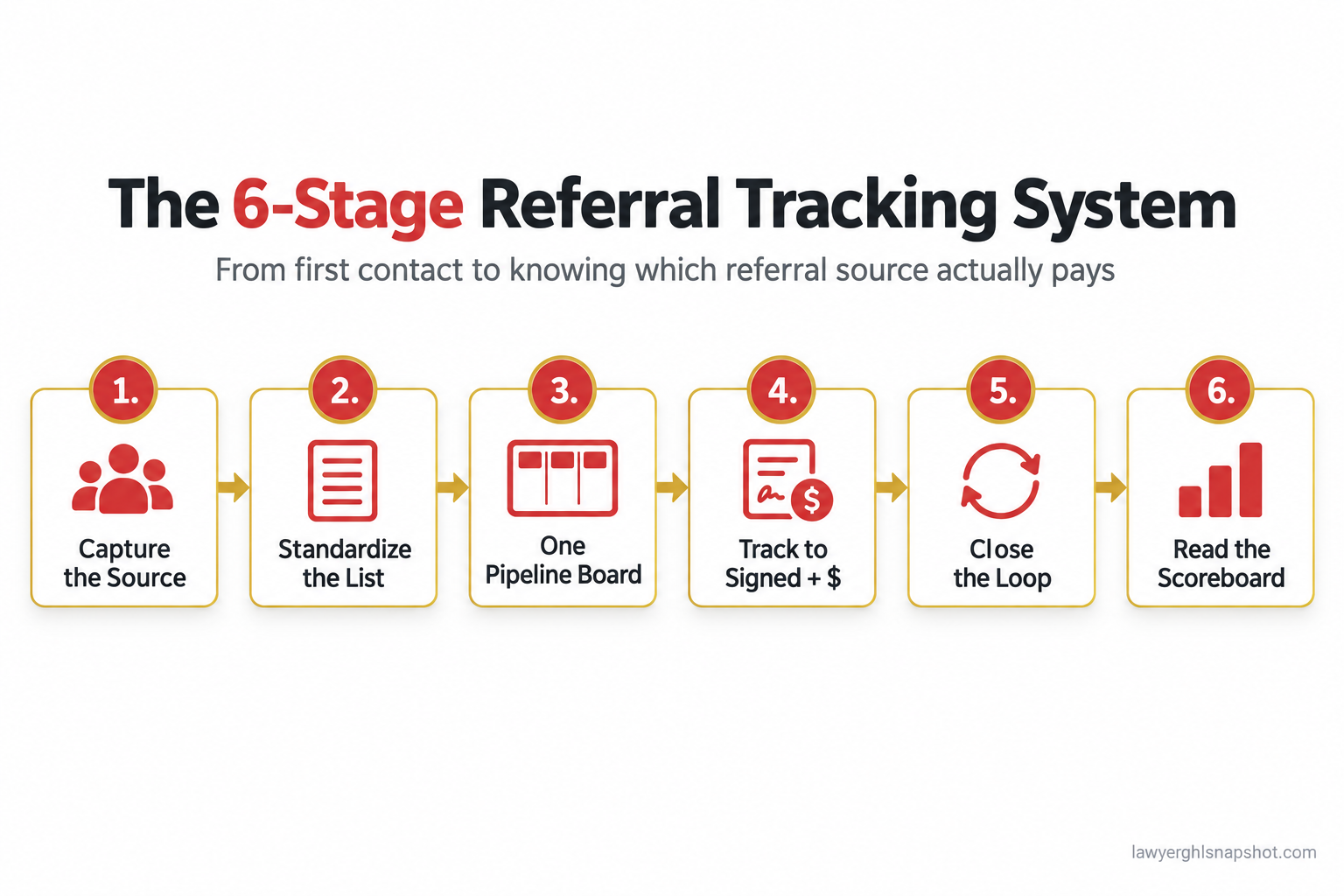
- The 6-stage referral tracking system
- Where should referral tracking actually live?
- The same system for a solo, a 5-attorney, and a 15-attorney firm
- The referral rules that keep your license
- Common objections
- Frequently asked questions
Why referrals are your firm’s biggest blind spot
Referrals are the channel owners trust most and measure least. You scrutinize a Local Service Ads invoice line by line, then a referral walks in worth $40,000 in fees and you log it as “word of mouth.”
Part of this is that referred clients rarely announce themselves cleanly. 74% of legal clients still research a firm online after getting a referral (report via PR Newswire, 2025), and 45% check the firm’s website before they ever call (Martindale-Avvo). So the referral Dave sent arrives through a Google search for your name and gets logged as “organic.” The credit goes to the wrong place, and Dave never gets thanked.
That misattribution is the whole problem. When you cannot see where signed cases come from, you keep funding channels that generate volume instead of value, you let your best referrers go unthanked so the pipeline “runs hot and cold,” and you cannot answer the one question that should drive your budget: if I had one more hour and one more dollar this month, where would they go?
What untracked referrals actually cost you
The cost never shows up on a bill. It is a set of quiet, compounding mistakes.
Start with misallocated spend. Your Google Ads are measurable, so they get the budget. Your referrals are invisible, so they get nothing. But if you tracked signed cases by source, you might find two referring attorneys quietly send your highest-value matters while the ads deliver tire-kickers.
Then there is referrer neglect. A referral relationship is a trust account, and every time someone sends you a client and hears nothing back, the balance drops. Send enough silence and the referrals stop. That hot-and-cold pipeline is almost always a tracking failure, not a reputation problem. Firms that cannot measure referrals cannot grow them on purpose, while they can quote their paid cost per lead to the dollar.
The 6-stage referral tracking system
You do not need new software to start, just a repeatable system and the discipline to run it. Here are the six stages, each with the setup, the copy, and the way it breaks.
Stage 1: Capture the source at first contact
The system lives or dies on one field: how did this person find us? Captured at first contact, before everyone forgets to ask.
The failure is universal. The attorney takes the call, gets absorbed in the facts, signs the client, and never records the source. Or the front desk types “a friend,” “online,” “not sure.” The fix is a scripted question with a required answer, mapped to a fixed list, asked every time.
Stage 2: Standardize your source list
If everyone logs sources in their own words, you end up with forty variations of the same five things and no way to total them. “Atty referral,” “lawyer sent them,” and “another attorney” are one source typed three ways. Lock the list first. For most small firms, six to eight buckets cover everything:
- Past client
- Another attorney
- Friend or family of a client
- Professional (doctor, chiropractor, financial advisor)
- Google / web search
- Paid ads (LSA, Google, social)
- Local networking / community
- Other (with a required note)
The failure mode is scope creep. Someone adds a ninth and tenth bucket, then a one-off for a person, and within a quarter the list is noise again. Keep it short and fixed, and put the specific referrer’s name in a separate field, not a new category.
Stage 3: Put every referral on one pipeline board
A source captured in five different places is a source you cannot read. Pick one home for every new matter and its source: one board, every lead, no exceptions.
Minimum columns: date, name, source bucket, referrer name, practice area, status, matter value, date signed. Eight columns answer every question that matters.
The failure here is the “I’ll add it later” lie. Leads on sticky notes and in text threads never make it onto the board, and the ones that do are the easy ones, which skews everything. The fix: a lead is not intake-complete until it is logged.
Illustrative referral pipeline for one small firm over a single quarter. Once referrals sit on one board, you can see where they fall out and fix that stage instead of guessing.
Stage 4: Track each referral through to signed and dollars
Counting referrals is where most firms stop, and it is the least useful number. Fourteen referrals that sign one case is worse than four that sign three. Carry every referral through to two outcomes: did it sign, and what was it worth.
Add a status that moves through clear stages (new, contacted, consult booked, signed, declined) and a matter-value figure when it signs. Now the board does real work: you can total signed cases, revenue, and conversion rate by source. The source that signs one low-value case in ten drops where it belongs, and the attorney who sends three high-value matters rises to the top.
The failure mode is stopping at “contacted,” which leaves your conversion math garbage. Close every record, even the losses, with a reason. Speed matters too, so pair this with your speed-to-lead process and your intake workflow.
Stage 5: Close the loop with the referrer
This stage turns tracking into more referrals, and almost everyone skips it. When a referral comes in, the referrer should hear from you fast and warm, and again when it signs or resolves well. Silence is what makes a pipeline run cold.
The failure mode is the “I’ll reach out when I get a minute” trap. You never get the minute, the referrer assumes their recommendation vanished, and they stop sending. The fix: automate the acknowledgment, keep the deeper relationship personal.
Stage 6: Read the scoreboard and double down
Once a quarter, read the board as a scoreboard. Sort sources by signed cases and revenue, not volume. The picture is almost always different from what you expected, and that difference is the entire payoff.
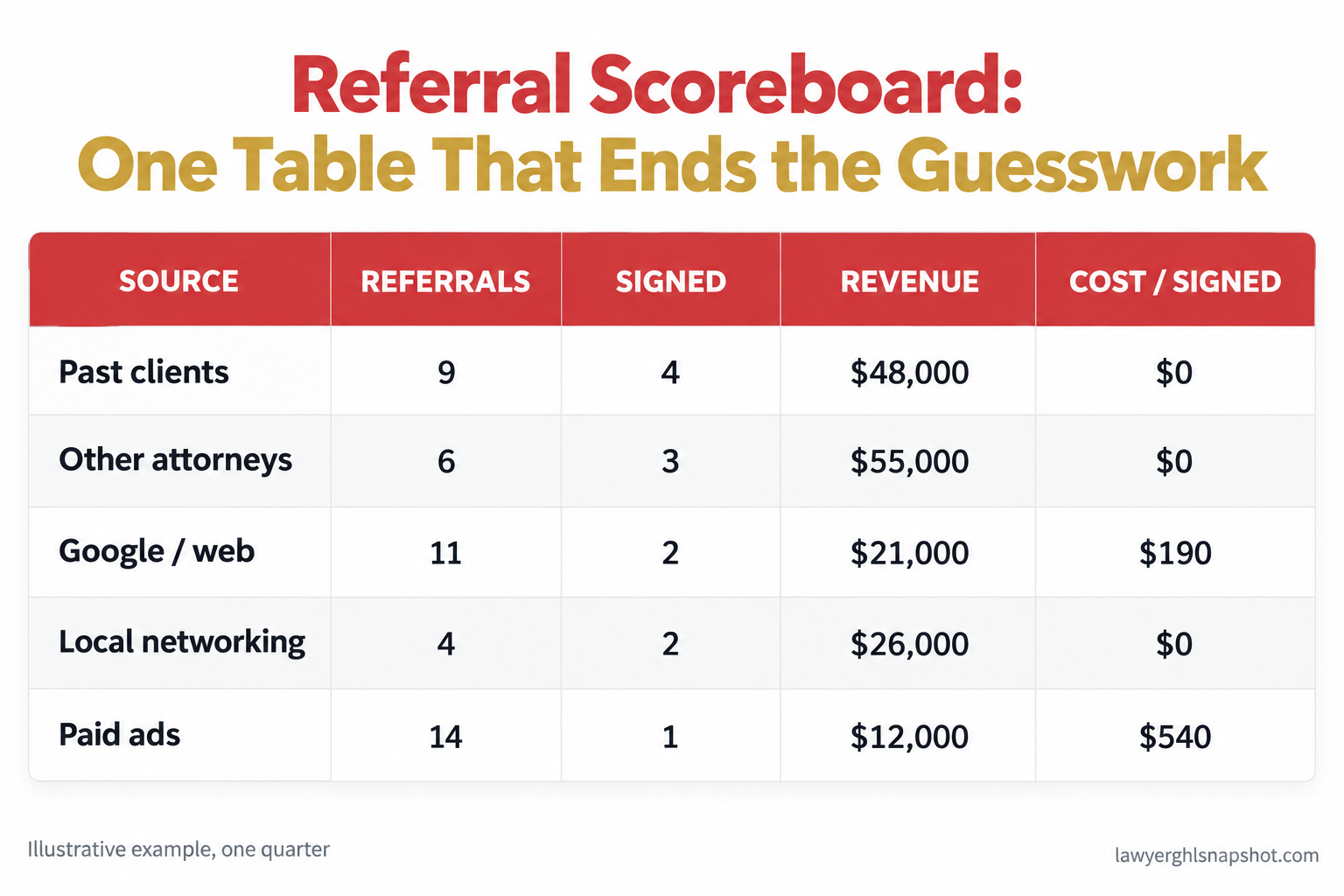
Now you act. Pour time into the two sources that produce the most signed revenue, fix or cut the source that generates volume but no value, and reach out personally to the people who sent your best cases. The failure mode here is treating the scoreboard as a report instead of a to-do list. One decision per quarter, made from real numbers, compounds fast.
Where should referral tracking actually live?
You have three realistic homes for this system, and the right one depends on your size and headcount.
Where to run law firm referral tracking (2026)
| Plan | Spreadsheet | Legal CRM | Automation platform recommended |
|---|---|---|---|
| Price | $0 | $49–$199 / user / mo | flat monthly |
| Feature 1 | Free and fully under your control | Clio, MyCase, PracticePanther, Lawmatics | GoHighLevel-style: one flat fee, not per seat |
| Feature 2 | Fine for a solo or under ~20 leads/month | Referral tracking bundled with case management | Source capture, pipeline, and auto thank-yous in one place |
| Feature 3 | No automation: every thank-you is manual | Cost scales with every attorney you add | Triggers follow-up without manual chasing |
| Feature 4 | Breaks down as volume and staff grow | Lawmatics starts at a 3-user minimum | Doubles as intake, booking, reactivation |
Legal CRMs are not bad. Clio and MyCase are strong case managers; see the best Clio alternatives for small firms if that is your call. The point is that you are probably already paying for referral tracking inside a per-seat bill that grows every time you hire. Here is the per-user math for a four-attorney firm.
Annual cost for a 4-attorney firm at each tool’s published per-user rate (PracticePanther, Clio, MyCase, Lawmatics via Capterra, 2026). Referral tracking is one bundled feature inside these bills, and the bill scales with headcount.
If you want tracking, intake, booking, and follow-up on one flat-fee platform instead of a per-seat case manager, that is the GoHighLevel approach, and it is what our GoHighLevel development for law firms work is built around. You can also start a GoHighLevel trial yourself. (Disclosure: that is our affiliate link and we may earn a commission if you sign up, at no extra cost to you.)
The same system for a solo, a 5-attorney, and a 15-attorney firm
The six stages do not change with size. What changes is who runs them and how much automation earns its keep.
The solo. You are intake, attorney, and marketing department, and your enemy is forgetting. A spreadsheet is genuinely fine, but the source field has to become a reflex on every call. Your best move is Stage 5, the thank-you, since your referrers are mostly past clients. Ten minutes every Friday updating the board and sending that week’s thank-yous is the whole program.
The 5-attorney firm. Now the problem is consistency: five attorneys mean five ways of not logging the source. You need one shared board and one owner, usually an office manager, who enforces that no matter opens without a source. This is where a spreadsheet cracks and automation pays. Automate the same-day acknowledgment, keep the outcome note personal, and read the scoreboard as a leadership exercise.
The 15-attorney firm. Here referrals are real revenue and untracked referrals are real losses, well into six figures a year. Pipeline, automation, and reporting all have to be systematized, because no discipline survives fifteen attorneys relying on memory. The scoreboard becomes a standing agenda item, referrer relationships get owners, and sequences run automatically with personal touches for top sources. This is also where database reactivation overlaps, since your past-client list is both your biggest referral source and your biggest reactivation opportunity.
The referral rules that keep your license
Tracking referrals is not just an operations question. The moment money or reciprocity enters, it becomes an ethics question, and a well-meaning marketing idea can turn into a bar complaint. Read this before you build any “referral reward” program.
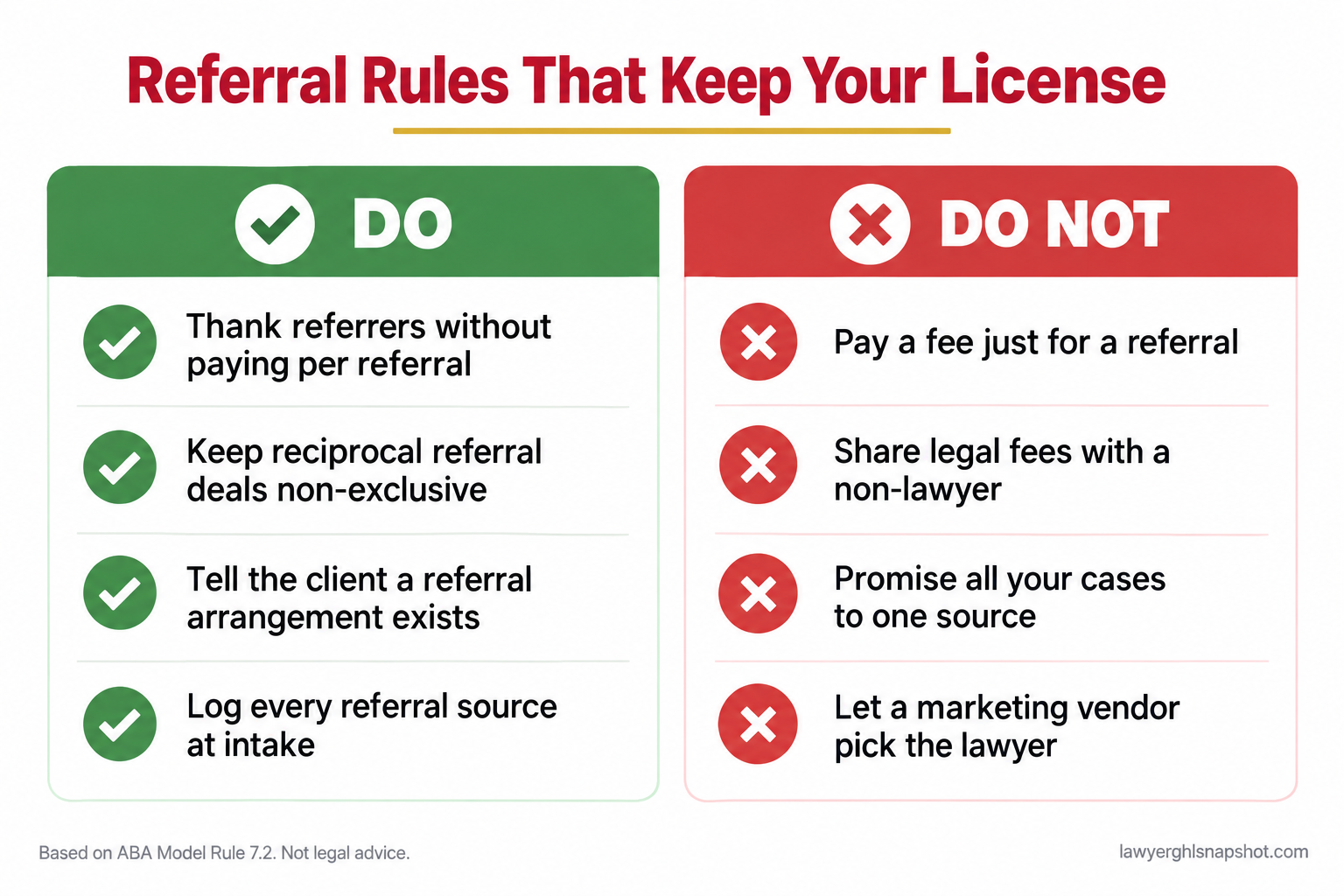
The governing rule is ABA Model Rule 7.2, adopted in some form by most states. Three things matter here.
First, you generally may not give anything of value for recommending your services. A per-referral cash “thank you,” a gift card for every case sent, a kickback to a chiropractor who steers clients: all of that runs into the rule. Thanking a referrer warmly is fine. Paying per referral is not.
Second, reciprocal referral arrangements are allowed only if they are not exclusive and the client is told. Under Rule 7.2(b)(4), you can agree to refer clients to another lawyer or professional who refers to you, as long as the arrangement is nonexclusive and your client knows it exists.
Third, fee-sharing with non-lawyers is broadly banned. Marketing vendors routinely propose revenue-share deals, taking a cut of fees from cases they send. In most states that is prohibited, which is why a flat-fee arrangement is the clean structure and a “pay per signed case” deal with a non-lawyer vendor is not.
Common objections
“Putting referrers in a spreadsheet feels cold.” The alternative is forgetting the people who send you your best work. Tracking is not transactional. Silence is. The system exists so the attorney who sent you a $60,000 case gets a thank-you instead of vanishing into your memory.
“I already pay for Clio or MyCase.” Then you may not need anything else. If your case manager has a working intake pipeline and you use the source field on every matter, run it there. The catch: most firms pay for that capability, never turn it on, and the cost scales per seat either way.
“I’m not technical. This sounds like a project.” The hard part is not the tool. It is the habit of asking one question on every call and writing the answer in one place. You can start this afternoon in a spreadsheet. The discipline, not the software, delivers the result.
“My referrals are all word of mouth.” That belief is what keeps the channel invisible. “Word of mouth” is five or six relationships producing very different results. Tracking turns it into “past clients signed four, referring attorneys signed three, and the networking group signed none.”
Frequently asked questions
What is law firm referral tracking?
Referral tracking is recording where every new client came from at first contact, mapping it to a fixed list of sources, and following each referral through to whether it signed and what it was worth. It turns 'we get a lot of referrals' into a scoreboard showing which sources actually produce signed, paying cases, even though referrals are most firms' largest channel (Martindale-Avvo, 2025).
Do I need an expensive legal CRM to track referrals?
No. A disciplined spreadsheet with eight columns tracks referrals well for a solo or small firm, and a flat-fee automation platform handles it at scale without per-seat pricing. Legal CRMs like Clio, MyCase, PracticePanther, and Lawmatics include referral tracking, but you pay per user, so the cost grows with every attorney (Clio, Lawmatics, 2026). The limiting factor is almost never the software. It is whether someone captures the source on every matter.
Can I pay someone for referring clients to my law firm?
Generally no. ABA Model Rule 7.2 bars giving anything of value for a recommendation of your services, and fee-sharing with non-lawyers is broadly prohibited (ABA). You can thank referrers warmly and maintain nonexclusive reciprocal referral arrangements with other lawyers if the client is informed, but paying a per-referral fee or a cut of fees to a non-lawyer vendor usually violates the rules. Confirm your state's exact version first. This is operations guidance, not legal advice.
How often should I review referral data?
Review the pipeline weekly for follow-up and thank-yous, and read the full scoreboard once a quarter for strategy. The weekly pass keeps referrals from going stale and makes sure every referrer gets acknowledged. The quarterly review is where you sort sources by signed revenue and decide which relationships to invest in.
Why do referred clients still show up as 'Google' in my analytics?
Because most referred clients research you online before calling. About 74% research a firm after a referral and roughly 45% visit the website first (PR Newswire, Martindale-Avvo). So a referral arrives through a branded Google search and your analytics credits 'organic search,' not the person who sent them. The fix is to ask at intake and, when someone says they Googled you, ask whether anyone recommended they look.