Does your law firm need custom GoHighLevel development?
You need custom GoHighLevel development when the off-the-shelf platform — or a stock snapshot — can no longer keep up with how your firm actually runs. In practice that means four things: GoHighLevel won’t sync cleanly with your case-management system, so your team re-keys the same client twice; its drag-and-drop workflow builder can’t model your matter logic (statute-of-limitations deadlines, lien tracking, conflict checks); no dashboard shows your real numbers across GHL, your ad platforms, and your case files; and you’ve bolted on so many disconnected tools that the “system” is really a stack of silos held together by copy-paste. Custom GHL development closes those gaps with API integrations, custom-coded workflows, and reporting built around your practice — not a template’s assumptions.
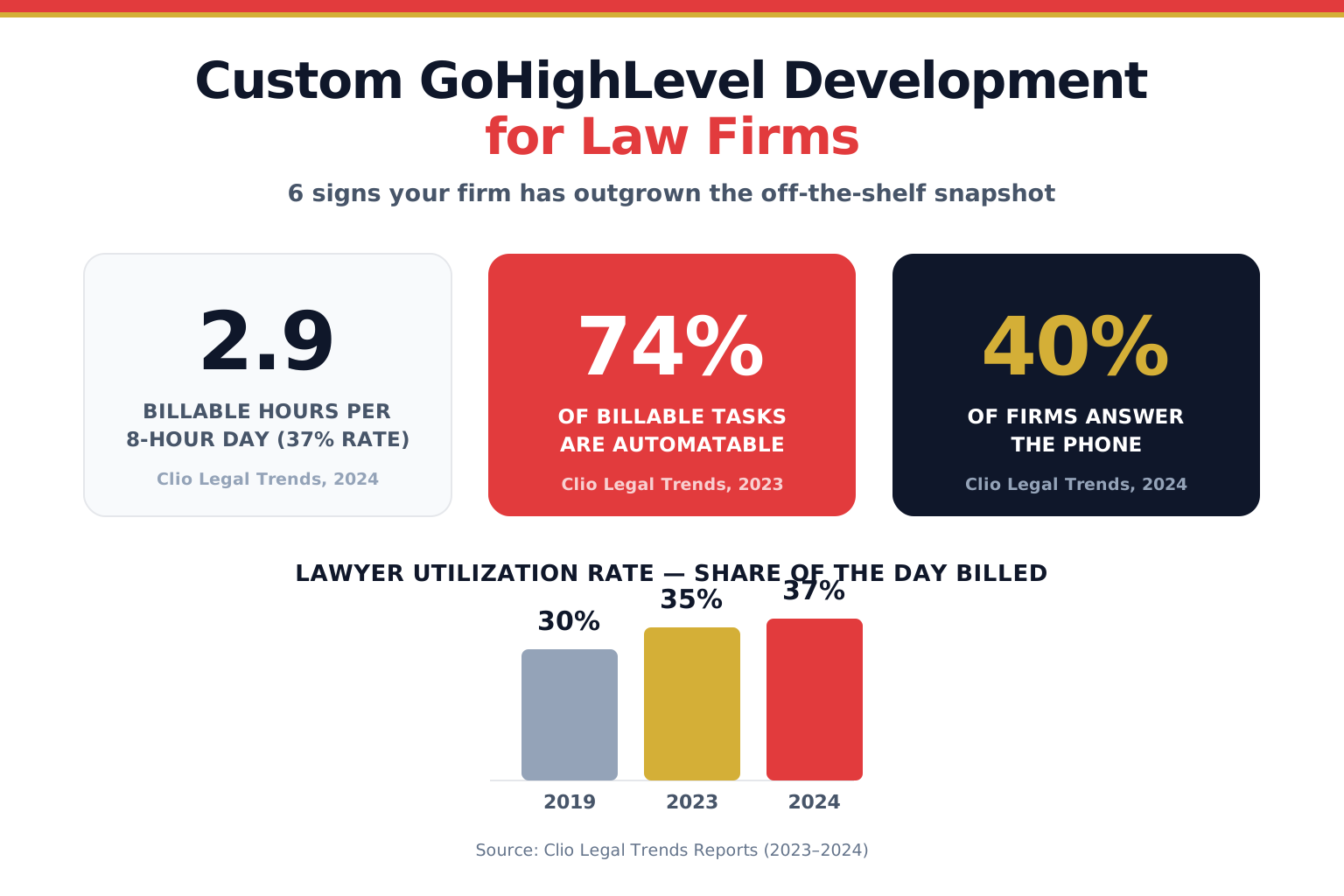
That gap is expensive, and the data shows why. The average lawyer records just 2.9 billable hours in an 8-hour workday — a 37% utilization rate, which means roughly five hours a day disappear into non-billable work like admin and data entry (Clio 2024 Legal Trends Report). A stock snapshot automates the easy 20% of that; the manual glue between your tools is where the other hours quietly go. When Clio analyzed millions of time entries, it found up to 74% of hourly billable legal work could be automated with today’s technology (Clio 2023 Legal Trends Report) — but only if your systems are actually wired together to do it.
This guide is written for two readers: the firm owner or operator who feels the friction every day but isn’t sure it’s fixable, and the agency deploying GoHighLevel for legal clients who keeps hitting the edge of what the platform does out of the box. We’ll walk the six signs you’ve outgrown off-the-shelf, what custom GHL development actually includes, what it costs, and how to decide.
Key Takeaways
- Off-the-shelf GHL automates the easy part; custom development closes the gaps. The average lawyer bills only 2.9 of 8 hours (Clio 2024), and much of the lost time is manual work between disconnected tools — exactly what a stock snapshot can’t reach.
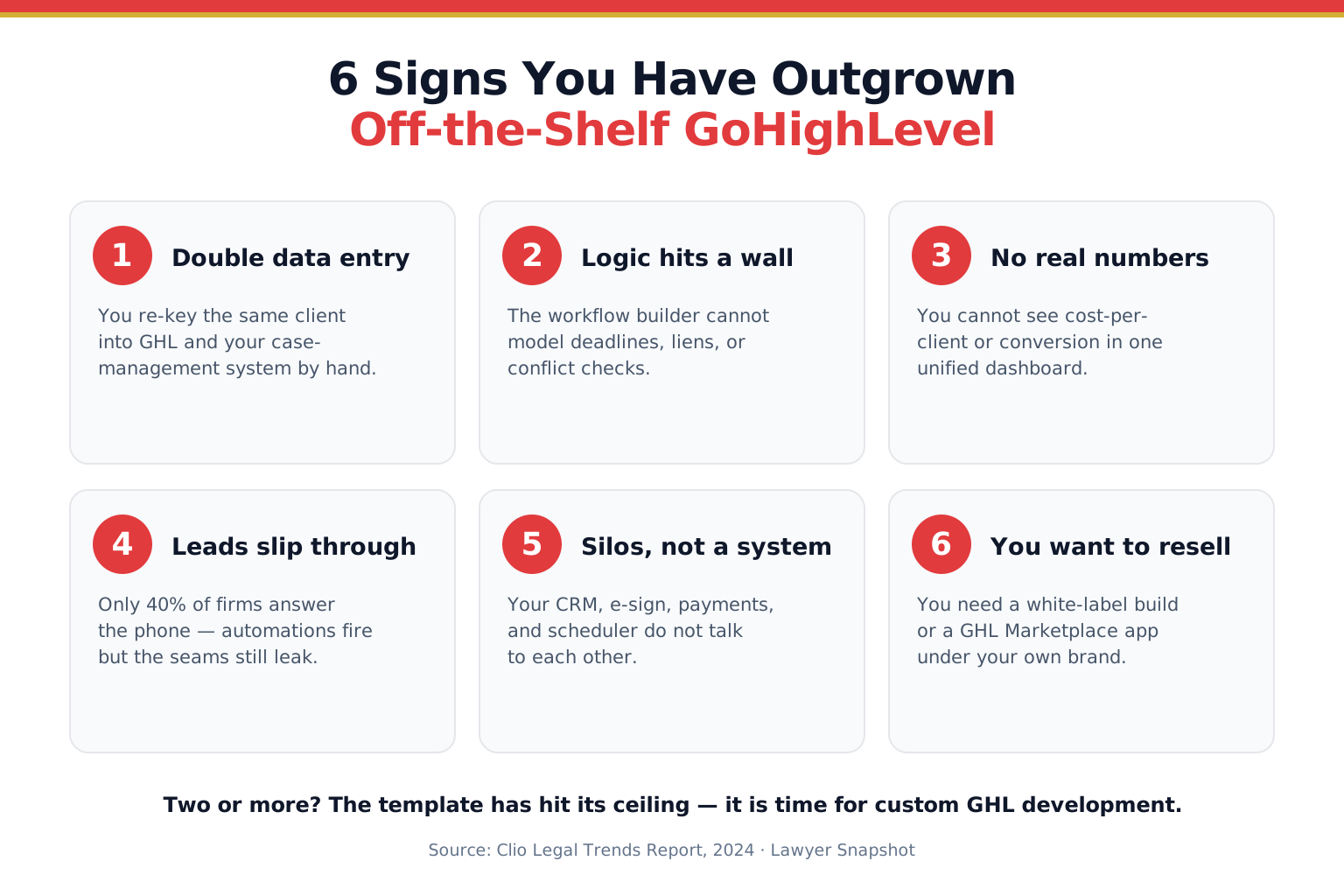
- Six signs you’ve outgrown the template: you re-key data between GHL and your case-management system; the workflow builder can’t model your matter logic; you have no unified reporting; leads still slip through intake; your tools don’t talk to each other; or you want to white-label / ship a Marketplace app.
- The automation wave is real and fast. AI use among legal professionals jumped from 19% in 2023 to 79% in 2024 (Clio 2024), and firm-level adoption rose from 11% to 30% (ABA 2024 Legal Technology Survey). Firms that wait keep paying the manual tax while competitors compound.
- The ROI is concrete. Thomson Reuters estimates each lawyer could save ~190 hours a year — about $100,000 in billable time — with AI and automation (Thomson Reuters, 2024).
- The fix is bounded, not a rebuild. Most firms don’t need to leave GoHighLevel — they need to extend it. Custom GHL development starts around $3K for a single integration and scales to full dashboards and portals, with fixed-price scopes and full IP ownership.
Table of contents
- Does your law firm need custom GoHighLevel development?
- What “custom GoHighLevel development” actually means
- The real cost of an off-the-shelf setup
- 6 signs you’ve outgrown off-the-shelf GoHighLevel
- Why firms are investing in automation right now
- Off-the-shelf snapshot vs. custom GHL development
- What custom GHL development costs
- Frequently asked questions
What “custom GoHighLevel development” actually means
GoHighLevel is a deep platform, and a good law firm snapshot gets a firm 80% of the way there out of the box — intake forms, pipelines and workflows, reminders, review requests, database reactivation. Custom GHL development is the other 20%: the code, integrations, and logic the drag-and-drop builder can’t produce on its own. It’s not “a different CRM.” It’s making the CRM you already run do the things your firm specifically needs.
In practice, custom GHL development for a law firm usually means one or more of these:
- API integrations — a live two-way connection between GoHighLevel and the tools that live outside it: your case-management system (Clio, MyCase, Filevine, PracticePanther), e-signature, court-calendaring, accounting, or a payment processor. This is what kills double data entry.
- Custom workflow logic — automations too conditional for the visual builder: statute-of-limitations countdowns, multi-party personal-injury matters, lien and medical-record tracking, conflict checks, or bilingual routing rules.
- Custom objects and portals — data structures GHL doesn’t ship (a “matter” with lien status and treatment stage) and client- or referral-facing front ends wired back into your workflows.
- Reporting dashboards — a single real-time view that pulls from GHL and your ad platforms and case files: cost-per-retained-client by channel, consultation-to-retainer conversion, referral-source ROI.
- Migrations onto GHL — a clean, complete move from a legacy CRM or spreadsheet stack, with contacts, pipelines, tags, custom fields, and history brought across intact (covered step-by-step in our migration playbook).
- Marketplace apps and white-label builds — for agencies that want to package and resell a legal snapshot, or ship a private app inside the GHL Marketplace.
The real cost of an off-the-shelf setup
The reason “it mostly works” is so dangerous is that the cost of the missing 20% is invisible on any invoice. It shows up as time — the single most valuable thing a firm sells. Remember the number: 2.9 billable hours out of eight (Clio 2024). That utilization rate has crept up over the years as firms adopt technology, but it’s still low, and the biggest remaining drain is the manual work between systems that a stock automation setup never touches.
Average lawyer utilization rate (share of an 8-hour day actually billed), 2019–2024. It’s rising as firms automate — but a third of the day is still non-billable. Source: Clio Legal Trends Reports (2024).
Where does that non-billable time go? A large share is exactly the work custom development eliminates: re-typing a new client’s details from GHL into your case-management system, chasing a document that’s stuck in an inbox, assembling a status report by hand from three tools. Legal-tech professionals themselves name it: at ILTACon 2025, fragmented workflows, manual handoffs, and integration gaps between core systems ranked among the top operational pain points reported by legal IT teams (ILTA, via Workstorm, 2025).
This is why “add another app” usually makes the problem worse, not better. Each new tool you bolt on without integrating it is one more place data lives, one more login, one more manual sync. The stock snapshot solved the automations inside GoHighLevel; the friction has simply moved to the seams between GHL and everything else. Custom development is the work of sealing those seams.
6 signs you’ve outgrown off-the-shelf GoHighLevel
You don’t need to be a large firm to justify custom development — you need to recognize the signals. If two or more of these sound like your Monday morning, the template has hit its ceiling.
1. You’re re-keying the same data into two systems
The clearest sign. A prospect fills out your GHL intake form, and then a paralegal opens Clio or MyCase and types the same name, matter type, and contact details in again. Every duplicate keystroke is billable time spent on data entry, and every hand-copy is a chance for a transposed phone number or a mismatched matter. A custom API integration makes the two systems one source of truth: create the contact once, and it appears everywhere, updated in real time.
2. GHL’s workflow builder can’t model your matter logic
GoHighLevel’s visual builder is excellent for linear sequences — lead comes in, send a text, wait, remind. It struggles with the branching, date-math, and conditional logic real legal matters demand: a statute-of-limitations clock that drives escalating internal alerts, a personal-injury matter with multiple defendants and lien holders, a conflict check that has to run before intake proceeds. When you find yourself building fragile 40-step workflows to fake logic the builder wasn’t designed for, custom-coded automation is cheaper and far more reliable.
3. You can’t see your real numbers in one place
Ask most firm owners for cost-per-retained-client by channel, or consultation-to-retainer conversion this quarter, and you’ll get a shrug or a spreadsheet built by hand once a month. The data exists — it’s just scattered across GHL, Google Ads, your case-management system, and your accounting tool. A custom reporting dashboard pulls it into one live view so you can actually manage the firm by the numbers instead of by feel. This is often the single highest-ROI custom build, because it changes how you spend every marketing dollar.
4. Leads are still slipping through intake
If your automations are running but your booked-consultation rate is flat, the leak is usually at the human seams. The industry baseline is bleak: in Clio’s 2024 secret-shopper study, only 40% of firms answered the phone and 33% responded to an email inquiry from a prospective client (Clio 2024). A stock snapshot fires the reminders; custom development closes the specific gaps — routing an after-hours call to the right on-call attorney, escalating an unworked lead, syncing a booked consult back to your calendar of record. If speed is your problem, our guide to speed to lead for law firms shows why the first five minutes decide the client, and the legal intake process guide maps the full path.
5. Your tools don’t talk to each other
Every firm accumulates software: a CRM here, a case-management system there, e-sign, payments, a scheduler, a call tracker. Bought separately, they become silos. When the ILTACon data names integration gaps as a leading operational headache (ILTA, 2025), this is the day-to-day reality it describes. Custom GHL development turns the stack into a system: a signed retainer in one tool triggers the next step in another, automatically, with no one copying anything.
6. You want to white-label, resell, or ship a Marketplace app
This one is for agencies and multi-location operators. If you’re reselling GoHighLevel to law firm clients, a generic snapshot only gets you so far — the firms that stick want features that fit their practice, under your brand. Custom development lets you build a differentiated, white-labelable legal product, or ship a private GHL Marketplace app that becomes its own line of recurring revenue.
Why firms are investing in automation right now
The pressure to fix this isn’t theoretical — it’s a market shift happening fast. AI use among legal professionals leapt from 19% in 2023 to 79% in 2024 (Clio 2024 Legal Trends Report), one of the sharpest adoption curves any professional field has recorded. At the firm level, the ABA’s 2024 survey found adoption climbing from 11% to 30% overall — and from 16% to 46% at firms with 100 or more attorneys (ABA 2024 Legal Technology Survey).
Law firm AI adoption, 2023 vs. 2024 — overall and at firms with 100+ attorneys. Larger firms are automating fastest. Source: ABA 2024 Legal Technology Survey Report.
Investment intent backs it up: 58% of firms plan to increase their AI investment over the next three years (Wolters Kluwer 2024 Future Ready Lawyer Survey). And the payoff is quantified — Thomson Reuters estimates each lawyer could save roughly 190 work-hours a year, about $100,000 in billable time, by putting AI and automation to work on the non-billable load (Thomson Reuters Future of Professionals, 2024).
The takeaway isn’t “buy AI.” It’s that the firms pulling ahead are the ones connecting their systems so automation has something to run on. A stock snapshot is the on-ramp; custom development is how you keep compounding the advantage while competitors are still copy-pasting between tabs. If you’d rather someone own the platform day-to-day than build it yourself, a dedicated GHL VA can run the operations layer while your developer handles the code.
Off-the-shelf snapshot vs. custom GHL development
To be clear: this isn’t snapshot or custom. It’s snapshot then custom, where the numbers justify it. Here’s the honest side-by-side.
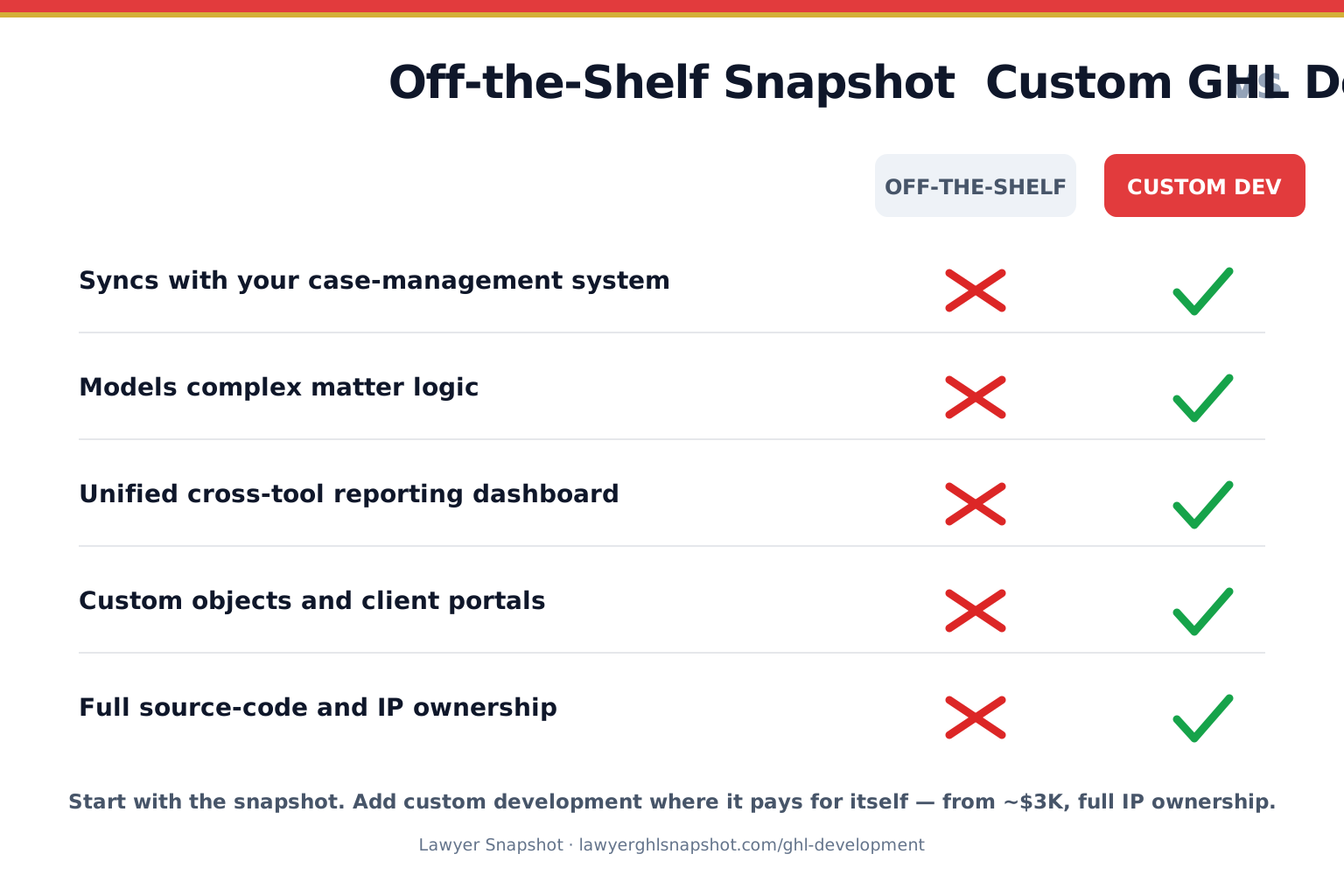
| Factor | Off-the-shelf snapshot | Custom GHL development |
|---|---|---|
| Setup speed | Fast — installed in days | Scoped project, weeks depending on complexity |
| Cost to start | Low, one flat install | From ~$3K per integration, scaling with scope |
| Case-management sync | Manual export/import | Live two-way API integration |
| Complex matter logic | Limited to the visual builder | Custom-coded, reliable at any complexity |
| Cross-tool reporting | Per-tool, assembled by hand | One real-time dashboard across GHL + ads + case files |
| Custom objects & portals | Not available | Built to your practice areas and matters |
| Ownership | You use the template | Full source-code / IP ownership |
| Best for | Getting live fast; most small firms | Firms hitting the template’s ceiling; agencies |
Off-the-shelf wins on speed and cost to start, and for a large share of firms the snapshot is genuinely all they need — if it fits, use it. The case for custom gets strong the moment the template forces your firm to work its way instead of yours: when integrations, matter logic, reporting, or a resale product is the thing standing between you and more signed clients. That’s the exact gap our GHL development team builds for — and if a build reaches beyond GoHighLevel entirely (a standalone portal or SaaS), that’s custom software territory, like the client portal a Chicago firm built.
What custom GHL development costs
Custom development is priced by scope, not by seat, and the range is wide because the work is. For our GHL development engagements, fixed-price scopes start around $3K for a single sync or migration, run $5K–$15K for custom AI legal intake, $15K–$40K for full dashboards and portals, and $25K+ for a GHL Marketplace app. Smaller, pay-as-you-go work is billed at $75/hour with no minimums, and every fixed-price build includes a 30-day bug-fix warranty and full IP ownership — you keep what you paid for.
For firms that want ongoing development plus day-to-day operations, the GHL Elite Expert + Dev plan ($1,500/month) pairs a full-time legal GHL specialist with a developer for custom code, API integrations, and maintenance — so you’re not choosing between “someone to run it” and “someone to build it.” Compare the options on the pricing page or hire a dedicated GHL VA if the operations layer is your bottleneck.
The way to think about ROI is the manual-hours trade. If a $3K–$8K integration removes even a few hours of re-keying and status-hunting a week, it pays for itself inside a year against a utilization rate where every recovered hour is billable — and then keeps paying, because you own the code and there are no per-seat fees stacking up as you grow.
Frequently asked questions
What is custom GoHighLevel development for a law firm?
It's the code, integrations, and logic that GoHighLevel's drag-and-drop builder can't produce on its own — layered on top of your existing GHL account or snapshot. For a law firm that typically means a two-way API sync with a case-management system (Clio, MyCase, Filevine), custom-coded workflow logic (statute-of-limitations tracking, multi-party matters, conflict checks), custom objects and client portals, cross-tool reporting dashboards, migrations onto GHL, or a white-label Marketplace app. It extends the platform you already run rather than replacing it.
How is this different from just installing a snapshot?
A snapshot is a pre-built template you install in days — it's the right starting point for almost every firm and covers roughly 80% of what you need out of the box. Custom development is the other 20%: the integrations, logic, and reporting the template can't reach. Most firms start with the snapshot and add custom development only where it pays for itself, such as eliminating double data entry or building a reporting dashboard.
Do I need custom development, or is my snapshot enough?
Look for the six signs: you re-key the same data into two systems; the workflow builder can't model your matter logic; you can't see your real numbers in one place; leads still slip through intake; your tools don't talk to each other; or you want to white-label or ship a Marketplace app. One sign is usually a workaround. Two or more is a pattern of manual work that a bounded custom build can remove — and a good partner will tell you honestly if the stock snapshot already covers your needs.
Can GoHighLevel really integrate with Clio, MyCase, or Filevine?
Yes. Through the GHL API and each case-management system's API, a custom integration can create and update contacts, matters, and tasks in both directions in real time, so a new intake in GoHighLevel appears in your case-management system automatically — no manual re-entry. The exact fields and triggers are defined during scoping to match how your firm works.
How much does custom GoHighLevel development cost?
Fixed-price scopes start around $3,000 for a single sync or migration, $5K–$15K for custom AI legal intake, $15K–$40K for full dashboards and portals, and $25K+ for a GHL Marketplace app. Smaller work is billed at $75/hour with no minimums. Every fixed-price build includes a 30-day bug-fix warranty and full IP ownership. Firms that want ongoing development plus operations can use the GHL Elite Expert + Dev plan at $1,500/month.
Will a custom build lock me in or break when GoHighLevel updates?
No. You receive full source-code and IP ownership on fixed-price builds, so you're never locked to a single vendor, and integrations are built against stable, documented APIs with a 30-day bug-fix warranty. For ongoing changes as GHL evolves, you can stay on an hourly retainer or the Elite Expert + Dev plan, but you own the software either way.
Marcus Trujillo is a Legal Intake & Automation Strategist at Lawyer Snapshot who spent nine years running intake and case-management operations for a multi-location firm before moving into legal-tech consulting. He designs GoHighLevel systems that capture after-hours leads and shorten the path from first call to signed retainer, and writes about the unglamorous mechanics of automation that quietly decide whether a firm grows or stalls. Lawyer Snapshot is a GoHighLevel automation and custom-software product for U.S. law firms — we are not a law firm and do not provide legal advice.
Related posts
- The Complete Guide to GoHighLevel for Law Firms
- How to Migrate Your Law Firm to GoHighLevel (From Clio, MyCase, or Lawmatics)
- Client Portals for Law Firms: Why Firms Build Custom Case-Status Software
- GoHighLevel AI Employee for Law Firms: What It Does and What It Costs
- Speed to Lead for Law Firms: Why the First 5 Minutes Win the Client