Do Chicago law firms need a client portal?
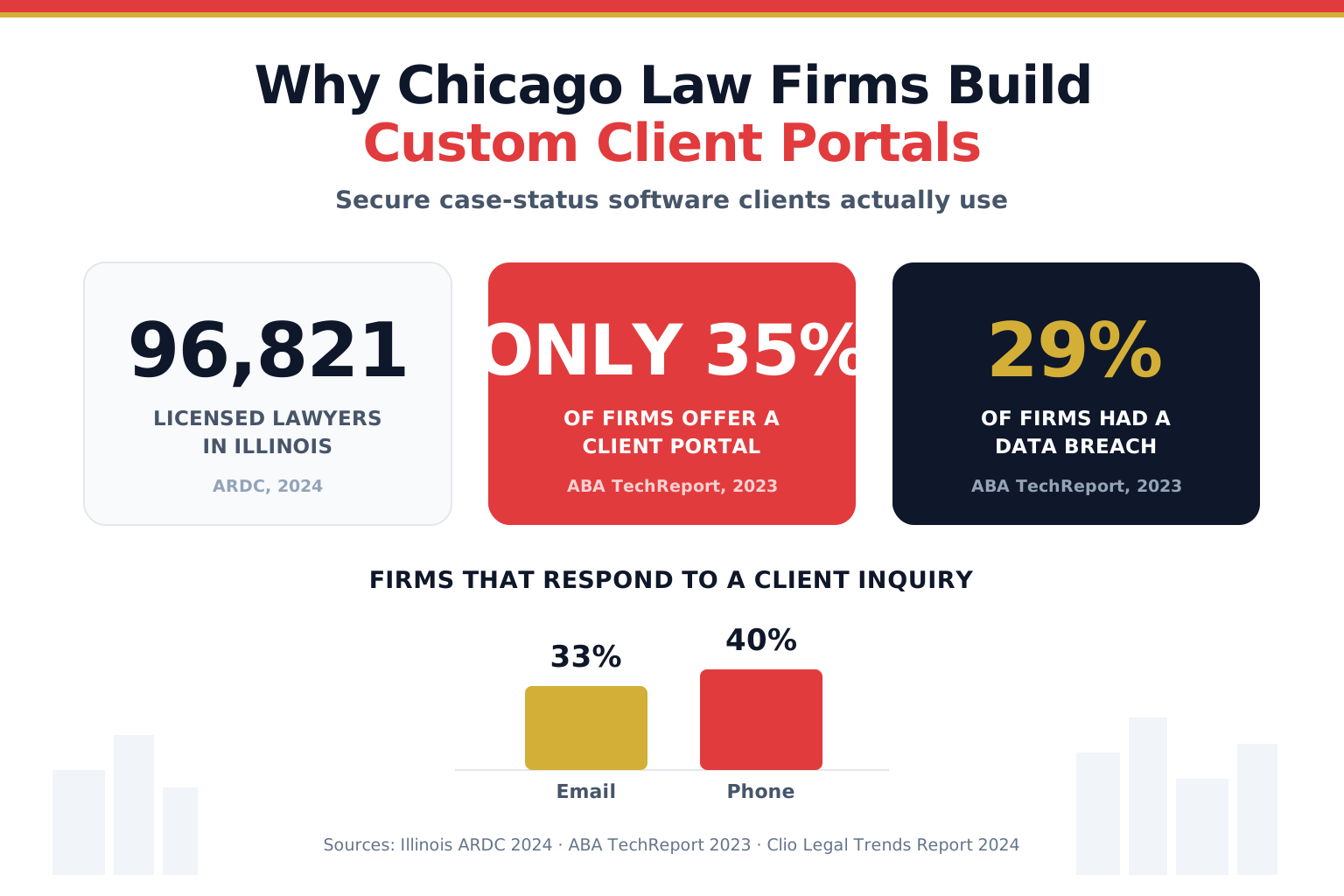
For most Chicago firms, yes — a secure client portal is quickly moving from “nice-to-have” to a real competitive edge, and only about 35% of law firms currently offer one (ABA 2023 Websites & Marketing TechReport). A client portal is the private, secure place where your clients log in to upload documents, e-sign the engagement letter, check their case status, and message your team — instead of trading sensitive files over email and calling the front desk for updates.
That gap matters more in Chicago than almost anywhere. Illinois had 96,821 licensed lawyers on its master roll in 2024 (Illinois ARDC, via ISBA), and the talent is overwhelmingly concentrated around Chicago — 91.6% of newly admitted resident attorneys practice in Cook County or the collar counties (ARDC 2024 Annual Report, via 2Civility). When that many firms compete for the same personal-injury, family-law, and immigration clients, the practice that feels the most organized, secure, and responsive wins — and the client portal is where that impression is made or lost.
The question isn’t really “should we have a portal.” It’s “should we settle for the generic one bolted onto our case-management software, or build one that fits how our firm actually works.” This guide answers both — with the current data — and shows where a custom-built client portal pays for itself. It’s written for two readers: the firm owner deciding whether to invest, and the operator or agency who has to make it work.
Key Takeaways
- A client portal is now a differentiator, not a luxury. Only 35% of firms offer one (ABA, 2023) — so in a market of 96,821 Illinois lawyers (ARDC, 2024), a portal that clients actually use sets a Chicago firm apart.
- Email is the weak link. 29% of firms have had a security breach (ABA 2023 Cybersecurity TechReport), and ABA Formal Opinion 477R warns that ordinary email may not meet a lawyer’s duty to protect sensitive client information (ABA).
- Clients want transparency and speed. 79% expect a response within 24 hours and 82% say timeliness matters (Clio 2024) — yet only 33% of firms reply to an email inquiry (Clio 2024).
- A portal saves real hours. 44% of firms save 1–2 hours a week with secure client messaging (17% save 3–5) (MyCase/LawPay 2024) — time otherwise lost to “what’s happening with my case?” calls.
- Off-the-shelf rarely fits. Generic portals don’t speak your practice areas, matter stages, or branding. A custom-built portal matches your workflow, connects your tools, and you own the software outright.
Table of contents
- What is a law firm client portal?
- Why Chicago firms are moving to client portals
- The email problem: why case documents shouldn’t live in your inbox
- What clients actually want from a portal
- Off-the-shelf portal vs. custom-built portal
- What a custom client portal for a Chicago firm includes
- The ROI: hours saved and clients won
- How to know it’s time to build one
- Frequently asked questions
What is a law firm client portal?
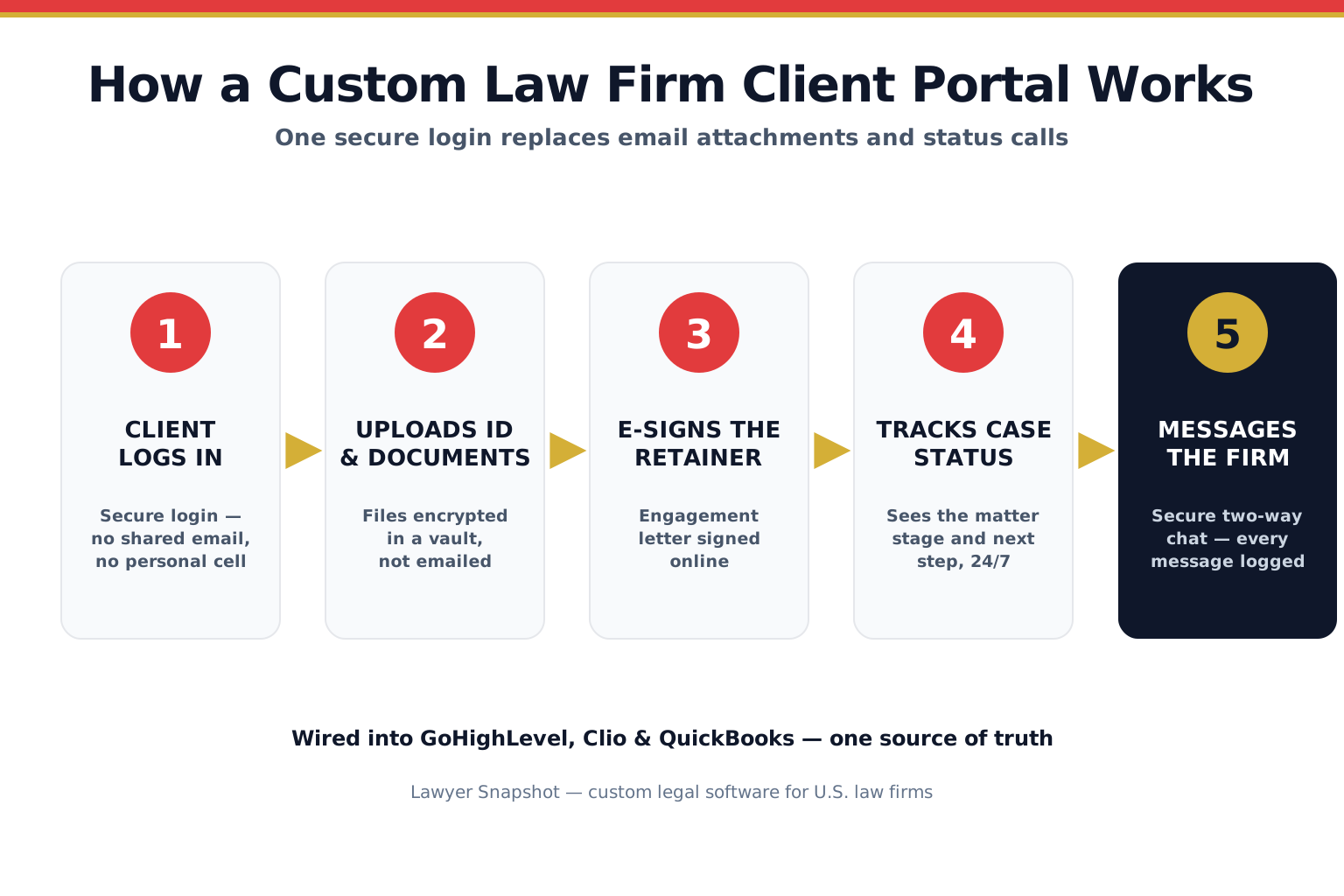
A law firm client portal is a secure, password-protected web area — often called case-status software — where each client can see and do the things that otherwise flood your phone and inbox:
- Upload documents and ID without emailing sensitive files back and forth.
- E-sign the engagement letter or retainer online, so intake doesn’t stall.
- Track their case status — the current matter stage, next steps, and upcoming dates — 24/7.
- Message the firm through a secure, logged two-way channel instead of scattered texts.
- View invoices and pay by card, which 46% of clients now prefer (Clio 2024).
The portal isn’t just a convenience for the client. It’s an operational layer that quietly cuts the volume of status calls, keeps every document in one auditable place, and makes a small firm feel like a large, buttoned-up practice. Think of it as the client-facing front end of your intake and case-management stack — the piece prospects and clients actually touch.
Most firms first meet the concept as the built-in portal inside Clio, MyCase, or Lawmatics. Those are fine starting points. But as this guide shows, the built-in portal is where “generic” starts to cost you — which is exactly why a growing number of Chicago firms are building their own.
Why Chicago firms are moving to client portals
Chicago is one of the deepest, most crowded legal markets in the country. With 96,821 lawyers licensed in Illinois and the vast majority practicing in and around Cook County (ARDC, 2024), firms aren’t just competing on results — they’re competing on experience. And right now, the average legal client experience is bad enough that a portal is an easy way to stand out.
Clio’s 2024 secret-shopper research — where testers posed as prospective clients contacting real firms — found the front door wide open: only 40% of firms answered the phone (down from 56% in 2019), just 33% responded to an email inquiry (down from 40%), and a striking 64% of prospects received no follow-up at all (Clio 2024). The downstream damage is just as telling: 73% of those secret-shopper clients said they would not recommend the firm they contacted (Clio 2024).
Share of U.S. law firms that responded to a prospective client’s email or answered the phone, 2019 vs. 2024. Responsiveness is falling. Source: Clio 2024 Legal Trends Report.
A client portal directly attacks that problem. It gives clients a place to get answers themselves — case status, next steps, documents — so fewer questions ever reach an unanswered phone. And it signals, on day one, that your firm is organized and secure. In a market this dense, that first impression is a real edge, the same way a fast, modern law firm website is: it’s the difference between a prospect who trusts you and one who books the firm ranked below you.
The email problem: why case documents shouldn’t live in your inbox
The most common reason firms build a real portal isn’t convenience — it’s security. Law firms are high-value targets, and the numbers show it: 29% of firms reported experiencing a security breach, up from 27% the year before (ABA 2023 Cybersecurity TechReport). Every driver’s license, medical record, financial statement, or settlement document that moves as an email attachment is a copy sitting in inboxes, on phones, and on mail servers you don’t control.
That’s not just a practical risk — it’s an ethics one. ABA Formal Opinion 477R makes clear that a lawyer’s duty of confidentiality extends to electronic communications, and that ordinary unencrypted email may be insufficient for particularly sensitive information (ABA). A secure portal replaces the attachment habit with encrypted uploads, access controls, and an audit trail — the exact controls the duty of technology competence (Model Rule 1.1, Comment 8) contemplates.
And yet most firms still don’t offer one. Only about 35% of firms give clients a secure portal, while the majority do not (ABA 2023 Websites & Marketing TechReport).
Share of law firms that offer clients a secure portal. A minority do — which is exactly why it’s a differentiator. Source: ABA 2023 Websites & Marketing TechReport.
What clients actually want from a portal
Client expectations have shifted, and legal is catching up late. In Clio’s research, 82% of clients say timeliness is important and 79% expect a response within 24 hours (Clio 2024). Clients also increasingly want to interact digitally: in Clio’s client surveys, a majority said they’d prefer to work with their lawyer through secure client portals (60%) and online file-sharing (56%), alongside email (63%) (Clio Legal Trends, via 2Civility).
The through-line is control and transparency. Clients don’t necessarily want to talk to you more — they want to know where things stand without having to chase you. A portal answers the single most common client question (“what’s happening with my case?”) before it’s ever asked, which is why firms that adopt one see the status-call volume drop.
Off-the-shelf portal vs. custom-built portal
Here’s where firms diverge. The portal built into Clio or MyCase is a reasonable default — but it’s a template, shared by thousands of firms, shaped around the vendor’s assumptions rather than yours. A custom-built portal is designed around your practice areas, your matter stages, your branding, and the tools you already run. The honest side-by-side:
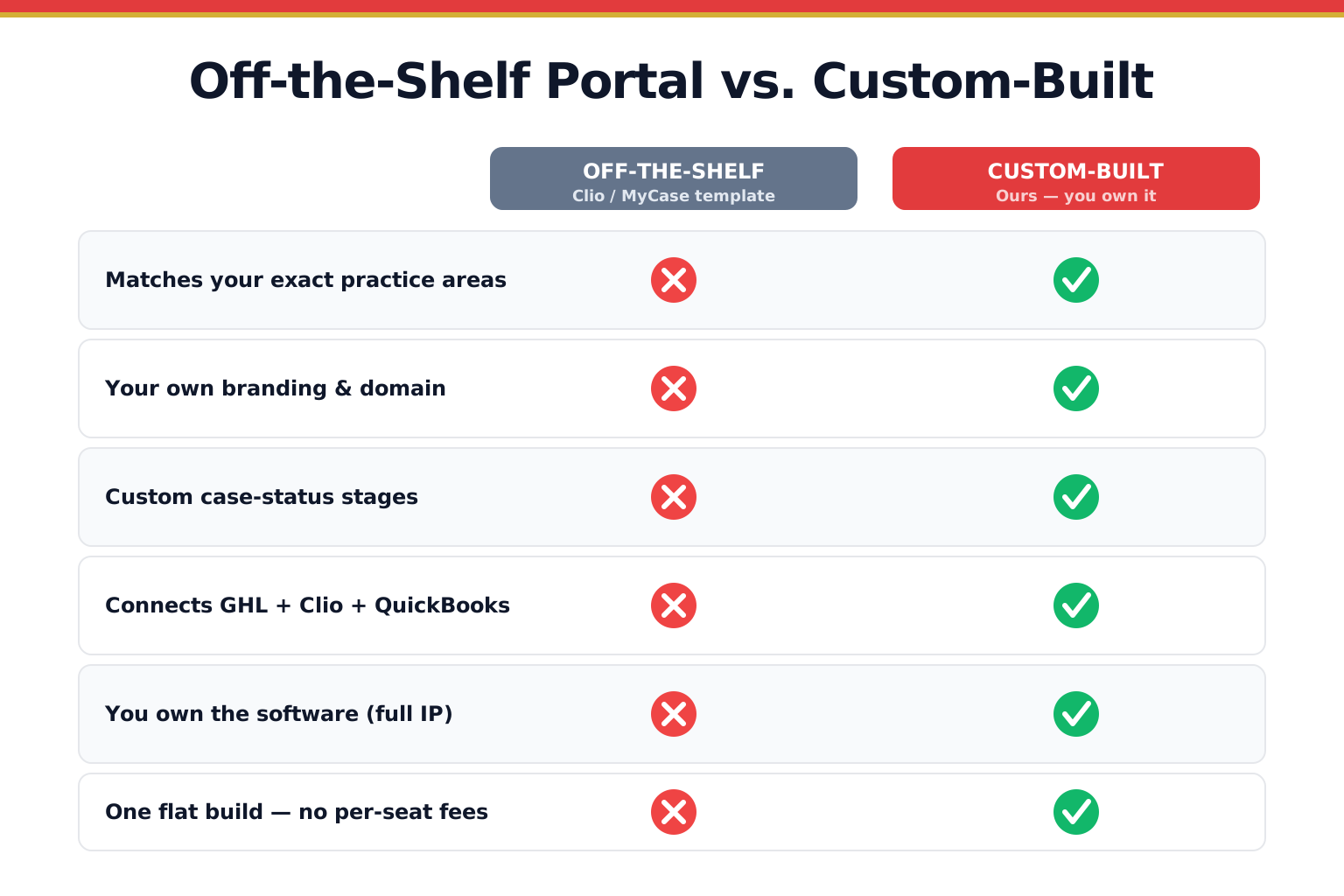
| Factor | Off-the-shelf portal (Clio / MyCase) | Custom-built portal |
|---|---|---|
| Fit to your practice | Generic template, vendor’s assumptions | Built around your practice areas, matter stages, and intake rules |
| Branding | Vendor branding, limited theming | Your brand, your domain, your look |
| Case-status stages | Fixed pipeline | Custom stages that mirror how you work |
| Integrations | Within the vendor’s ecosystem | Connects GoHighLevel, Clio, QuickBooks, court e-filing, and more |
| Ownership | You rent it; leave and it’s gone | You own the software outright (full IP transfer) |
| Pricing model | Recurring per-seat / per-user fees | One flat build, then optional maintenance |
| Cost to start | Bundled into your subscription | From ~$3K depending on scope |
Off-the-shelf wins on speed-to-start and is genuinely the right call for many small firms — if the built-in portal fits, use it. The case for custom gets strong when the generic template forces your firm to work its way: when you have practice-area-specific intake, a unique matter workflow, referral-partner logins, or a stack (GHL + Clio + QuickBooks) that no single vendor unifies. That’s the exact gap our custom software team builds for, using Claude Code to ship production legal software faster and at a lower cost than a traditional dev shop — with full IP transfer, so you own what you paid for.
What a custom client portal for a Chicago firm includes
A “portal” is really a bundle of features that touch intake, security, and retention. A well-built one for a Chicago law firm typically includes:
- Secure client login and document vault — encrypted uploads for ID, records, and evidence, with per-matter access controls and an audit trail (no more email attachments).
- E-signature and online intake — engagement letters and retainers signed in the portal, wired into your legal intake process so a new client is onboarded without a single printout.
- Live case-status tracking — custom matter stages that mirror your practice (PI, family, criminal defense, immigration, estate planning), so clients always see where things stand.
- Secure two-way messaging — a logged, compliant channel that replaces scattered texts and personal cell numbers.
- Payments — card and payment-plan support inside the portal, matching the 46% of clients who prefer to pay by card (Clio 2024).
- Integrations — a live connection to your existing stack: GoHighLevel for follow-up and reminders, Clio/MyCase for matters, QuickBooks for accounting, so you keep one source of truth. (Moving your CRM over? See our migration playbook.)
That last point is where custom software earns its keep. A portal that stands alone just adds another silo. A portal wired into GoHighLevel means a document upload or a signed retainer can trigger the next step — a confirmation text, a task for your paralegal, a nurture sequence — automatically. If you’d rather extend what you already run in GHL than build from scratch, our GHL development team can bolt a custom portal onto your existing snapshot; if you want ongoing help running it, a dedicated GHL VA can own the day-to-day.
The ROI: hours saved and clients won
A portal earns back its cost in two currencies: staff time and new business.
On time: secure client messaging alone saves 44% of firms one to two hours a week, and 17% save three to five hours (MyCase/LawPay 2024 Legal Industry Report). Those are hours your team currently spends fielding “any update?” calls and hunting for emailed documents — hours a portal converts into billable or business-development time.
Share of firms reporting weekly time savings from secure client messaging tools. Source: MyCase/LawPay 2024 Legal Industry Report.
On new business: the digital front end drives real growth. Clio found that firms adopting online client intake tools see roughly 50% more prospective clients and 50% more revenue on average (Clio 2024). A portal that makes signing and onboarding frictionless is exactly the kind of intake upgrade that captures more of the leads you’re already paying to generate — the same leverage covered in our guide to speed to lead for law firms.
How to know it’s time to build one
You don’t need to be a large firm to justify a client portal. You need to recognize the signals. It’s time to invest in a custom portal when:
- Sensitive documents are moving by email or text. If IDs, medical records, or financial statements land in your inbox, you already have a security and ethics problem a portal solves.
- Your team fields constant “status” calls. Repeated “what’s happening with my case?” questions mean clients have no self-serve visibility — the exact job of a portal.
- The built-in portal doesn’t fit. If Clio’s or MyCase’s template forces your practice-area intake or matter stages into the wrong shape, a custom build is the fix.
- Your tools don’t talk to each other. GHL here, Clio there, QuickBooks somewhere else — a custom portal can unify them into one client-facing front end.
- You’re competing on experience, not just results. In a market as crowded as Chicago’s, the firm that feels the most organized and secure wins the client and the referral.
If two or more of these sound familiar, the decision is really just a matter of scope and timing. You can book a free scoping call to price it out, compare engagement options on our pricing page, or read how we build production legal software on the custom software page.
Frequently asked questions
What is a client portal for a law firm?
A law firm client portal is a secure, password-protected web area — often called case-status software — where each client can upload documents and ID, e-sign the engagement letter, track their case status, message the firm, and pay invoices. It replaces trading sensitive files over email and reduces the volume of status-update phone calls, giving clients 24/7 self-service visibility into their matter.
Do Chicago law firms really need a client portal?
For most, it's a strong competitive edge. Illinois had 96,821 licensed lawyers in 2024 and the majority practice around Chicago, so firms compete heavily on client experience. Only about 35% of firms offer a secure portal (ABA 2023), which means a portal that clients actually use sets a Chicago firm apart — while also addressing the security duty around sensitive documents that ordinary email doesn't meet.
Is a custom client portal better than the one built into Clio or MyCase?
It depends on fit. The built-in portals in Clio, MyCase, or Lawmatics are fine defaults for many small firms. A custom-built portal wins when the generic template doesn't match your practice areas, matter stages, or branding, or when you need to unify tools the vendor doesn't — such as GoHighLevel, QuickBooks, and court e-filing. With a custom build you also own the software outright (full IP transfer) and avoid recurring per-seat fees.
How much does a custom law firm client portal cost?
Custom legal software projects typically start around $3,000 and scale with scope, with an hourly option at $75/hour for smaller work. A client portal and intake system usually takes about 4–10 weeks to build. Because we develop with Claude Code, timelines and cost are typically well below a traditional dev shop, and every project includes a 30-day bug-fix warranty and full IP transfer. See the custom software page for details.
Is email safe for sending legal documents to clients?
Ordinary, unencrypted email is a known weak point. 29% of law firms have experienced a security breach (ABA 2023 Cybersecurity TechReport), and ABA Formal Opinion 477R warns that standard email may not satisfy a lawyer's duty to protect particularly sensitive client information. A secure client portal replaces email attachments with encrypted uploads, access controls, and an audit trail — the controls the duty of technology competence contemplates.
Can a client portal connect to GoHighLevel and our existing tools?
Yes. A custom portal can be wired into GoHighLevel for follow-up and reminders, Clio or MyCase for matters, and QuickBooks for accounting, so you keep one source of truth. That integration is the main advantage of building custom: a document upload or signed retainer in the portal can automatically trigger the next step in your GHL workflow, rather than sitting in a separate silo.
Spencer Ruiz is a GHL Snapshot Implementation Engineer at Lawyer Snapshot who builds and deploys the systems that power law firm intake, scheduling, and reactivation. He has strong opinions about A2P 10DLC compliance, secure document handling, and what actually breaks in production — and writes install-tested playbooks for operators who have to make the technology work on Monday morning. Lawyer Snapshot is a GoHighLevel automation and custom-software product for U.S. law firms; we are not a law firm and do not provide legal advice.
Related posts
- The Complete Guide to GoHighLevel for Law Firms
- How to Migrate Your Law Firm to GoHighLevel (From Clio, MyCase, or Lawmatics)
- Legal Intake Process: 7 Steps to Convert More Leads Into Paying Clients
- Astro vs. WordPress for Houston Law Firm Websites: Page Speed Compared
- Speed to Lead for Law Firms: Why the First 5 Minutes Win the Client