It is a Thursday afternoon and you are 40 minutes into a Filevine demo. The rep has nodded along to every workflow your personal injury practice runs. Then you ask the only question that matters, what will this cost my six-person firm per year, and the answer is a smile and a sentence you have heard from every enterprise vendor: “Let’s build you a custom quote.” You still do not have a number. That is not an accident, it is the pricing model.
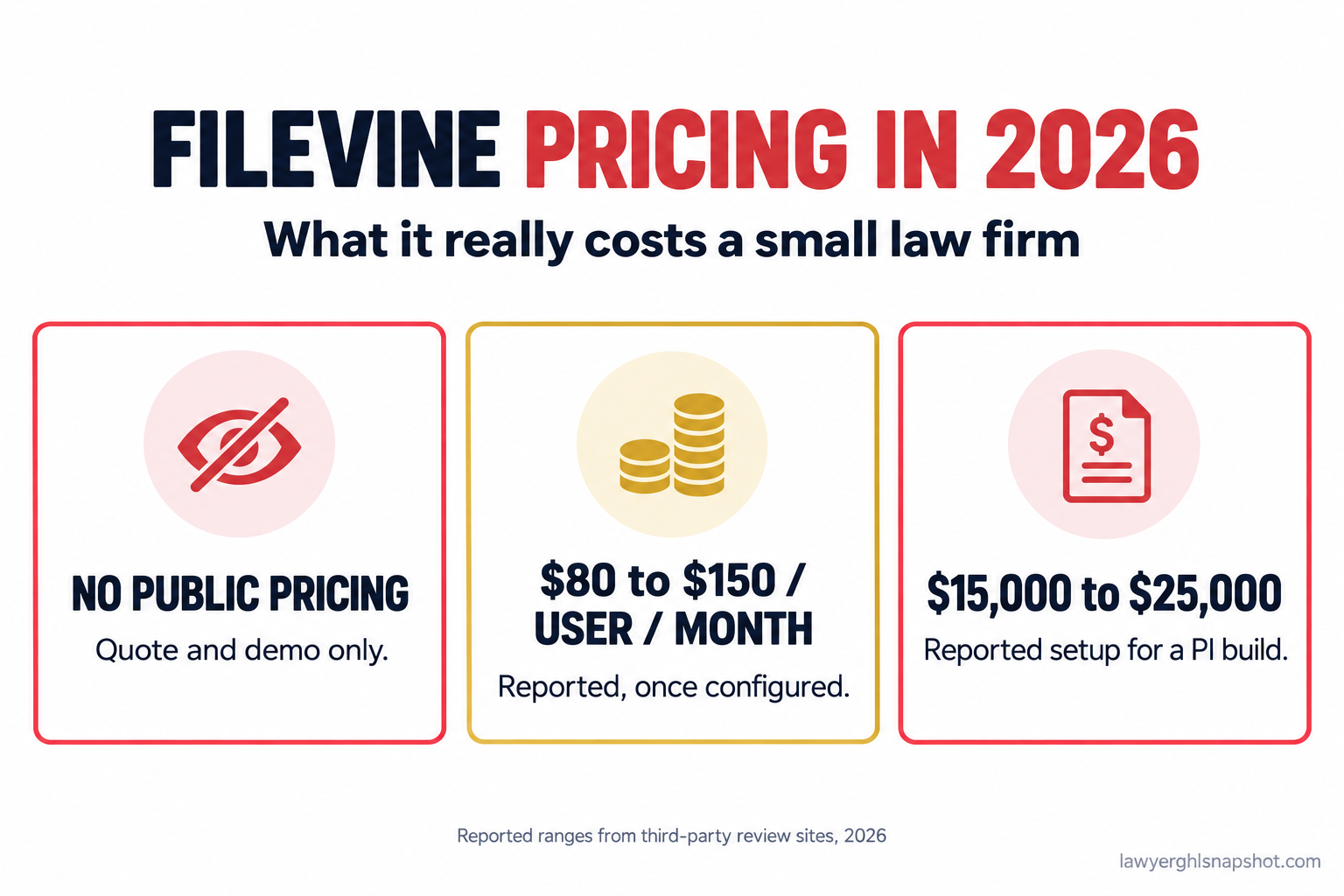
Here is the short answer. Filevine does not publish prices. It is sold by quote, in modules, after a sales call, which is why a small firm struggles to compare it to anything. Based on third-party review sites and firm reports, the software lands around $80 to $150 per user per month once configured, and the implementation is where the real money hides: for a full PI build, reportedly $15,000 to $25,000 or more before you sign a single case through it. For a large plaintiff shop that can be worth it. For a solo or small firm, it usually is not. Here is the math, then four cheaper ways to get the same result.
Key Takeaways
- Filevine publishes no public pricing. It is quote-only, sold in modules, after a demo, which makes apples-to-apples comparison nearly impossible (Capterra).
- Reported software cost runs roughly $80 to $150 per user per month once AI and modules are included. Aggregators list a starting figure near $87 per user (SelectHub), but the real number only arrives after sales qualifies your firm.
- Implementation is the hidden cost. Onboarding is reported from a few thousand dollars up to $15,000 to $25,000 or more for a PI workflow build, on top of the annual subscription.
- Filevine is built for large, high-volume PI and mass-tort firms. For a solo or small practice, the per-seat and setup cost is hard to justify against what you will actually use.
- Cheaper paths exist. Clio Manage publishes seats from $49 to $149 per user (Clio), CASEpeer runs $79 to $149 per user for PI firms, and an automation-first stack covers the intake and follow-up that actually win cases for far less.
Table of contents
- Why won’t Filevine just tell you the price?
- What does Filevine actually cost in 2026?
- The fees nobody puts in the demo
- What Filevine costs at three firm sizes
- Is Filevine worth it, and who is it actually for?
- 4 cheaper ways to get the same result
- Steal this: the email that forces a real quote
- Common objections
- Frequently asked questions
Why won’t Filevine just tell you the price?
Open the pricing page of a tool like Clio and you see numbers. Open Filevine’s and you see a button that says “Request a demo.” That difference is a strategy.
Quote-only pricing does three things for the vendor. It lets the rep anchor the price to how much your firm appears able to pay, not to a fixed rate card. It stops you comparing seat-to-seat with a cheaper competitor before a human has sold you on the platform. And it bundles software, modules, AI features, and implementation into one big number that is hard to pull apart later. None of that is unusual for enterprise software. It just means the burden of discovering the real cost falls on you.
The practical effect for a small firm is that you cannot budget. You cannot read a page on a Friday and know whether this is a $6,000 or a $30,000 decision. You give up your contact info, sit through a call, describe your caseload, and wait to learn a number a competitor prints on its homepage. Renewal is a blind spot too: with no public rate going in, you have nothing to anchor to when the price climbs in year two.
What does Filevine actually cost in 2026?
Because Filevine will not publish a rate, every public number is secondhand, so here is where each figure comes from and how much to trust it.
On the software itself, review aggregators list a starting point around $87 per user per month (SelectHub). Firm-reported numbers push higher, commonly into the $100 to $150 per user per month range once you add the AI features and modules that made the demo look good. You will also see figures anywhere from $49 to $300 a seat, and that spread is the tell: when a dozen review sites each report a different price for the same product, none of them were given a real one either.
Filevine’s reported configured price sits at the high end, next to the top published tier of a tool you could sign up for this afternoon. You are paying for an enterprise platform aimed at firms much larger than yours.
A warning on one figure: a “$7,500 per year median” for Filevine gets quoted around the web. It traces to low-authority content and could not be verified against any primary source, so treat it as noise. The only Filevine number you can trust is the one that arrives in writing with your firm’s name on it.
The fees nobody puts in the demo
The seat price is the part they eventually tell you. The rest of the bill is where a small firm gets surprised.
Implementation and configuration. Standing up Filevine is a project, not a signup. Reported onboarding runs from a few thousand dollars for a light setup to, for a full PI workflow build, $15,000 to $25,000 or more, over a rollout of 60 to 120 days (Lawyerist). How it breaks you: a firm budgets $87 a seat, signs, then meets a five-figure setup invoice it never planned for.
Data migration in. Moving your matters, contacts, and documents into Filevine is billable work. Ask who does it and what it costs. How it breaks you: the quote covers the software but not the migration, so the “included” platform arrives empty and your paralegals spend three weeks re-keying files.
AI and add-on modules. The features that sparkled in the demo, the AI document fields, the analytics, the templated workflows, are often separate line items, and some reports note AI can add more per user than the base license. How it breaks you: you priced the base, but the version you saw demoed costs more per seat.
Data export out, and the annual contract. Ask before you sign: if we leave in two years, what does it cost to get our data out, and in what format? Enterprise legal software is typically an annual commitment billed up front, with the year-two rate open to increase. How it breaks you: the switching cost keeps you paying in year three.
What Filevine costs at three firm sizes
The same product lands very differently by seat count and setup. These are illustrative estimates from the reported ranges above, not quotes, meant to show the shape of the decision.
Solo or two-attorney firm (2 seats). At roughly $100 a seat that is about $2,400 a year in subscription, which sounds fine until you add even a modest four-figure implementation and the modules you will want. The first year realistically lands in the mid four to low five figures, for a platform built to coordinate dozens of people you do not have. You will use a fraction of it. Verdict: hard to justify.
Mid-size firm, 5 to 6 attorneys (6 seats). Around $100 to $150 a seat puts subscription near $7,200 to $10,800 a year. Layer on a reported PI implementation of $15,000 to $25,000 and your first year can land in the $22,000 to $35,000 range, dropping to subscription in year two. This is the band where firms agonize: the platform is genuinely capable and the number is large. Verdict: only if you will use the case-management depth, not just intake.
Larger firm, 12 to 15 attorneys (15 seats). At scale the per-seat math works harder for you, because a $15,000 to $25,000 implementation spreads across far more users and case volume. Subscription alone runs roughly $18,000 to $27,000 a year. For a high-volume PI or mass-tort operation that lives inside its case system all day, that can pay for itself. Verdict: this is the firm Filevine was built for. The pattern: more defensible as you get bigger, more punishing as you get smaller.
A solo pays near the same setup cost as a mid-size firm but spreads it across one or two seats. That is the opposite of what a small practice needs.
Is Filevine worth it, and who is it actually for?
Filevine is a strong product, not a punching bag. It is a deep, configurable case-management platform with serious document automation, and the firms that love it share one thing: volume. They run hundreds or thousands of active matters and need every attorney inside one system, so the efficiency dwarfs the setup cost. If that is you, a large plaintiff or mass-tort practice where case management is the whole operation, Filevine can earn its price.
If that is not you, be honest about what you would actually use. Most small firms do not lose money because their software lacks a feature. They lose it upstream, at intake. The firm average tells the story: lawyers bill only about 3.0 hours of an 8-hour day, a 38% utilization rate, and collect about 93 cents on every dollar invoiced (Clio Legal Trends Report). A $25,000 platform does nothing about the after-hours call that went to voicemail or the lead that never got a callback. That gap is cheaper to close, and it is where a small firm’s money actually is.
4 cheaper ways to get the same result
“The same result” for a small firm is not a thousand features. It is this: capture every lead, book the consultation, follow up until they sign, and keep the matter organized. Four ways to get there without an enterprise invoice.
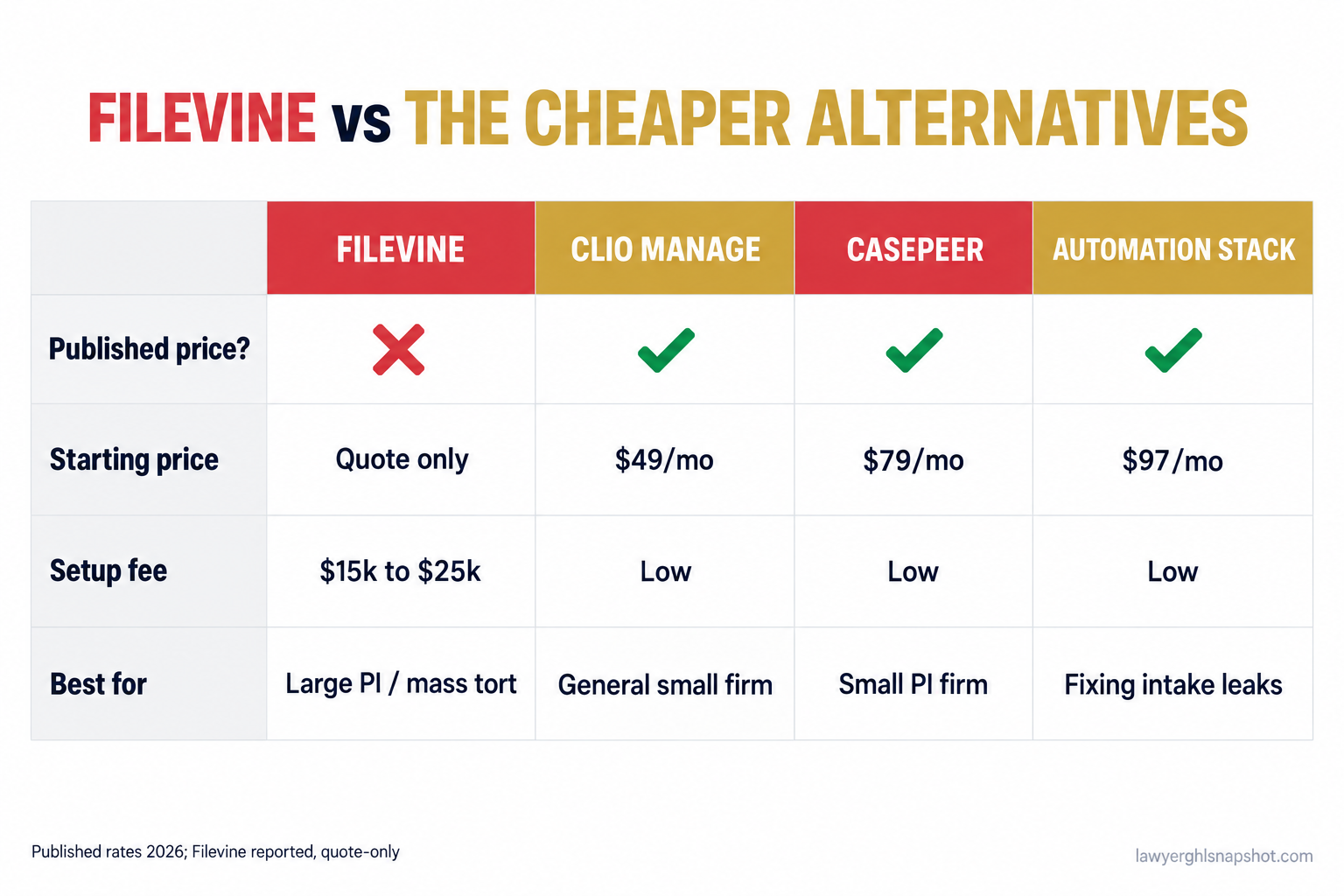
1. Clio Manage, if you want a published price and a safe default. Clio is the most widely used legal case tool and, crucially, it tells you the price: seats run from $49 per user per month on EasyStart to $149 on Complete (Clio). It is less PI-specialized than Filevine, but for most small firms it covers matters, billing, and documents without a five-figure setup. See our Clio vs. MyCase comparison and best Clio alternatives guide.
2. CASEpeer, if you are specifically a PI firm. CASEpeer is purpose-built for personal injury and publishes its rates: $79 on Basic, $119 on Pro, $149 on Advanced, per user (PricingSaaS). You get PI-native pipelines, settlement tracking, and intake without Filevine’s enterprise price tag or its opaque quote. For a small plaintiff shop it is often the more honest fit.
3. MyCase or PracticePanther, if you want all-in-one simplicity. Both publish per-user pricing in roughly the $39 to $130 per user per month band, cover intake, billing, and client communication, and skip the demo-wall. For a general small practice that wants one tool and a known number, either is a lighter, cheaper landing spot than Filevine. Full rundown in our software pricing teardown.
4. An automation-first stack, if your real problem is leaks, not features. The one most small firms overlook. Instead of paying enterprise rates for case-management depth you will never use, put the money where cases are won: a 24/7 AI receptionist, missed-call text-back, instant lead follow-up, and automated scheduling. Built on a platform like GoHighLevel (plans run $97 to $497 per month, see GoHighLevel pricing), it handles the intake and speed-to-lead work a case tool does not attempt. Run it alongside a cheap case tool and still spend less than a Filevine implementation.
“Expensive and enterprise” is not the same as “right for a six-person firm.” Match the tool to where your money actually leaks.
Steal this: the email that forces a real quote
If you are going to sit through the demo anyway, make it produce a number you can use. Paste this into your reply and do not sign until every line has a written answer. A vendor who answers all of it is being straight with you. One who dodges three is telling you how year two will go.
That blended monthly number, not the seat price the rep led with, is what Filevine actually costs you.
Common objections
“But Filevine is the more powerful platform. Isn’t cheaper just worse?” Power you do not use is not value, it is overhead. A platform built to coordinate a 200-person mass-tort operation will not sign more of your six-person firm’s cases than a cheaper tool plus a system that answers the phone at night. Pay for the problem you have, which for most small firms is intake and follow-up, not case-management depth.
“I run a small PI firm. Isn’t Filevine the PI standard?” It is a standard for large, high-volume plaintiff shops. For a small PI firm, CASEpeer gives you PI-native workflows with a published price and no five-figure rollout, and an automation layer closes the intake leak Filevine does not touch.
“The demo was impressive. Won’t a cheaper tool feel like a downgrade?” Demos are built to impress. The real question is not how the software feels in a 40-minute walkthrough, it is what you will still be using, and paying for, in month 18. A tool you fully use beats one you half-use at three times the price.
“Switching sounds like a nightmare. Isn’t it easier to just sign?” Migration is real work with any tool, which is why you ask what data export costs before you sign, in either direction. The firms that feel trapped never asked what leaving would cost. Our guide on migrating a law firm to a unified system walks through moving without losing a file.
Frequently asked questions
How much does Filevine cost per user?
Filevine does not publish per-user pricing, so every figure is secondhand. Review aggregators report a starting point near $87 per user per month, and firm-reported numbers commonly land in the $100 to $150 range once AI and add-on modules are included. The only reliable figure is the written quote Filevine gives your firm (SelectHub, Capterra, 2026).
Why doesn't Filevine show its prices publicly?
Filevine sells by quote, in modules, after a demo. Quote-only pricing lets the vendor anchor to what a firm appears able to pay, prevents easy seat-to-seat comparison with cheaper competitors, and bundles software, modules, and implementation into one number that is hard to unpack. It shifts the work of discovering the real cost onto the buyer.
What are Filevine's implementation or setup fees?
Implementation is billed separately from the subscription and is often the largest first-year cost. Reported onboarding runs from a few thousand dollars for a light setup up to $15,000 to $25,000 or more for a full personal injury workflow build, over a rollout of roughly 60 to 120 days. Get it in writing before you sign.
Is Filevine worth it for a small law firm?
Usually not. Filevine is built for large, high-volume PI and mass-tort firms that spread a big implementation cost across many seats and heavy case volume. A solo or small firm pays a similar setup cost across one or two seats and uses a fraction of the platform. Smaller firms get a better return from a published-price case tool plus an automation layer that fixes intake.
What are the best cheaper alternatives to Filevine?
For published pricing and a safe default, Clio Manage ($49 to $149 per user). For a PI-specific tool with public rates, CASEpeer ($79 to $149 per user). For all-in-one simplicity, MyCase or PracticePanther (roughly $39 to $130 per user). And for the intake and follow-up leaks that actually cost small firms cases, an automation-first stack on a platform like GoHighLevel.
Back in that demo. The product was good and the rep was sharp, and you still left without a number, which tells you most of what you need to know about whether Filevine was built with your six-person firm in mind. Get the written quote anyway, run the two-year total, and compare it against a tool that prints its price. For most small firms, the cases are not lost inside the case-management software. They are lost before anyone opens it.