It’s 9:15 on a Sunday night. A woman at her kitchen table has just decided she’s filing for divorce. She searches your practice area and city and taps the first few results, one of them yours, because you pay for that ranking. She lands on your homepage and can’t tell what to do next. No phone number she can tap, a form that wants nine fields, a chat bubble promising a reply “in 1 to 2 business days.” She backs out and taps the next firm. By Monday she’s signed with someone else, and you never knew she existed.
That’s a conversion problem, not a traffic problem. If people reach your website and don’t become consultations, more ads and SEO just buy more silent exits. The fix is the path a visitor walks from first click to booked consult, and almost every firm site leaks prospects at the same seven points.
Key Takeaways
- Traffic is rarely the real problem. The median legal landing page converts about 6.3% of visitors into leads (Unbounce). If yours is far below that, the leak is the page and the response, not the ad budget.
- Speed decides who gets the case. A one-second site converts about 3x better than a five-second one (Portent), and reaching a lead within an hour makes a qualifying conversation about 7x more likely (HBR).
- The first contact is where firms already fail. In a 2024 secret-shopper study, only 40% of firms answered a prospect’s call, down from 56% in 2019 (ABA Law Practice).
- Seven stages separate a click from a signed client. Fix them in order and the same traffic books more consults.
- Your website is a lawyer communication. A conversion win can become a bar problem if the claims and disclaimers are wrong.
Table of contents
- Why your law firm website doesn’t convert
- What a non-converting website actually costs you
- The 7-stage path from first click to booked consult
- The same path for a solo, a 5-attorney firm, and a 15-attorney firm
- The bar rules your website has to follow
- Common objections
- Frequently asked questions
Why your law firm website doesn’t convert
Most owners assume a quiet website means too few visitors. Sometimes that’s true, and local SEO is the answer. Far more often the traffic is fine and the site just doesn’t move anyone to act. A visitor who can’t tell what you do, can’t reach you fast, or hits a slow page and a cold form will leave, and extra traffic won’t fix that.
Here’s the uncomfortable part. The median legal landing page converts about 6.3% of its visitors into leads, in line with the 6.6% all-industry baseline (Unbounce). If yours converts at 1% or 2%, the gap between that and 6% is profit you’ve already paid to acquire.
The leak isn’t one broken thing, it’s a chain. A prospect has to understand your page, trust it, see one obvious next step, get an instant response, book without friction, and then show up. Break any link and the whole thing fails quietly, which is why a site can look professional and never ring the phone.
Share of firms taking each action with a prospective client in a secret-shopper test of U.S. firms (Clio 2024 Legal Trends Report, via the Illinois Commission on Professionalism). The visitor reached out; most firms dropped the first contact.
What a non-converting website actually costs you
Say your site gets 1,000 visitors a month at 2% conversion, so 20 leads. Lift it to 6% and you have 60 from the same traffic and spend. If one in five signs and your average matter is worth $3,500, those 40 extra leads are roughly eight new cases and $28,000 a month you were already paying to reach.
The second cost is your time. Clio’s benchmarks put the average lawyer’s utilization at 38%, about three billable hours in an eight-hour day (Clio Legal Trends benchmarks). When your website can’t screen or book on its own, every half-formed inquiry lands on you as a call to chase, stolen from the hours that pay. A site that converts well hands you the qualified leads and screens out the rest.
The 7-stage path from first click to booked consult
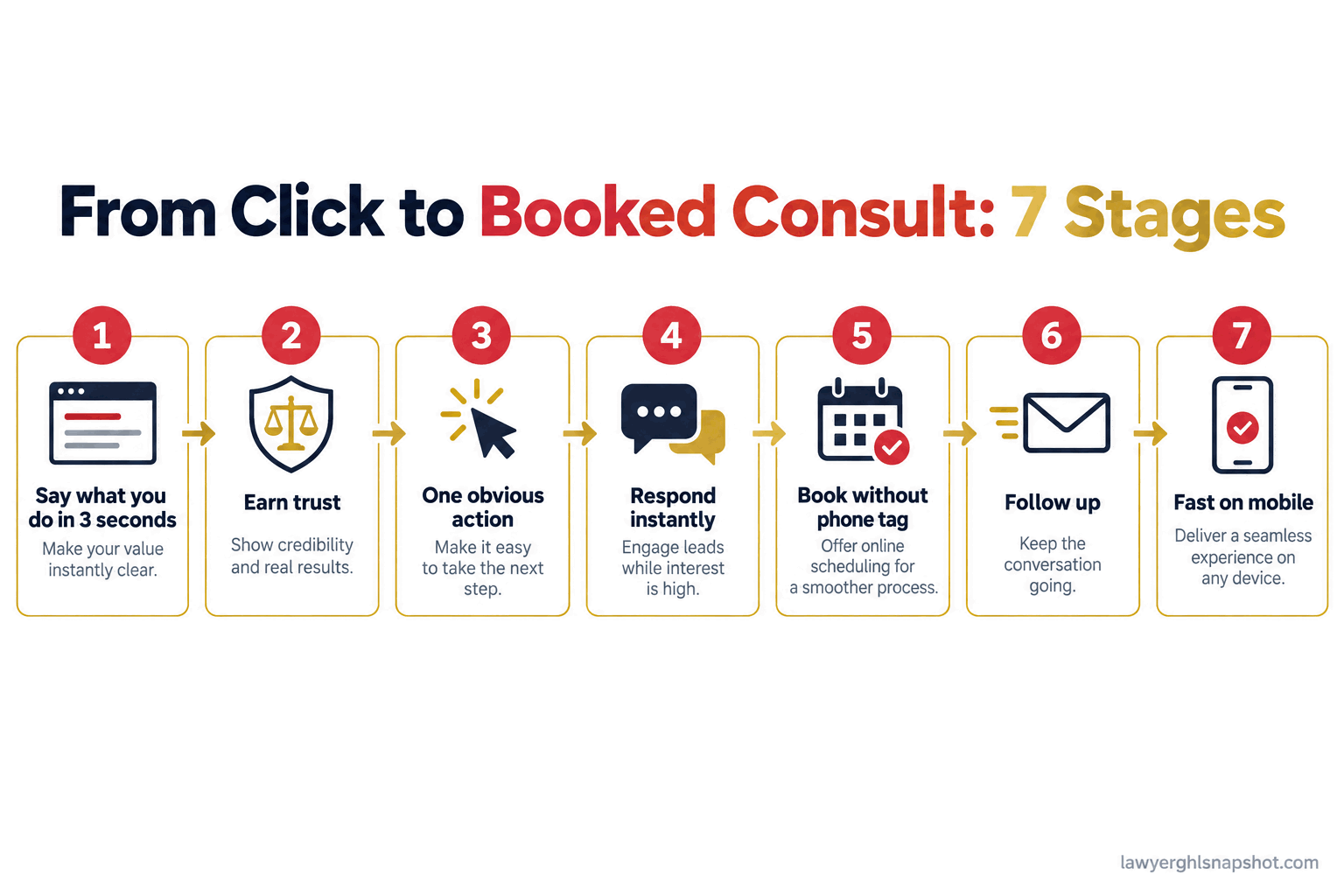
Treat your website as the top of your intake funnel. A visitor walks seven stages from landing to a consult, each with one job and a way it breaks. Fix them in order, because an early leak makes the later stages irrelevant.
Stage 1: Say what you do and prove it in 3 seconds
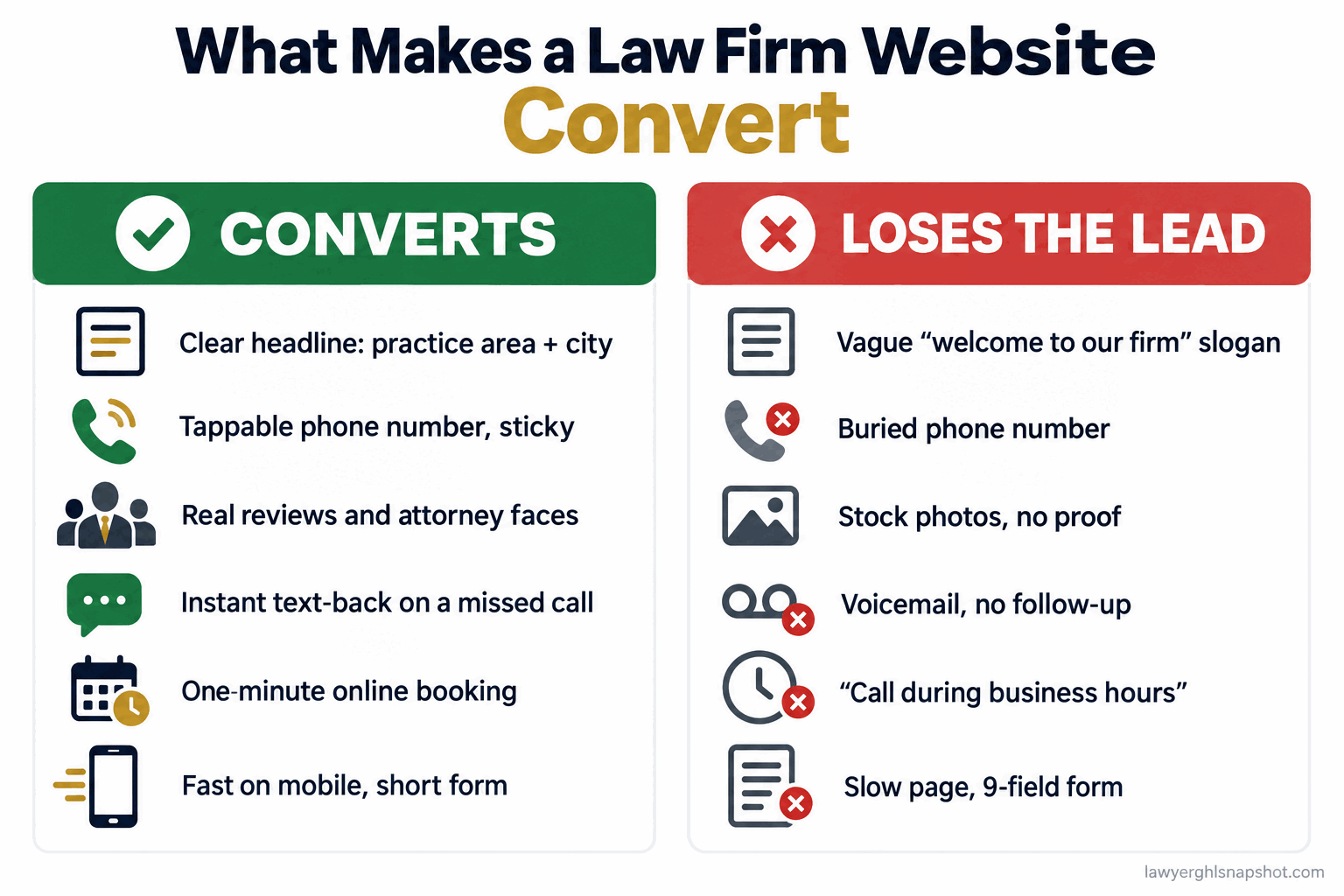
The top of your page, visible before anyone scrolls, has to answer three questions instantly: what you do, who for, and whether this visitor is in the right place. A divorce client who lands on “Experienced Legal Counsel Serving the Community Since 1998” has learned nothing; “Divorce and custody lawyers in Tampa. Free, confidential consultation” tells her she’s home.
How it breaks: vague firm-first headlines, a stock photo of a gavel, and a slogan where a promise should be. The visitor can’t confirm in a glance that you handle their problem, so they leave. The fix is free and follows one formula: [practice area] lawyers in [city]. [The outcome or offer they want]. Think “Personal injury lawyers in Austin. No fee unless we win.” Keep it under about 12 words, put it at the very top, make the next line a single clear action, and drop the “welcome to our firm.”
Stage 2: Earn trust before you ask for anything
People don’t hand a legal problem to a stranger. Before acting, a visitor scans for proof that you’re real and safe: real reviews and ratings, the attorneys’ names and faces, and signals like “your information is confidential.” Social proof near the call to action lifts conversion more than almost anything else on the page.
How it breaks in two directions. The first is no proof at all, a template site with stock photos and zero reviews. The second, the one that gets lawyers in trouble, is proof that oversteps the rules: a testimonial implying a guaranteed outcome, a “98% win rate” you can’t substantiate. The lines you can and can’t use are in the bar rules section.
Stage 3: Give them one obvious thing to do
A converting page has one primary action per screen, not a choice between five equal buttons. For most firms that action is a tappable phone number in a sticky header, with a “book a consultation” button and a short form as backup.
How it breaks: the “wall of equal buttons,” where call, email, chat, and a download all compete, so the visitor picks nothing. For legal, the phone matters most: untracked calls represented as much as 61% of a legal firm’s conversions in one benchmark (Ruler Analytics), and small businesses rate phone calls their single best lead source (BIA Advisory Services). Make the number a real tap-to-call link.
Stage 4: Respond the instant they reach out
This stage quietly loses the most cases, because it happens after the click, where most firms never look. A visitor who gets voicemail, or hears nothing after a form, is already dialing the next firm. Reaching a new lead within an hour makes a qualifying conversation about seven times more likely than waiting one more hour (Harvard Business Review), and the drop-off inside that hour is steep, so the only reliable answer is an automated instant response that buys time to call back.
How it breaks: the missed call that dies in voicemail, and the form that fires an email nobody reads until tomorrow. The fix is a system, not willpower. When a call rings out, a text goes to the caller in seconds; when a form comes in, an instant reply lands immediately, opening a real conversation while the prospect is still thinking about you. The mechanics are in the missed-call text-back playbook and the full speed-to-lead system.
Stage 5: Let them book without phone tag
A prospect who’s ready to talk should be able to put themselves on your calendar in under a minute. A live booking link that shows your real availability, confirms instantly, and holds the slot removes the most common place a warm lead goes cold: the “call us during business hours to schedule” dead end.
How it breaks: scheduling that depends on a human playing phone tag, or a booking page that asks for too much before it shows a single time. Show availability first, collect only what you need, and confirm the moment they book. Then protect the slot with reminders, since a booked consult isn’t a kept consult; the full cascade is in how to reduce no-shows.
Stage 6: Follow up with the 90% who don’t act the first time
Most visitors won’t book on the first visit, even good ones. A site that treats the first visit as the only shot throws away most of its interest. The firms that win capture a contact early, then follow up until the prospect books or clearly says no.
How it breaks: silence after first contact. A prospect who filled out a form Tuesday and never heard back is gone by Thursday. The fix is a short follow-up for anyone who gave you their number but didn’t book, plus a slower nurture for the “not yet” crowd. The same tooling runs database reactivation for older leads, with cadences you can borrow from these follow-up templates.
Stage 7: Make it fast and flawless on a phone
Every stage above has to work on a phone, because that’s where most of these visitors are, often at night. The probability a mobile visitor bounces rises 32% as load time goes from one second to three (Think with Google). A one-second site converts about three times better than a five-second one (Portent), and even a 0.1-second gain lifted conversions across dozens of brands (Google and Deloitte).
How it breaks: a heavy page builder, uncompressed images, tap targets too small for a thumb, and forms that are miserable on mobile. Keep forms short, since conversions fall as you add fields and long textareas hurt the most (HubSpot). Then measure, because if you don’t know where visitors drop off, you’re guessing. For a locally focused walkthrough, see our Phoenix website conversion guide.
The same path for a solo, a 5-attorney firm, and a 15-attorney firm
The seven stages are identical at every size. What changes is who handles the human steps once the website hands off a warm, screened lead. The site does the same job in all three cases; the staffing after that differs.
How the conversion path plays out by firm size
| Plan | Solo practitioner | 5-attorney firm | 15-attorney firm |
|---|---|---|---|
| Price | You are the whole funnel | One intake owner | Dedicated intake team |
| Feature 1 | Automation is non-negotiable; you're in court when leads call | Website books the consult, a coordinator confirms and routes it | Website is the top of a measured, reportable funnel |
| Feature 2 | A missed call rings out to text-back and a booking link, not voicemail | Instant response covers nights and weekends the team can't | Conversion tracked by source so ad spend is accountable |
| Feature 3 | Goal: never lose a lead to being unavailable | Goal: stop leaks between the site, the phone, and the calendar | Goal: scale intake without new headcount for every lead |
For the solo, the website and its automation are the entire intake department, which is why the solo intake system exists: there’s no one else to catch a dropped lead. For the fifteen-attorney firm, the site becomes a measurable funnel, and the question shifts from “did we miss a call” to “which source converts, and what’s each consult costing us.”
The bar rules your website has to follow
A conversion win you can’t keep isn’t a win. Your website is a communication about your services, so the lawyer advertising rules govern it. This is operational guidance, not legal advice; your state’s rules control. Start with three things.
Rule 7.1, nothing false or misleading. Under ABA Model Rule 7.1, every claim on your site must be truthful and not misleading, which includes creating “unjustified expectations.” The aggressive copy that works elsewhere (“Guaranteed results,” “We always win”) is what gets lawyers disciplined. Testimonials and case results can be strong trust signals, but many states require a disclaimer that past results don’t guarantee a similar one.
Rule 7.2, who you can pay. ABA Model Rule 7.2 lets you pay for advertising, and Comment 5 confirms you can pay a lead generator, but only if it doesn’t recommend or vouch for you. This matters because marketing vendors routinely propose revenue-share deals, and splitting fees with a non-lawyer is broadly prohibited. Pay a flat fee for the work, not a cut of the matter.
Your AI and chat have to stay in their lane. If you add a chatbot to lift conversion, it must disclose that it isn’t an attorney and should only gather facts, screen, and schedule. Letting a bot answer “what are my chances” risks the unauthorized practice of law. The full picture, including TCPA consent for the texting, is in our texting and chatbot compliance guide.
Common objections
“I get plenty of traffic, isn’t that the hard part?” Traffic is the expensive part, not the hard part. If people arrive and leave, more traffic just means more exits. Fix conversion first, then scale into a page that holds it.
“My site looks professional, what’s wrong with it?” Looking good and converting are different jobs. Plenty of beautiful sites bury the phone number, load slowly on a phone, and have no follow-up behind the form. Walk your own site on your phone at night like a stressed prospect: can you tell what the firm does in three seconds, call in one tap, and book in under a minute? Most can’t.
“I already pay for Clio” (or a web company). A case-management system runs matters you’ve already signed. It usually isn’t converting the stranger on your homepage at 9pm, and most firms never switch on the instant-response piece. The company that built a pretty site often didn’t wire up text-back, booking, and follow-up, because that’s intake, not web design.
“Do I need to be technical to fix this?” No. Stages 1 through 3 are copy and layout decisions you can make today. Stages 4 through 6 are an automation layer behind the site, built once and then running on its own. You stop losing the leads you already pay for.
Frequently asked questions
What is a good conversion rate for a law firm website?
The median legal landing page converts about 6.3% of visitors into leads, close to the 6.6% all-industry baseline (Unbounce). If yours converts at 1% or 2%, the problem is almost certainly the page and the response path, not your traffic.
Why does my law firm website get traffic but no calls?
Usually one of seven things: a vague headline, no trust signals, no single obvious action, a slow mobile page, a buried phone number, no instant response, and no follow-up for the majority who don't act on the first visit. Each leaks prospects quietly, and more traffic won't fix a page that converts poorly.
How fast do I need to respond to a lead from my website?
As close to instantly as you can. Reaching a lead within an hour makes a qualifying conversation about seven times more likely than waiting one more hour (Harvard Business Review). Since no firm answers every call live, the reliable answer is an automated instant text that holds the lead until a person calls back.
Is page speed really that important for a law firm site?
Yes. A site that loads in one second converts about three times better than one that loads in five (Portent), and the probability a mobile visitor bounces rises 32% between a one- and three-second load (Think with Google). Most prospects are on a phone.
Should my website push a phone call or a form?
For most legal practices, make calling the easiest action, with a form and booking link as backups. Untracked calls can represent as much as 61% of a legal firm's conversions (Ruler Analytics), and small businesses rate phone calls their best lead source (BIA Advisory Services). Use a tappable number with text-back behind it.
Can I use testimonials and case results to boost conversions?
Yes, carefully. Under ABA Model Rule 7.1, claims can't be false, misleading, or create unjustified expectations. Many states require a disclaimer that past results don't guarantee a similar outcome. Show real reviews, keep claims truthful, and check your own bar's exact wording. This is operational guidance, not legal advice.