It is the Tuesday after the Fourth of July and your voicemail is full. A family got rear-ended Saturday night, a young man got a DUI coming home from a cookout, and a woman who spent the long weekend with her husband has decided she is done. Three real matters dialing lawyers this morning, and your two-person office is already underwater from the holiday backlog. By Thursday, two of them have signed somewhere else.
That is the busy season problem, and almost nobody plans for it. Legal demand is not flat. It surges on a calendar you can predict, and the cruel twist is that small firms leak the most leads during their own peak weeks, because the phones get buried exactly when the best cases are calling. The fix is not to answer faster by hand. It is a system that scales to the surge on its own, so the week you get 60 calls converts as well as the week you get 20. Below is the operator’s year, with the real numbers on when each practice area spikes and the intake setup that stops the leak.
Key Takeaways
- Legal demand is seasonal and predictable. Divorce filings peak in March and August (University of Washington), auto and DUI matters surge all summer (AAA), and estate planning clusters at year-end.
- Your busy season is your worst leak. Fixed capacity meets a demand spike, the phones overflow, and even normally only 40% of firms answer a prospective client’s call (Clio, via ABA).
- Answering faster by hand does not scale. A system that texts back missed calls, replies instantly, and books online absorbs a surge without new hires.
- Plan staffing by season, not headcount. The solo, the solo plus a VA, and the three-attorney firm each hit the surge differently.
Table of contents
- What leaking your busy season actually costs
- The legal year in four seasons
- Winter: the fresh-start surge
- Spring: the filing peak
- Summer: the 100 deadliest days
- Fall and year-end: the estate rush and the lull
- How to staff the surge: solo, solo plus VA, and a 3-attorney firm
- Keeping surge messaging compliant
- Common objections
- Frequently asked questions
What leaking your busy season actually costs
The math is simple. Your intake capacity is fixed: you and maybe one other person can field so many calls a day, and that does not change in July. Demand is not fixed. When it doubles for six weeks, the calls you cannot reach do not wait politely. They dial the next firm.
And most firms already leak in a normal week. In Clio’s secret-shopper study of 500 U.S. law firms, only 40% answered a prospective client’s call, down from 56% in 2019, and just 20% of missed calls were returned. Nearly two-thirds of prospective clients got no follow-up at all (Clio 2024 Legal Trends Report, via ABA Law Practice). That is the baseline on a quiet Wednesday. Now push a surge through it.
The second cost is your own time. Clio’s benchmarks put the average lawyer’s utilization at 38%, about three billable hours in an eight-hour day, with realization at 88% and collection at 93% (Clio Legal Trends benchmarks). During a surge, every hour spent playing phone tag with the overflow is stolen from the three that pay. The busy season punishes you twice: you lose the leads you cannot reach, and you burn billable time chasing the ones you can. A system that answers the surge on its own fixes both.
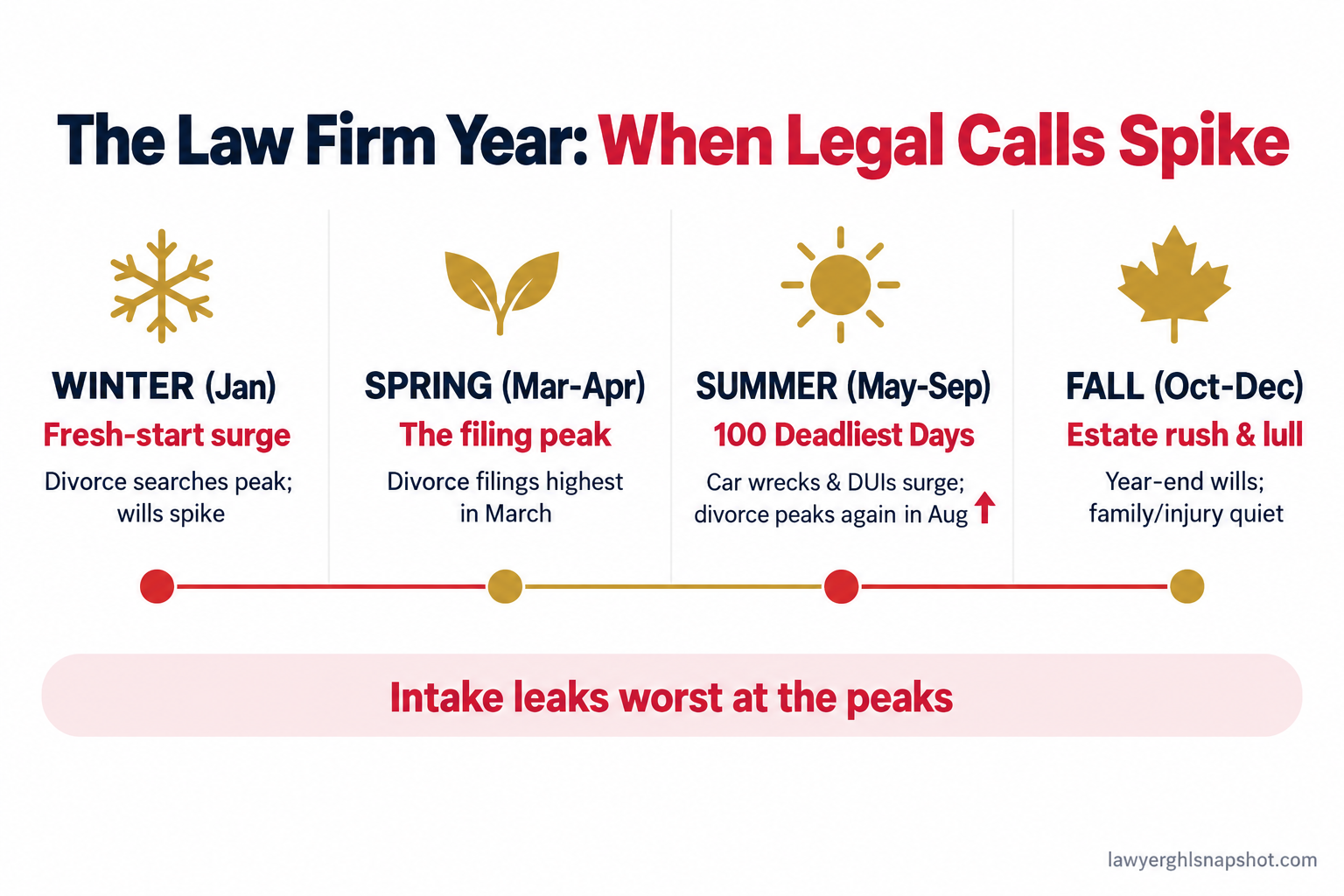
The legal year in four seasons
Different practice areas peak at different times, but the pattern repeats every year.
- ❄Winter · Jan
The fresh-start surge
Divorce search interest hits its annual high, wills spike on New Year's resolutions, and holiday DUIs land on the docket.
- 🌱Spring · Mar–Apr
The filing peak
Divorce filings hit their yearly high in March and January's searchers turn into signed cases.
- ☀Summer · May–Sep
The 100 deadliest days
Car wrecks and DUIs surge from Memorial Day to Labor Day, and divorce peaks again in August. The biggest leak season.
- 🍂Fall · Oct–Dec
The estate rush and the lull
Estate planning clusters at year-end while family and injury intake quiets down. Time to prep for January.
No firm feels all four peaks equally, but they share one trap: the busy stretch is when a leaked lead costs the most, because those are your highest-volume, highest-intent weeks.
Winter: the fresh-start surge
January is the clearest “new year, new life” month in law, and divorce is the headline. Searches for divorce and divorce lawyers reliably spike in January while December sits at the yearly low, a pattern consistent enough that practitioners nicknamed it “divorce month” (Boston Globe). The University of Washington filings study found the same winter lift, with filings climbing sharply from the December trough (University of Washington).
Estate planning rides the same resolution energy, with practitioners reporting December and January as their busiest months for wills, part year-end tax deadline and part New Year’s resolution (WealthCounsel). And the holiday stretch feeds the criminal and DUI docket, with New Year’s Eve among the higher-risk impaired-driving nights.
Winter intake breaks in a subtle way. A January divorce caller is rarely in a rush. She has thought about it for months and is quietly comparing two or three firms. If your office takes a message and promises a callback “sometime this week,” she books with the firm that offered her a time on the spot. Slow follow-up loses the deliberate client as surely as a missed call loses the urgent one.
The winter move is to make deliberate follow-up automatic: reply instantly, offer a confidential booking link in the first message, and set a multi-day nurture so the decider still hears from you on day three. See the speed-to-lead playbook for why the first firm to respond usually wins the consult.
Spring: the filing peak
Spring is when winter’s thinking turns into action. The University of Washington researchers found divorce filings consistently peak in March, “the period following winter holidays,” across Washington and four other states they checked (University of Washington). The January searchers who were still deciding are now ready to retain, so family law volume is high and the leads are warm.
Tax season layers on top. From late January through April, money problems surface: back taxes, disputes, the reckoning that pushes some couples over the edge and some people toward bankruptcy. Estate planning usually cools in spring after its year-end rush.
Spring breaks intake through conversion pressure. These leads are ready to sign, so a clumsy booking process costs you real retainers, not just inquiries. The firm that makes it effortless to go from “I am ready” to a held consultation slot wins the spring; the one that makes a ready client call back during business hours loses a share of them down the street.
The spring move is to make booking frictionless: a live booking link in the first reply, an auto-nudge to any qualified lead who has not picked a time within an hour, and never a demand that a ready client call back to schedule. If you run paid ads to catch spring demand, make the follow-up behind them as fast as the click, because the gap between a form fill and a booked consult is almost always response speed, not ad spend. Our guide to client intake for a solo practice covers the full capture-to-booking flow.
Summer: the 100 deadliest days
Summer is the biggest leak season of the year, and it belongs to personal injury and criminal defense. AAA calls the stretch from Memorial Day to Labor Day the “100 Deadliest Days”: in 2023, 2,897 people were killed in crashes involving a teen driver, and 860 of them, roughly a third, died in that summer window. Across 2019 to 2023, 13,135 were killed in such crashes, more than a third in the summer months (AAA).
U.S. deaths in crashes involving a teen driver in 2023, summer “100 Deadliest Days” versus the rest of the year (AAA, 2025). The window is about 27% of the calendar but nearly 30% of the deaths.
DUI follows the same curve. More people die in drunk-driving crashes in July than in any other month, and over the 2020 to 2024 Fourth of July holiday periods, 38% of the drivers killed were legally drunk, the highest impaired-driver share of any major U.S. holiday (MoneyGeek analysis of NHTSA data; NHTSA). Each crash and arrest is a potential case calling a lawyer within days, and divorce adds its second annual peak in August.
Summer intake breaks because the surge is high-volume and high-urgency and hits when your office is short-staffed on vacations. An injury victim does not deliberate like a January divorce caller. They call three firms in an afternoon and retain the first that picks up or texts back fast. If your paralegal is at the beach and your voicemail is full, that case is gone in hours.
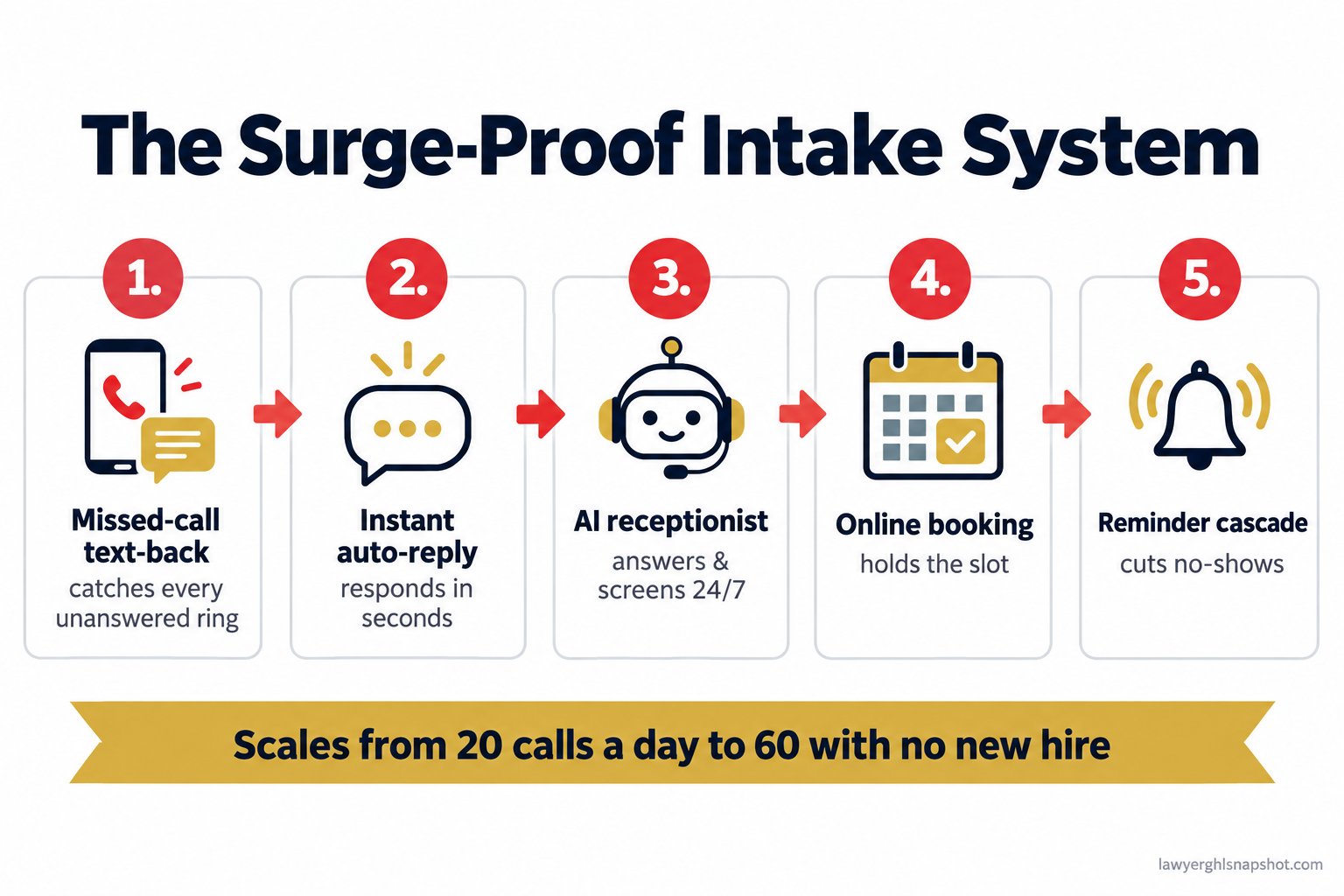
The summer answer is capacity that does not care how many calls arrive. Missed-call text-back catches every unanswered ring, an AI receptionist answers around the clock and screens the matter, and online booking holds the slot before the caller cools off. None needs a new hire, and all of it works the same at 60 calls a day as at 20.
Fall and year-end: the estate rush and the lull
Fall splits in two. For most of the litigation and injury world, intake quiets after Labor Day, the one genuine lull in the legal year, and family law filings fall to their yearly low in November and December as couples hold off until after the holidays. That lull is when you build and test the systems that carry January.
Estate planning runs the opposite direction. Demand clusters hard in the fourth quarter as clients race the December 31 tax deadline and finally act on documents they have put off all year. Practitioners describe an inevitable Q4 surge, part deadline pressure and part the need for a hard date to force a decision (WealthCounsel). If estates are your bread and butter, your busy season is now.
The year-end move for everyone else is preparation. Use the lull to wire up missed-call text-back, write the seasonal message copy, test the booking flow, and reactivate the cold leads and past clients in your database. A quiet November is the cheapest time to fix the leak before January, and our database reactivation playbook covers how to turn a dormant list into booked consults.
How to staff the surge: solo, solo plus VA, and a 3-attorney firm
The true solo. You cannot hire a receptionist for six weeks, so automation is the only way the phones get covered while you are in a deposition. Lean hardest on instant capture and automated first response, and let your busy-season job shrink to a ten-minute daily pass through the intake queue. Answering a doubled call volume by hand guarantees you miss cases while neglecting the ones you signed.
The solo plus a part-time VA. Point your VA at the human touches, the screened-lead review and the warm calls, and let automation handle the instant and after-hours load. This is the most resilient small-firm setup for a surge, because the virtual assistant works on top of automation, not instead of it, and the VA’s hours flex up in your busy months.
The three-attorney firm. Your surge problem is routing on top of response: leads have to reach the right attorney and nothing can sit while everyone assumes someone else has it. Add assignment rules, a shared pipeline, and a report on which sources sign, then staff coverage to your calendar. Three people relying on memory drop three times as many leads.
Preparing for the surge by firm size (2026)
| Plan | True solo | Solo + part-time VA recommended | 3-attorney firm |
|---|---|---|---|
| Price | Automation-first | Automation + human | Routing + coverage |
| Feature 1 | Instant capture on every channel | Automation covers after-hours | Assignment rules route by matter |
| Feature 2 | Automated first reply + booking | VA works screened, warm leads | Shared pipeline, nothing sits |
| Feature 3 | 10-minute daily queue review | Flex VA hours up in busy months | Source reporting on what signs |
| Feature 4 | No seasonal hire needed | Most resilient small-firm setup | Staff intake to the calendar |
Keeping surge messaging compliant
A surge is when compliance slips. Build the guardrails in before the busy season, not after a bar complaint. This is operations guidance, not legal advice, and the rules vary by state.
Register before you text at volume. U.S. carriers require business texting to run through the A2P 10DLC system, with a verified brand and campaign filed through The Campaign Registry. Unregistered traffic gets blocked, so register weeks ahead of your peak.
Get consent and honor the opt-out instantly. The conservative TCPA standard is prior express written consent for marketing texts. Capture clear consent when a prospect contacts you, keep the record, include a STOP line, and honor it immediately, even in your busiest week. Our texting and chatbot compliance guide has the consent language.
Your chatbot is not a lawyer, and it must say so. An AI intake assistant should disclose it is not an attorney and should route, screen, and schedule, never answer “what are my chances.” A bot that opines on the merits of a fresh wreck or arrest risks the unauthorized practice of law. Keep it to qualifying and booking.
Mind advertising and solicitation rules. ABA Model Rule 7.1 bars false or misleading claims, Rule 7.3 limits soliciting someone who did not reach out first, and Rule 7.2 plus the fee-sharing ban make a “cut of the fee per lead” vendor pitch a problem in most states. Automated follow-up to someone who contacted you is fine; blasting accident victims who never raised a hand is not.
Common objections
“My practice is not seasonal, my cases come in all year.” Even a steady firm has weeks that run hot: a holiday backlog, a post-vacation flood. Those are the weeks your fixed capacity gets overwhelmed and leaks. A system that absorbs any spike costs the same whether your year is lumpy or smooth.
“I will just answer faster when it gets busy.” You cannot, and that is the point. Your capacity is fixed and the surge is not, so “try harder” means fielding a doubled call volume while doing the legal work you already have. Automation does not get tired or go to court.
“Won’t an automated text during a crisis feel cold?” For an injured caller who just hit a full voicemail, a warm, specific text in ten seconds reads as a firm that has its act together. The cold experience is the one where nobody calls back until Thursday.
“I already pay for Clio or MyCase, isn’t this covered?” A case manager runs the matters you have signed, not the leads you have not. Most have some intake capability, but firms rarely switch it on, and almost none text back a missed call in seconds. The surge leaks upstream of your case software, at the phone and the web form.
Frequently asked questions
When is the busy season for a law firm?
It depends on practice area. Personal injury and DUI peak in summer, the '100 Deadliest Days' from Memorial Day to Labor Day (AAA). Divorce and family law peak in March and again in August (University of Washington), with a January search surge first. Estate planning clusters in the fourth quarter around the year-end tax deadline.
Why do small firms lose the most leads during their busy season?
Because intake capacity is fixed but demand is not. When call volume doubles for a few weeks, the calls you cannot reach dial the next firm. Even in a normal week only 40% of firms answered a prospective client's call and 20% of missed calls were returned (Clio, via ABA). A surge widens every gap.
How do I handle a surge of calls without hiring more staff?
Use automation that scales on its own: missed-call text-back to catch every unanswered ring, an instant first reply, an AI receptionist to answer and screen around the clock, and online booking to hold the slot. It handles 60 calls a day the same as 20, with no seasonal hire, and routes only the human decisions to you.
Is divorce really more common in January?
January is the annual peak for divorce search interest, and December the low, a pattern consistent enough to be nicknamed 'divorce month.' Actual filings, though, peak later, in March and August, per a University of Washington analysis across several states (University of Washington). January is when they start looking; spring is when they sign.
Does surge texting create TCPA or bar compliance risk?
It can if you skip the guardrails. Register business texting through A2P 10DLC, capture clear consent, include a STOP opt-out and honor it immediately, and keep any AI assistant to screening and scheduling so it does not give legal advice. Automated follow-up to someone who contacted you is generally fine; soliciting people who never reached out raises Model Rule 7.3 issues. Confirm the rules in your state.